On this page
Many parents assume that a national medal guarantees their child a college seat. While athletic achievements provide a significant edge, the sports quota is a structured process with strict rules about which certificates count and how candidates are evaluated.
What is the sports quota in college admission?
Indian universities reserve a percentage of their seats—typically up to 5% for extracurricular and sports quotas combined, as seen in Delhi University (University of Delhi)—for students who excel in recognized sports.
The specific sports available under the quota vary each year based on a college's team needs. For instance, a college might have a quota open for basketball and athletics, but not for swimming, depending on their vacant roster spots.
Which sports certificates are valid?
Not every medal earns points. Universities evaluate certificates based on strict hierarchies and validity windows:
Recognition: Certificates must be issued by bodies affiliated with the Ministry of Youth Affairs and Sports, the Association of Indian Universities (AIU), or the School Games Federation of India (SGFI). Private tournaments, memorial trophies, and invitational leagues are generally invalid. If your child's federation is not recognized by the AIU, their certificate will not be counted during the document verification stage.
Validity period: Colleges typically require certificates from the preceding three to four years. For 2024 admissions, Delhi University only considered certificates issued between May 1, 2021, and April 30, 2024 (University of Delhi). Provisional certificates are usually rejected.
Hierarchy of achievement: International representation (Tier 1) like the Olympics, Asian Games, or Commonwealth Games often qualifies a student for direct admission without trials. National (Tier 2) and State (Tier 3) level certificates earn points that contribute to the final merit score. A gold medal at the national level will award significantly more points than a participation certificate at the state level.
How are you scored for the sports quota?
Unless a student qualifies for Tier 1 direct admission, their final rank is calculated using a dual- or triple-scoring model that balances physical ability, official recognition, and academic readiness.
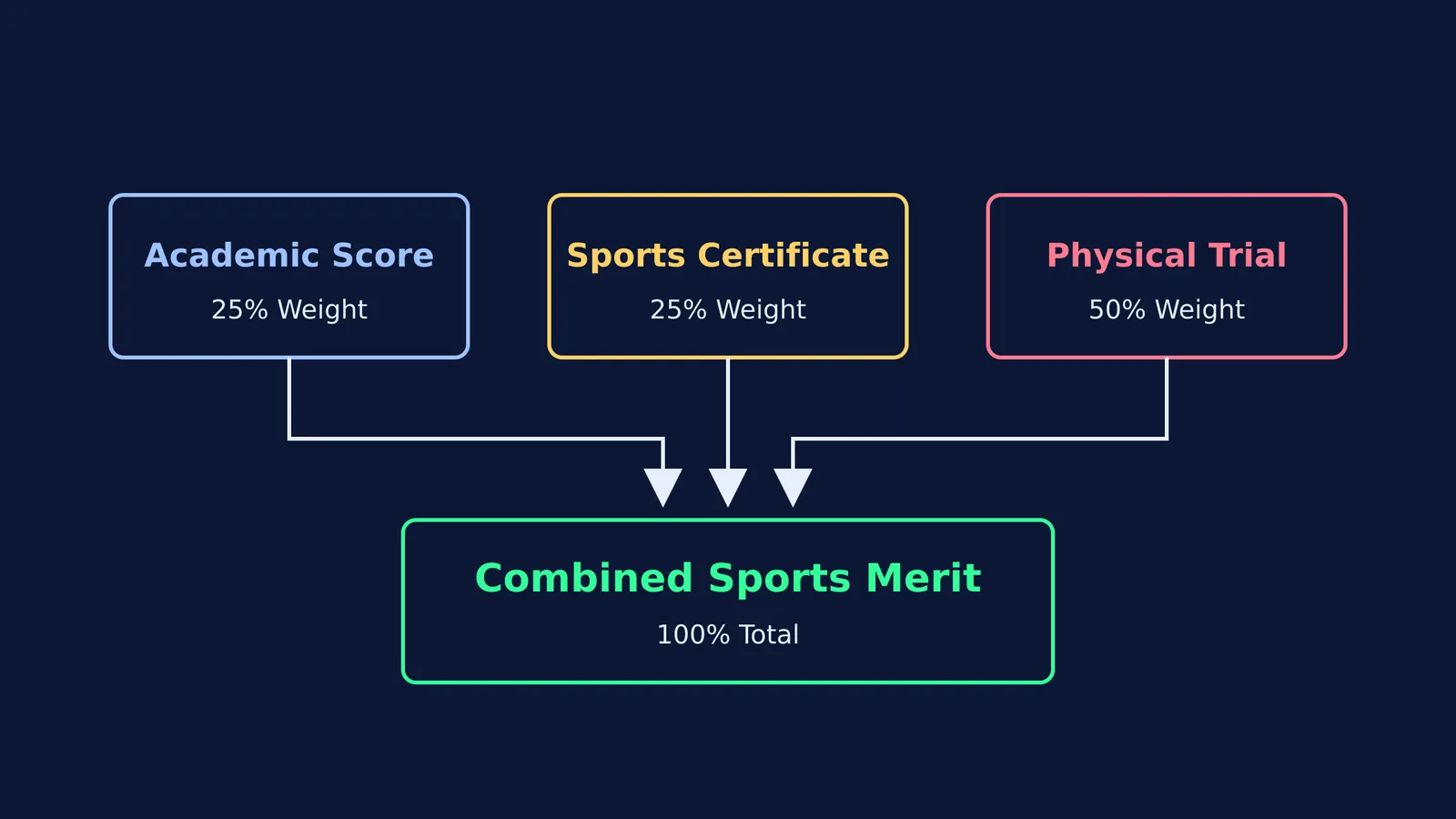
For example, Delhi University evaluates students using a Combined Sports Merit score. This is split into three components: 25% weightage for the academic entrance score, 25% for the evaluation of the highest-level sports certificates, and 50% for sports trials (University of Delhi).
Trials are mandatory for most applicants and test sport-specific fitness, endurance, and fundamental skills. Crucially, athletes must meet a minimum performance threshold on the day. At Delhi University, candidates must score at least 200 out of 400 marks (50%) in the physical trials to be considered for the merit list (University of Delhi). If a student has a top-tier national certificate but fails to score the minimum passing marks during the physical trial, they are disqualified from the quota.
State engineering colleges sometimes follow a different pattern. For example, Tamil Nadu engineering admission relies on a point-based system where marks are assigned directly to certificates based on the level of competition, rather than holding physical trials. In these systems, accumulating points over multiple recognized tournaments during classes 11 and 12 becomes the primary strategy.
Does the sports quota bypass academic requirements?
A common misconception is that exceptional athletes do not need to worry about academic scores. In reality, a strong sports record does not bypass basic academic eligibility.
Students must pass their Class 12 board exams and meet course-specific criteria. For example, applying to premium technical institutes still requires meeting a minimum board marks rule, regardless of athletic prowess. Furthermore, many centralized university admission processes now incorporate academic entrance exam scores, meaning an athlete's academic performance directly impacts their final sports merit rank.
A checklist for parents applying through the sports quota
Navigating admissions as an athlete requires balancing practice schedules with paperwork.
Check federation affiliations: Ensure the body issuing your child's certificate is recognized by the government or AIU.
Review the dates: Confirm the certificate falls within the university's accepted time frame.
Target specific colleges: Research which colleges need athletes in your child's specific sport and position.
Prepare for the physical trials: A certificate gets you to the trial; your performance on the day gets you the seat.
Maintain academic minimums: Keep track of mandatory board marks and entrance exam cutoffs.
Balancing these academic minimums is often the hardest part. Athletes frequently miss weeks of school for state or national camps. When they return, catching up on the syllabus can be overwhelming. Fermi's AI tutor works out what the student knows and builds a plan for the session, so they sit down to a clear next step instead of a blank page. If they are making calculation errors after rushing through missed chapters, the Fermi Problem Library has a step-by-step solver that explains the reasoning rather than just printing an answer.
By maintaining academic eligibility and preparing valid documentation early, student-athletes can ensure their hard work on the field translates to a strong college admission outcome.