

On this page
Managing schoolwork when siblings study in different boards is a delicate balancing act. One child may follow the Central Board of Secondary Education (CBSE) with NCERT textbooks, while the other studies under the Council for the Indian School Certificate Examinations (CISCE / ICSE), a State Board, or an international curriculum. When calendars, textbooks, and exam patterns diverge, running a single household routine breaks down. Managing two tracks successfully requires synchronising schedules, zoning study spaces, and decoupling expectations.
Why is managing two school boards at home so difficult?
The challenge stems from structural divergence across educational authorities. A July 2024 report by the PARAKH unit of NCERT on establishing equivalence across India's 69 school boards highlighted that assessment designs, blueprints, and cognitive demands vary substantially between boards.
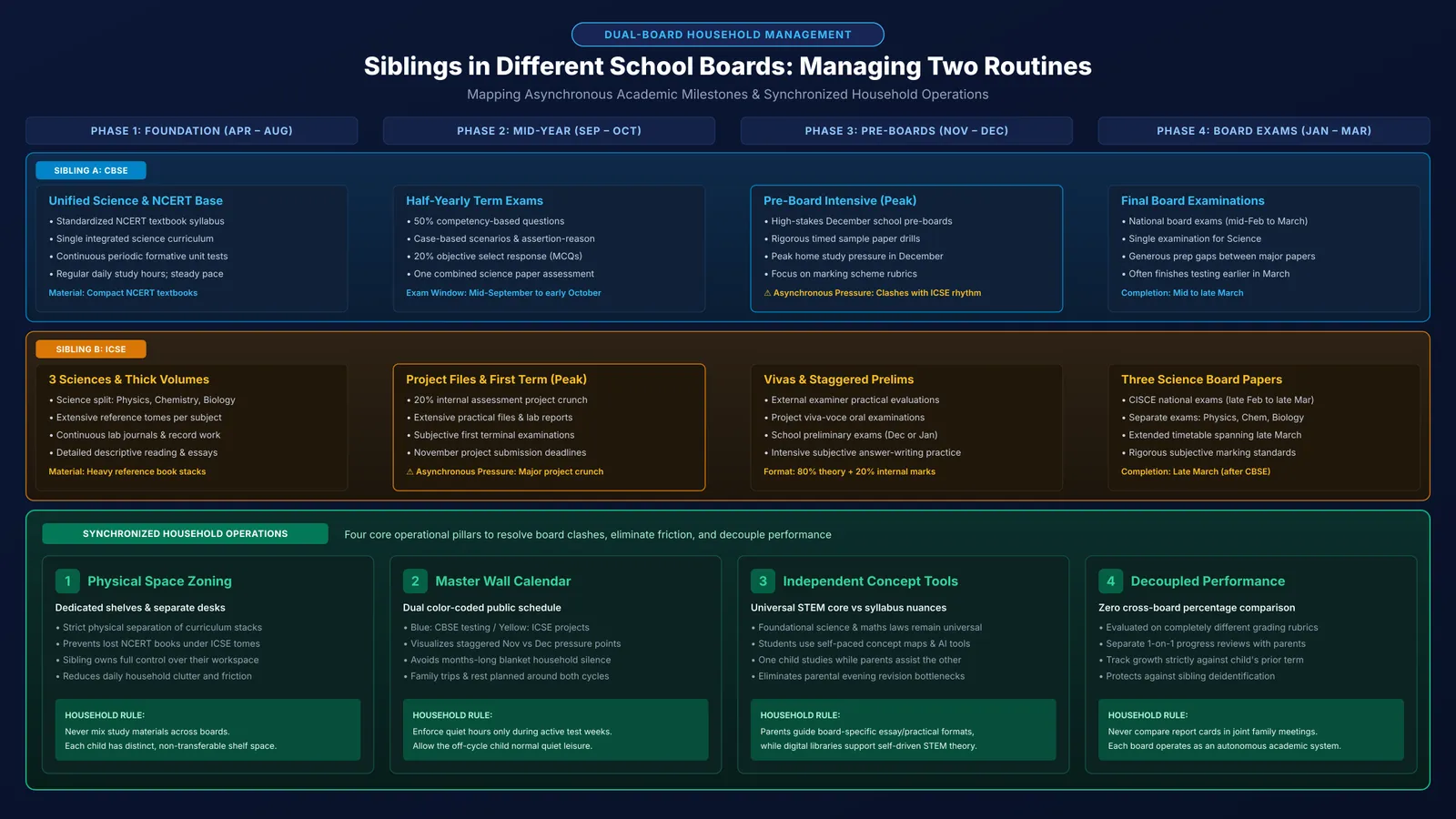
For instance, the Central Board of Secondary Education allocates 50% of secondary assessment weightage to competency-based questions. In contrast, ICSE splits secondary science into three separate papers for physics, chemistry, and biology, alongside a 20% internal assessment component requiring extensive project reports and practical notebooks.
Because these curricula diverge, parents cannot rely on hand-me-down books or shared notes. One desk holds compact NCERT volumes; the other holds thick reference tomes. Expecting siblings to study at the same pace overlooks how differently each board operates.
How do you balance clashing exam calendars and study spaces?
Academic calendars rarely align across two school boards. A CBSE student may face pre-board tests in December, while an ICSE sibling faces project deadlines or examinations in November. If parents enforce house-wide silence whenever either child is testing, the home remains stressed for months.
Families manage this best by establishing three operational boundaries:
Zone study materials and desks: Mixed book stacks lead to lost assignments. Provide separate shelves and dedicated desks so each sibling controls their own curriculum tools.
Maintain a shared master calendar: Digital diaries on separate phones often conceal scheduling clashes until it is too late. Put one physical calendar in a common area.
Support independent concept mastery: Juggling two syllabi can overwhelm parents during evening revision. While chapter sequences differ, core STEM ideas remain universal. When parents need to guide one sibling through coursework, the other can turn to the Fermi Concept Library, which covers every concept in physics, chemistry, biology, mathematics, and computing with its place in the concept map. If a student needs step-by-step problem-solving while parents assist a sibling, Fermi's AI tutor can work out what the student already knows, build a plan for the session, and explain reasoning on a digital board.
For broader household strategies during testing weeks, see our guide to exam season routines at home.
Why should you never compare marks across different boards?
The most damaging mistake in a multi-board home is comparing percentage marks. A given percentage in an ICSE examination with rigorous subjective marking does not reflect the same performance profile as that identical percentage on a CBSE or State Board paper. Each system uses distinct marking schemes and scoring distributions.
In a three-year longitudinal study of 388 families published in the *Journal of Family Psychology*, Alexander C. Jensen and Susan M. McHale found that parental comparative beliefs acted as a self-fulfilling prophecy. When parents believed one sibling was more academically capable, that child achieved a higher grade point average the following year, with standardized path coefficients of 0.24 and 0.37 across successive waves. In turn, differences in grades predicted differences in academic interests the following year, with path coefficients of 0.15 and 0.12. Actual grades did not predict changes in parents' beliefs, yielding non-significant coefficients of -0.11 and -0.10.
When parents draw direct comparisons, they accelerate what Shawn D. Whiteman, Susan M. McHale, and Ann C. Crouter described in *Social Development* as sibling deidentification. In their study of 171 two-adolescent families, children who perceive unfavourable comparison often disengage from an academic domain entirely to carve out an uncontested personal niche.
To protect sibling bonds, see our analysis on why comparing siblings backfires. Families considering future transitions between curricula can also read our CBSE, ICSE or state board guide.
What should you say when others compare your children's marks?
Relatives and neighbours frequently ask why one child earned a higher percentage than the other, assuming marks mean the same thing across different systems. Having a clear response protects both children from internalising false hierarchies.
When fielding unsolicited comparisons, use this concise script:
"The two boards use completely different assessment rubrics and question patterns. We track each child's progress against their own previous term, not against each other."
To keep daily family life calm, apply this four-point checklist:
Conduct separate academic check-ins: Never discuss report cards in a joint family meeting. Review feedback one-on-one, focusing on personal progress rather than percentage scores.
Respect differing daily workloads: One board may require extensive essays, while another prioritises short-answer numerical practice. Measure effort by focus, not page count.
Protect off-schedule leisure: When one child finishes term exams early, let them enjoy downtime quietly without forcing them to mirror their sibling's revision timetable.
Reach out for guidance when needed: If differing academic pressures cause persistent emotional friction, consult a school counsellor or call Tele MANAS at 14416 for free, confidential guidance.


