

On this page
Project-based learning (PBL) changes how students experience school. Instead of listening to a lecture, memorising facts, and taking a multiple-choice test, they are asked to investigate a real-world problem, build a solution, and present their findings to an audience. For parents, this shift from rote memorisation to active learning requires a completely new approach to support at home.
A 2019 Gallup study found that 77% of parents agree teaching methods that inspire creativity have a bigger payoff for students. However, supporting a project that spans several weeks, involves group dynamics, and has no single correct answer in the back of the textbook can be daunting.
Your role is less about checking if the homework is correct and more about acting as a mentor, resource broker, and sounding board.
What is the parent role in project-based learning at school?
In traditional learning, a parent's role is often focused on enforcing study schedules, checking answers, and ensuring assignments are handed in on time. In project-based learning, the parent becomes a facilitator. You are there to help them structure the research process, not to do the work for them.
A 2024 study published in *Cogent Education* found that 89.3% of parents foster a supportive home environment by providing physical space and materials for projects. The same study noted that 92.6% of parents provide motivation and show interest in their child's project.
The most effective parent involvement focuses heavily on the process of learning rather than just the final grade. You are helping your child learn how to research efficiently, how to plan a long-term task, and how to recover when an initial idea fails.
What are the four hats parents wear during a project?
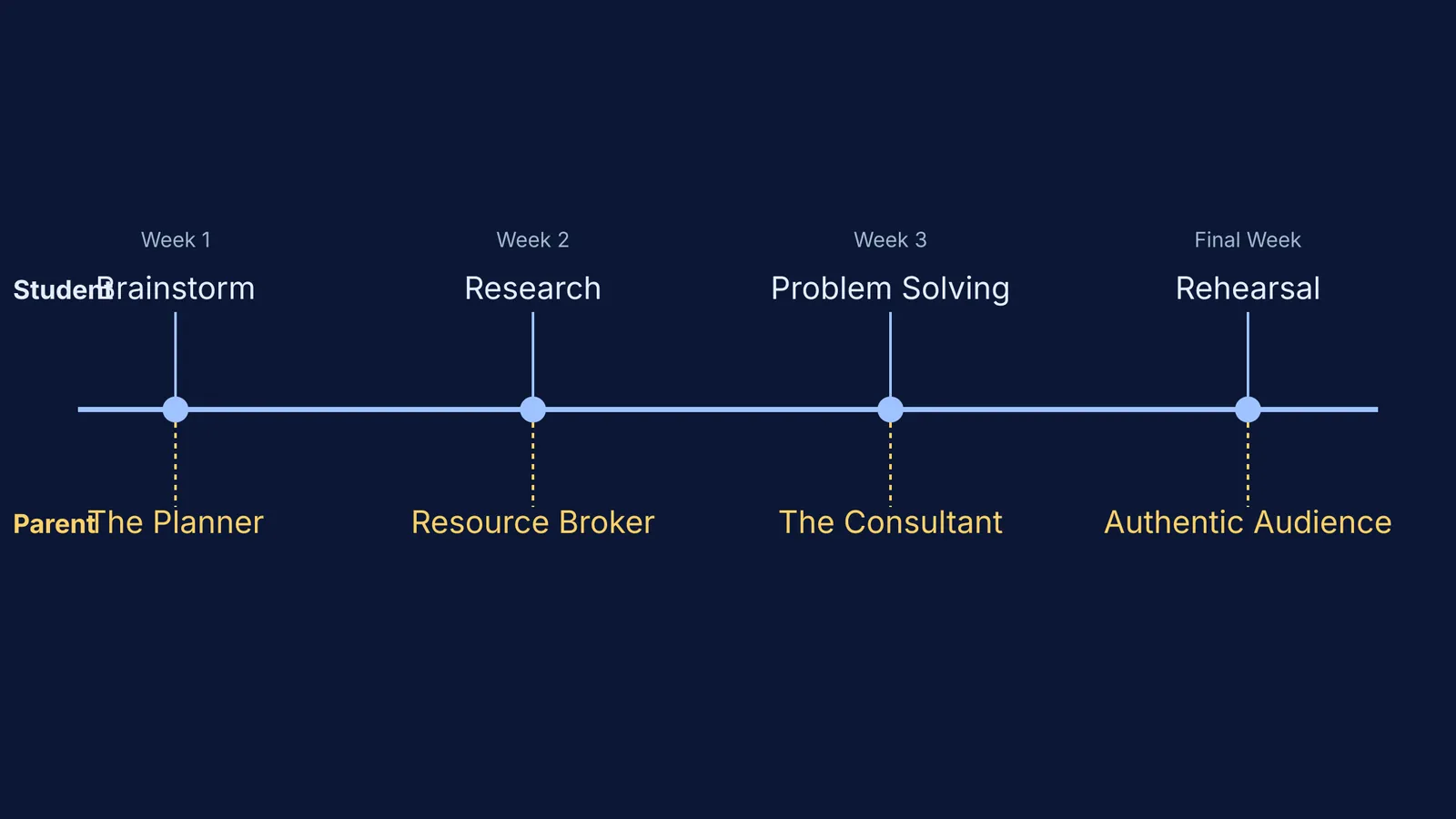
When your child brings home a complex project, you will likely switch between four distinct roles over the course of a few weeks:
The Planner: A four-week project is overwhelming for a teenager who is used to nightly homework. Help them break the assignment down into weekly milestones, working backwards from the final deadline to ensure they do not leave everything to the last minute.
The Resource Broker: Your professional network, hobbies, or life experience are valuable assets. You might help them find a local business owner to interview, source specific building materials from a hardware store, or locate an expert who can answer their niche questions.
The Consultant: When they get stuck on a difficult problem, avoid giving them the direct answer. Instead, ask open-ended questions like, "What would happen if you tried it the other way?" or "Where else could we look for this missing data?" If there is a gap in their fundamental understanding of the topic, the Fermi Concept Library covers every concept in physics, chemistry, biology, and mathematics.
The Authentic Audience: The final step of most PBL assignments is a presentation. Providing a trial run at home gives them a safe space to practice public speaking, refine their slides, and anticipate the questions their teacher might ask.
How do you support research and planning at home?
The hardest part of a project often happens before any building or writing begins. Students frequently need help defining their core question and planning their research approach.
A practical way to support this early phase is the three-step project check-in:
The Brainstorm (Week 1): Sit down for 15 minutes to discuss their initial ideas. Ask them to explain the project's goal in one sentence. If they do not know where to start their research, Fermi's AI tutor can work out what they already know and build a plan for the session, so they sit down to a clear next step.
The Mid-Point Review (Week 2): Ask them to show you their progress against the teacher's grading rubric. This is the time to identify missing data, stalled experiments, or areas where they need to pivot their strategy.
The Rehearsal (Final Week): Listen to their final presentation without interrupting, then ask one or two challenging questions to help them think on their feet.
How to give feedback without taking over?
When you see a wobbly cardboard model, a messy paragraph, or a graph that does not make sense, it is extremely tempting to step in and fix it for them. However, taking over defeats the entire purpose of the project.
Instead, use growth-producing feedback. Avoid pointing out flaws directly. Try using conversational stems like "I like how you..." followed by "A good next step would be to..." For example, instead of saying, "Your bridge is going to collapse," say, "I like how you built the base. A good next step would be to test how much weight it can hold before it starts to bend."
By focusing your support on planning, providing resources, and offering constructive feedback, you help your child build the critical thinking and problem-solving skills that project-based learning is specifically designed to teach.


