On this page
Your child comes home after the half-yearly results and says, "They moved me from 9A to 9D." Higher, lower or routine, your child has lost a seat, friends and sometimes a favourite teacher overnight. Here is what the move usually means, what research says, and how to help.
Why do schools change a child's section based on marks?
Schools reshuffle sections for several reasons, and marks are only one of them. Common ones include:
Grouping students by marks so a teacher can pitch lessons at one level.
Balancing section sizes after students leave or join.
Splitting up friend groups the school sees as a distraction.
Mixing students every year as a fixed policy, whatever their marks.
Arranging classes around electives or streams, as in Class 11.
The notice rarely says which, so ask rather than guess.
Does putting children in sections by marks actually help?
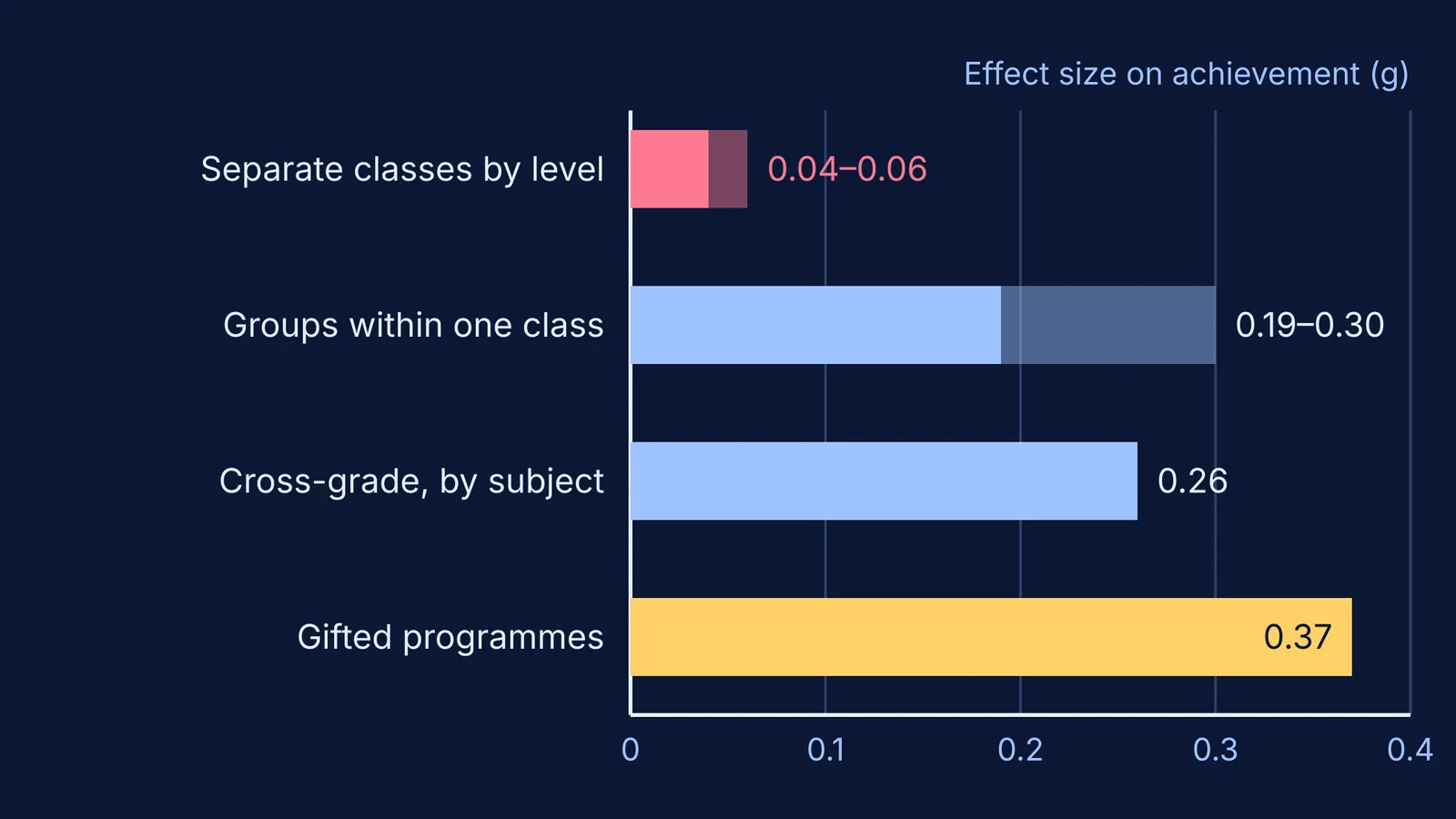
On average, not much. A 2016 review in Review of Educational Research pulled together about 100 years of research, including 13 meta-analyses on ability grouping (Steenbergen-Hu, Makel and Olszewski-Kubilius, 2016). Students placed in separate classes by ability did not benefit in achievement, with effect sizes of 0.04 to 0.06. Grouping children within one class did better, with effect sizes of 0.19 to 0.30. The effects did not vary for high-, medium- and low-ability students.
The teaching matters more than the label. In a randomised study of 121 Kenyan primary schools, Duflo, Dupas and Kremer found that students at all levels benefited when first-grade classes were split by prior achievement. They linked this to teachers adjusting their teaching to the level of the class. So a new section can help if the new teacher actually teaches to where your child is.
Children moved "up" may pay a price in confidence. In a study of 103,558 fifteen-year-olds across 26 countries, Marsh and Hau found that, at the same level of ability, students in higher-achieving schools had lower academic self-concept, which researchers call the big-fish-little-pond effect. That study compared schools, not sections, but the risk is similar: a child near the top of their old section may now sit in the middle and decide they are "bad at maths".
How do you ask the school the reason without a fight?
Ask for a short meeting with the class teacher or coordinator rather than arguing on the parents' WhatsApp group. Go to understand the decision, not to reverse it. A script you can adapt:
"We noticed [name] has moved to Section D. Could you help us understand why?"
"Was it based on the half-yearly marks, or something else?"
"Which subjects or skills should [name] focus on now?"
"Is there a review later in the year, and what would it take to move again?"
"Who can [name] go to if they feel lost in the first few weeks?"
Write the answers down. If the move was about marks, question 3 gives you a study plan; if it was about numbers, say so plainly. If your child wants to go back for friendship reasons, our guide on what to do when a child wants to change section covers that conversation.
How can you help your child settle in the new section?
Start with feelings before fixes. Ask "What's the hardest part?" and listen; it may be lunch-break friends rather than the syllabus. Then work through a four-week plan:
Week 1, name the change: repeat what the school told you in one honest sentence. Avoid "you got demoted" and "you're with the toppers now".
Week 1, keep one old anchor: old friends at lunch, the same bus, the same evening routine.
Week 2, find one new person: encourage your child to work with one new classmate.
Weeks 2 and 3, fix the gap the school named: go back slowly to any weak chapter.
Weeks 3 and 4, praise the process, not the position: talk about the hours, the method and the questions asked.
Week 4, check in with the teacher: a two-line note asking how your child is settling is enough.
For step 4, the Fermi Concept Library has a lesson for every concept in physics, chemistry, biology and mathematics, which helps when a weak chapter rests on an older one. If your child does not know where to begin, Fermi's AI tutor works out what they already know and builds a plan for the session.
For step 5, our piece on praising effort rather than ability has phrases you can use. If marks have also slipped, the steps in what to do when your child's rank drops in class fit alongside this plan.
When is it more than settling-in trouble?
Some signs go beyond a normal adjustment: refusing school for days, big changes in sleep or appetite, or talk of feeling worthless. Speak to the school counsellor. You or your child can also call Tele MANAS on 14416 or 1800-891-4416, a free, 24x7 national mental-health helpline launched by the Ministry of Health and Family Welfare.
Give it a month, and judge the new section by how your child is learning, not by the letter on the classroom door.