

On this page
Generative AI has moved from a novelty to an everyday tool in education. According to a December 2025 survey by the Pew Research Center, 64% of teenagers report using chatbots. Yet parents are often the last to know: the same survey found that only about a third of parents are aware of their children using these tools for schoolwork.
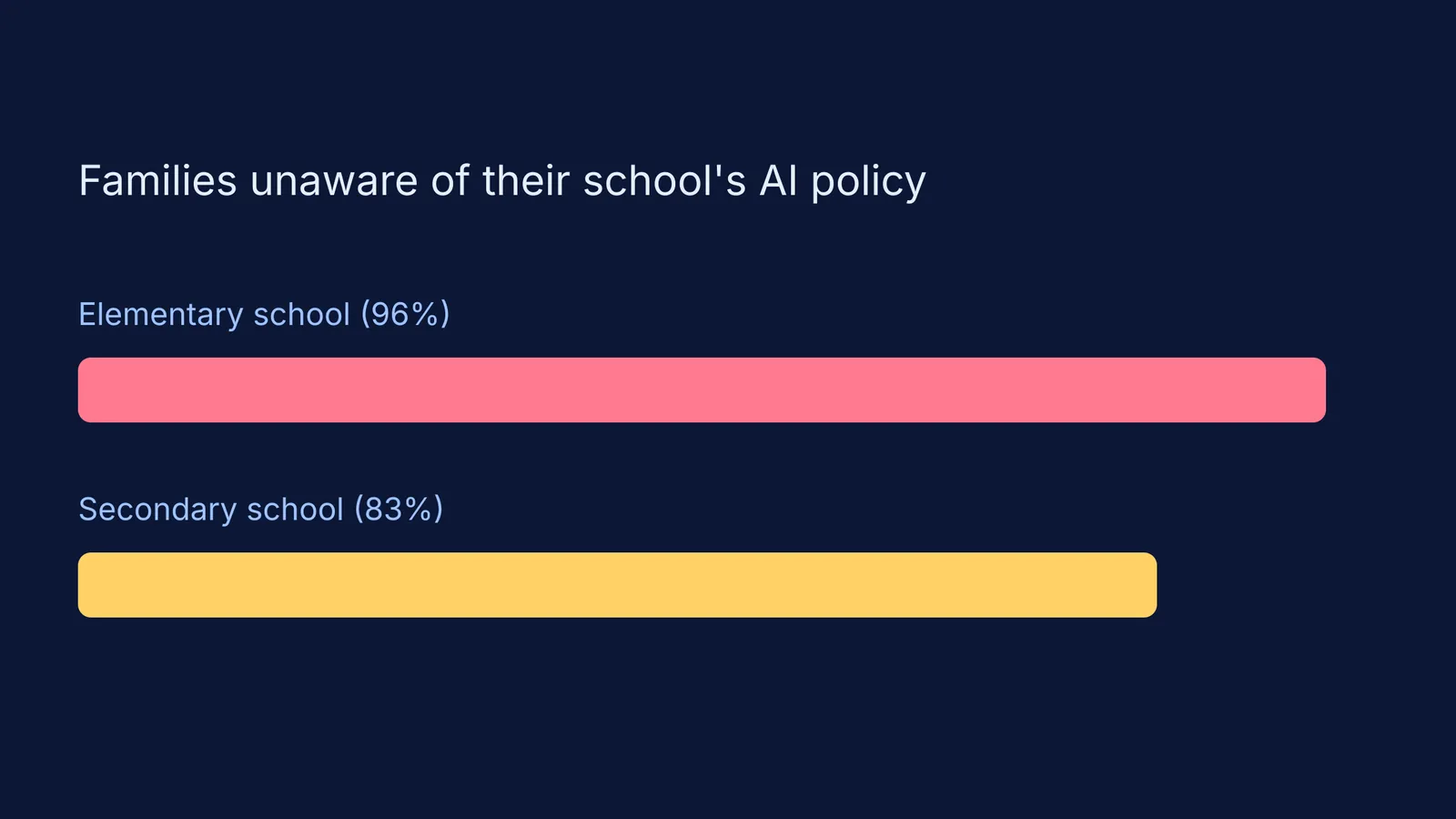
This communication gap extends to the schools themselves. A 2025 report by the Center on Reinventing Public Education revealed that 83% of families with secondary students — and 96% of those with elementary students — are unaware of any school policy on AI, or report that their school has not communicated one. Even globally, institutions are playing catch-up; a 2025 UNESCO survey found that only 19% of higher education institutions had a formal AI policy in place.
In India, the shift is becoming official. Starting in the 2027–28 academic session, the CBSE has made Artificial Intelligence a mandatory subject for Class IX, ensuring that AI literacy becomes a core part of the curriculum.
If your child is using AI, you need to know how the school handles it. Here are the questions to ask at your next parent-teacher meeting, and how to use the answers to set rules at home.
What is the school's policy on AI for homework?
The biggest grey area is homework. You need to know where the line is drawn between getting help and cheating. Students often feel confused when different teachers have different rules.
Ask the school:
Is there a written policy on using AI for assignments, and how is it communicated to students?
Are students allowed to use AI to brainstorm ideas, check their grammar, or explain a difficult concept?
What are the consequences if a student submits AI-generated text as their own work?
How do teachers check if work is original, and are they aware that AI detection tools can sometimes be inaccurate?
When a school treats AI as a learning aid rather than just a shortcut, the focus shifts to understanding. For instance, if your child is struggling with a physics problem, Fermi's AI tutor works out what they already know and builds a plan for the session, teaching through the concept rather than just handing over the answer. This approach encourages active learning instead of passive copying.
How are teachers using AI in the classroom?
AI is not just for students. Teachers use it to plan lessons, grade papers, and create study materials. Asking about this shows you are engaged with the school's methods, and helps you understand the classroom environment.
Ask the school:
Are teachers trained to use AI safely and effectively in their teaching?
How is the school teaching students to use AI responsibly and critically?
Are teachers using AI to grade assignments, and if so, how do they ensure feedback remains personal and accurate?
Understanding how teachers model AI use can help you mirror those practices. This is also a good time to ask how you can support their methods at home. If you want a structured approach for your child's self-study, reading Trying an AI tutor with your child: a 20-minute parent's guide is a helpful starting point.
What happens to my child's data?
Data privacy is a major concern when using digital tools in education. Generative AI models often learn from the inputs they receive. You have the right to know what information is collected from your child and who has access to it.
Ask the school:
Which AI tools are officially approved for classroom use, and do they require students to create accounts?
Does the school have agreements with these software companies to protect student data from being used to train public AI models?
What safeguards are in place to ensure that students do not accidentally share personal information while chatting with an AI?
Before downloading any new educational app at home, you should apply the same scrutiny. Our guide on Privacy in learning apps: what parents should check in India covers the specifics of data protection that you should look out for.
How can we align home rules with school policy?
Once you understand the school's stance, you can set boundaries at home that make sense. Consistency between school and home reduces confusion and helps your child build better habits.
If the school forbids using AI to write essays, enforce that rule when your child is working at the kitchen table. If the school encourages using AI to test their knowledge or brainstorm, show them how to prompt the tool effectively without letting it do the heavy lifting.
Here is a simple framework for managing AI use at home:
Be clear about the line: Explain the difference between asking an AI to "explain how the heart works" versus "write my biology essay on the heart". One is a tutor, the other is cheating.
Review their work: Ask them to explain the concepts they learned with the AI's help. If they cannot explain it in their own words, they have not truly learned it.
Talk about the limitations: Remind them that AI can make mistakes, invent facts, or present biased information. They must still check facts against their textbooks and trusted sources.
Keep it in the open: Encourage them to use AI tools in shared spaces like the living room, rather than alone in their bedroom, so you can guide them if they get stuck.
For a deeper look into setting boundaries, Should children use ChatGPT for homework? A parent's guide offers practical advice on navigating these everyday decisions.


