On this page
How much will higher education in India actually cost?
Planning for higher education requires calculating total degree costs rather than headline tuition alone. According to the National Statistical Office 75th round survey on education expenditure, urban Indian households spent an average of ₹64,763 annually on technical and professional courses, with course fees driving over 75% of the total outlay. For general undergraduate degrees, annual urban expenses averaged ₹16,308 per student.
Public institution fees have also risen. At the Indian Institutes of Technology, statutory undergraduate tuition stands at ₹1,00,000 per semester (₹2,00,000 per year) under official IIT academic fee guidelines. Including hostel rent, mess bills, books, and laboratory supplies, a four-year residential degree at top government institutions regularly totals between ₹12 lakh and ₹14 lakh.
Private university programmes require substantially larger budgets. Four-year private engineering degrees cost ₹15 lakh to ₹25 lakh, while private medical colleges can exceed ₹60 lakh to ₹1 crore. To estimate what a degree will cost when your child turns 18, multiply today's cost by (1 + r)ⁿ, where r represents an estimated education inflation rate of 8% to 10% and n is the years remaining. At an 8% inflation rate, a degree costing ₹15 lakh today will require approximately ₹32.4 lakh in 10 years. Before committing large sums to test preparation, families can review our guide to evaluating coaching institute fees and contracts.
Why does starting early matter for college savings?
When families begin investing early, compound growth shoulders the majority of the financial burden. Investor guidance from the Securities and Exchange Board of India stresses that starting early gives your capital more compounding cycles, allowing accumulated returns to outgrow personal deposits over long horizons.
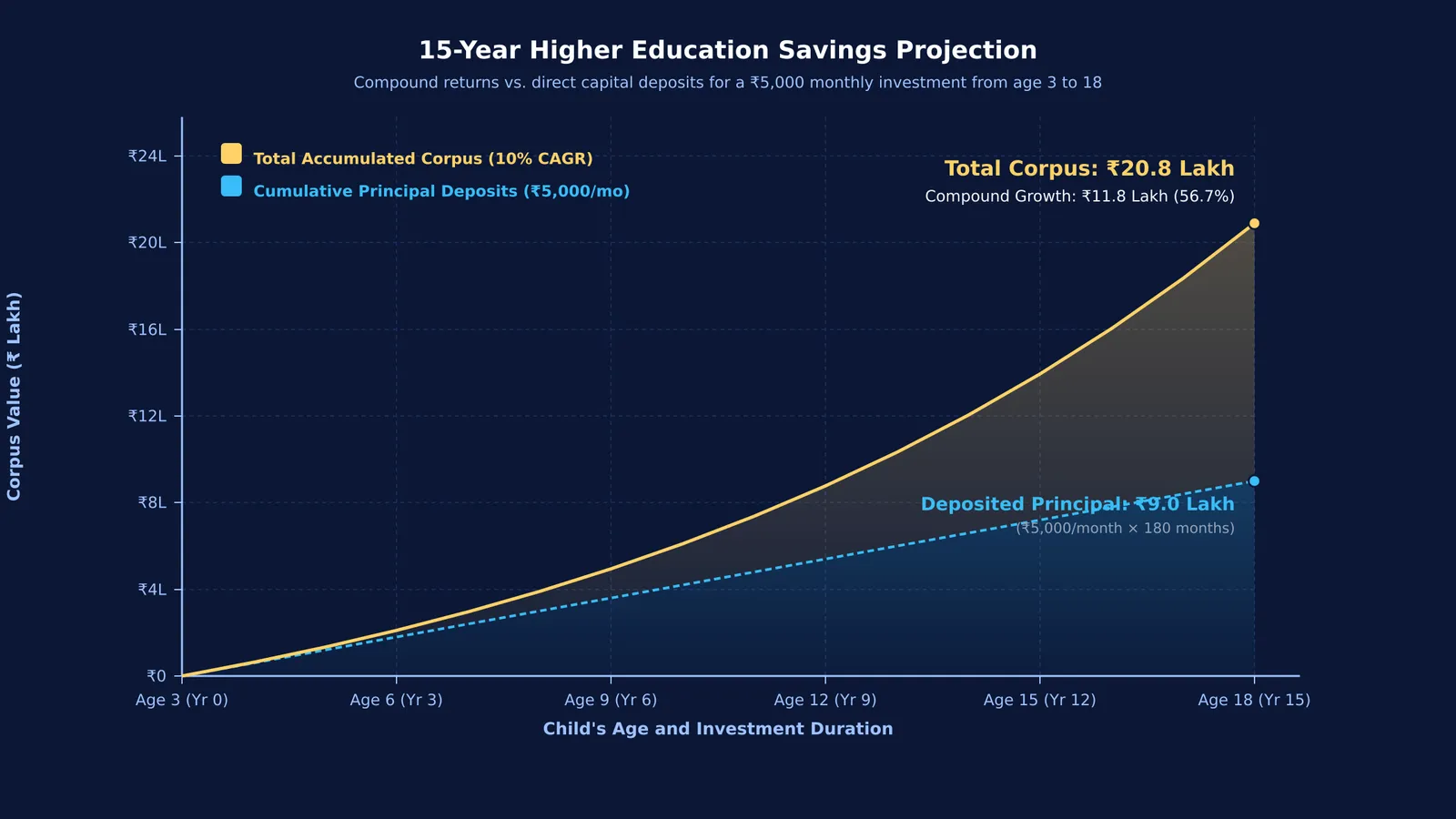
Consider the mathematical difference between starting early versus waiting. To build a ₹20.8 lakh college fund by age 18:
Starting at age 3 (15-year horizon): Investing ₹5,000 monthly in a diversified equity portfolio at an annualized 10% return requires ₹9.0 lakh in total deposits across 180 months. Compound returns generate ₹11.8 lakh, funding more than 56% of the final corpus.
Starting at age 13 (5-year horizon): Reaching that same ₹20.8 lakh target over 60 months at a 10% return demands approximately ₹26,800 monthly. You must deposit ₹16.1 lakh of your own capital, while compound returns generate only ₹4.7 lakh.
Delaying by a decade forces parents to commit more than five times as much cash every month. Long-term planning also protects household stability. The Reserve Bank of India National Strategy for Financial Education 2020-2025 highlights that systematic, goal-oriented savings protect families from high-cost unhedged debt or prematurely exhausting retirement savings when college admission arrives.
How should families separate education funds from general savings?
A frequent pitfall in family financial planning is holding college funds in the household's primary bank account. In his foundational work on mental accounting1099-0771(199909)12:3%3C183::AID-BDM318%3E3.0.CO;2-F), Nobel laureate Richard Thaler demonstrated that individuals treat money differently based on how it is categorized. When funds remain in an undifferentiated pool, they are easily diverted toward lifestyle upgrades or unplanned household expenses.
Segregating education money creates a clear boundary against impulsive withdrawals. Opening a separate mutual fund folio or a dedicated account tagged specifically with your child's name enforces this discipline. For families with a daughter, the government's Sukanya Samriddhi Account provides a tax-exempt small-savings vehicle yielding 8.2% per annum, allowing partial withdrawals up to 50% specifically for higher education after she turns 18.
Earmarking savings also produces measurable educational advantages. Research published by William Elliott in Children and Youth Services Review revealed that children with designated college savings accounts were three times more likely to enrol in college and four times more likely to graduate than peers without dedicated accounts. Having a tangible account in their name builds a "college-bound identity," making academic goals feel concrete. Parents can also explore government and institutional scholarships for science students to supplement their savings.
What investment framework protects your education corpus?
A reliable higher education plan balances early wealth accumulation with capital preservation as admission day approaches. Following asset-allocation principles from the Securities and Exchange Board of India, dividing your timeline into three progressive asset-allocation phases keeps savings safe:
Growth phase (10+ years remaining): Allocate 70% to 80% of monthly savings to diversified equity index funds to outpace education inflation.
Transition phase (5 to 10 years remaining): Shift toward a 50:50 balance between equities and fixed-income assets like the Public Provident Fund (PPF) or high-grade debt funds.
Capital preservation phase (final 3 years): Move college funds into liquid mutual funds or fixed deposits to protect against market downturns.
Alongside financial planning, maintaining a supportive atmosphere at home keeps educational goals sustainable; parents can review practical strategies to help children learn without adding pressure. During secondary school, families can support self-directed study at home. When a student encounters difficult topics in STEM subjects, Fermi's AI tutor can work out what they already know and build a plan for the session, teaching step by step rather than printing answers. To build deep foundational understanding, the Fermi Concept Library offers every concept in physics, chemistry, biology, mathematics, and computing, each with its own lesson and its place in the map.