

On this page
Most Indian teenagers communicate effortlessly in their mother tongue at home, yet their reading life happens almost entirely in English. While school curricula demand English proficiency, setting aside Indian language literature creates a surprising academic blind spot.
Why should teenagers read books in regional languages?
Reading for pleasure provides profound cognitive benefits. In a study analyzing 3,583 cohort members from the 1970 British Cohort Study, Alice Sullivan and Matt Brown at the UCL Institute of Education showed that leisure reading between ages 10 and 16 drives substantial progress in vocabulary and mathematics (Sullivan & Brown, 2015), with an effect four times greater than having a parent with a university degree. International assessments confirm this pattern: according to the OECD's PISA in Focus report, 15-year-olds reading daily for enjoyment score the equivalent of one and a half school years higher than non-readers (OECD, 2011).
These cognitive gains cross language boundaries. Jim Cummins' Linguistic Interdependence Hypothesis showed that literacy strategies established in a first language transfer directly to secondary languages through Common Underlying Proficiency (Cummins, 1979). Parsing nuanced metaphors or complex narratives in Bengali, Tamil, or Marathi elevates overall reading comprehension in English. Our guide on mother tongue and learning discusses how first-language depth anchors academic growth. Developing reading for pleasure in regional languages enriches this foundation.
Why do teenagers resist reading in their mother tongue?
If reading in a mother tongue is so helpful, why do teenagers resist it? The primary barrier is a decoding speed gap.
A high schooler who reads effortlessly in English often slows down noticeably when sounding out complex conjunct consonants and unfamiliar orthography in regional scripts. They understand everyday conversation, but decoding print takes heavy conscious effort. When families introduce only heavy historical classics or moral lessons, teens conclude regional reading is tedious homework.
Family habits also matter. The National Youth Readership Survey, conducted by the National Council of Applied Economic Research (NCAER) for the National Book Trust across 311,431 literate youth in 207 districts, revealed that while 25% of youth read books outside their syllabus, only 18.8% were encouraged by parents to read for leisure. When reading is tied strictly to marks, leisure reading rarely takes root.
How can parents find good regional books for teenagers?
Finding engaging titles requires looking beyond school textbooks. Several established catalogs curate modern regional literature:
Sahitya Akademi catalogs: The Sahitya Akademi instituted the Bal Sahitya Puraskar in 2010 for books written for readers aged 9 to 16 across 24 Indian languages. Its annual shortlists highlight contemporary novels and short stories matched to adolescent sensibilities, while the Yuva Puraskar list features writers under 35.
National Digital Library of India (NDLI): Hosted by IIT Kharagpur and sponsored by the Ministry of Education, the National Digital Library of India offers open-access regional literature and translated collections across major Indian scripts.
Open multilingual archives: Platforms such as Pratham Books' StoryWeaver provide thousands of illustrated digital stories in dozens of Indian languages at intermediate reading levels.
Regional book fairs: Visiting events like the New Delhi World Book Fair, Kolkata Book Fair, or Chennai Book Fair introduces teens to translations, graphic adaptations, and modern novellas rarely stocked in local shops.
Which genres and starter titles work best for teens?
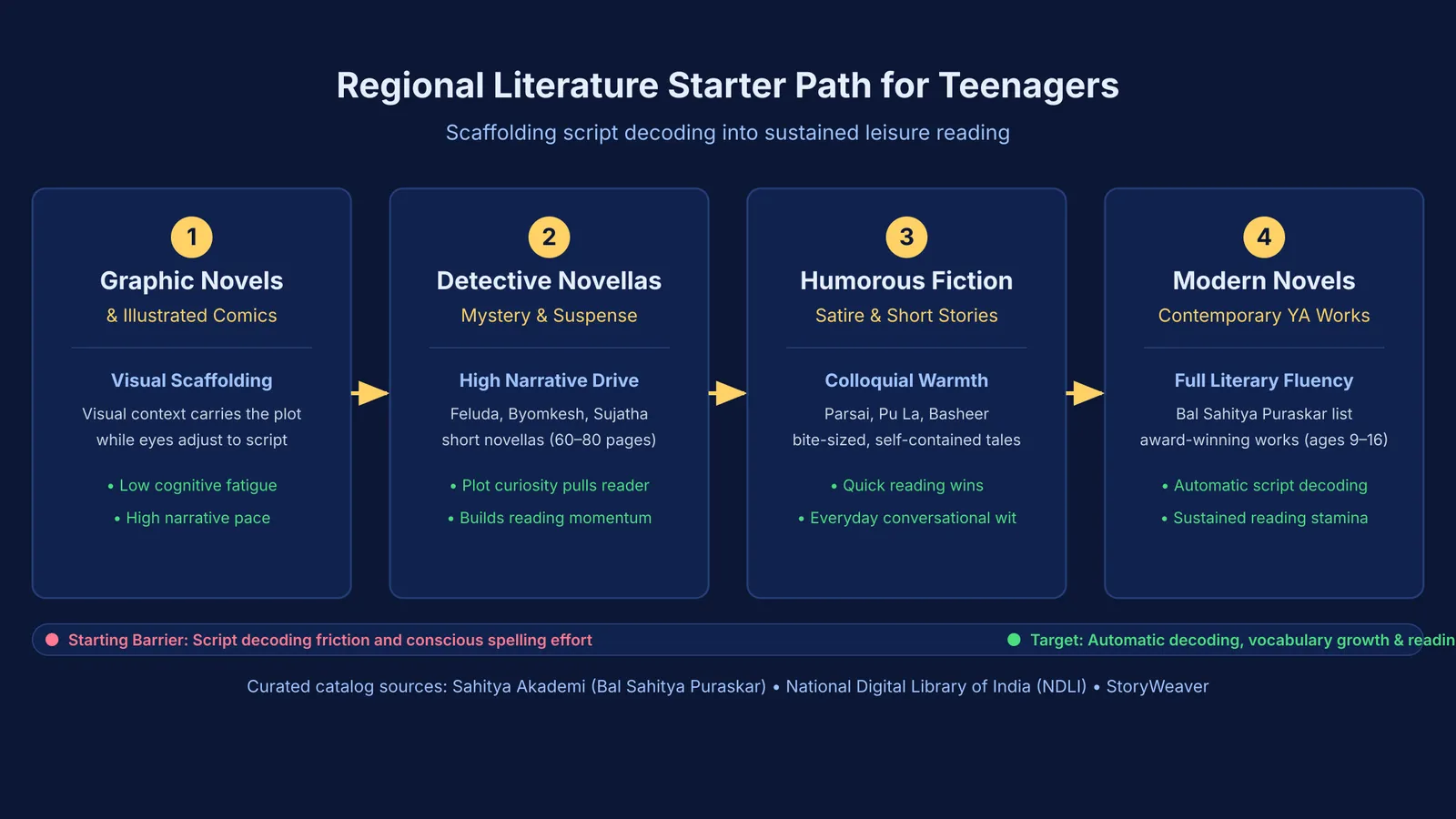
To build reading momentum, introduce genres that match teenage tastes before moving to literary classics:
Graphic novels and comics: Visual storytelling lightens the cognitive burden of script decoding while keeping narrative pacing high.
Detective mysteries: Page-turners build momentum. Classic examples include Satyajit Ray's Feluda and Sharadindu Bandyopadhyay's Byomkesh Bakshi in Bengali, Sujatha's thrillers in Tamil, and contemporary regional detective stories.
Humorous short fiction: Short pieces deliver quick wins. Harishankar Parsai and Premchand in Hindi, Pu La Deshpande in Marathi, or Vaikom Muhammad Basheer in Malayalam provide humor without intimidating page counts.
Translated young adult fiction: Reading an Indian-language translation of a story they already know, such as popular fantasy or adventure novels, lets teens practice the script with familiar plot context.
What should you say when a teen says reading is too slow?
When teens find regional reading slow, empathetic guidance prevents defensiveness. Establish a low-stress routine by trying a family quiet hour.
When students finish their daily STEM practice on Fermi's AI tutor, stepping away from glowing displays into evening mother-tongue reading provides a natural cognitive reset that protects sleep and builds sustained attention.
Use this simple script to reframe their struggle:
Avoid: "You speak the language at home, so why can't you read it smoothly?"
Say instead: "Your reading feels slow right now simply because your eyes haven't logged enough miles on this script. Let's read this short mystery together: you read one page out loud, and I will read the next two."
Shared reading removes performance anxiety, turning regional literature into an enjoyable family routine.


