On this page
A red cabbage from the sabzi mandi, a kettle and three things from your kitchen and bathroom are enough for a real chemistry experiment. Your child sees acids and bases change colour in front of them, instead of only reading the word "pH" in a textbook.
How do you make red cabbage indicator at home?
The method below follows the Science Buddies cabbage chemistry activity published by Scientific American, which uses grated cabbage, boiling water and at least half an hour of steeping.
Grate or finely chop about half a small red cabbage and put it in a steel bowl.
An adult pours boiling water over it until the cabbage is just covered.
Stir now and then and leave it until the liquid reaches room temperature, which takes at least 30 minutes.
Strain out the cabbage. The purple liquid is your indicator.
Pour about one tablespoon into each of several small white cups or steel katoris, one per test, so the colour is easy to see.
Keep a plain-water cup as your control. It shows the colour of "neutral", and every other cup is compared with it.
What colours should you expect for lemon, soap and baking soda?
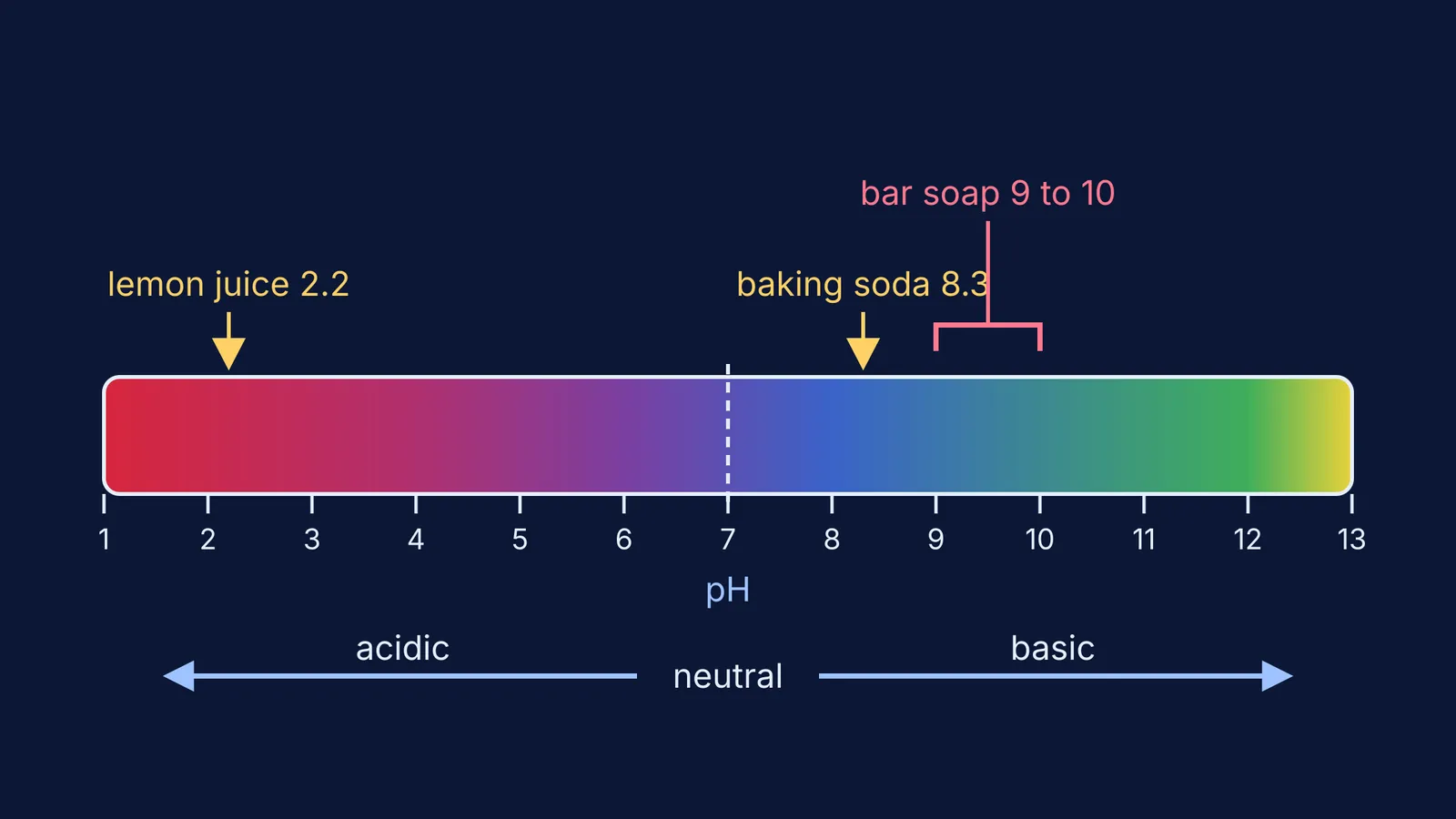
An acid-base indicator is a substance that shows different colours in the presence of an acid or a base, according to LibreTexts Chemistry. The same page explains that cabbage extract is red when acidic, purple when neutral, and green to yellow when basic. A LibreTexts table on anthocyanins gives the full run: red at pH 1, purple at pH 6, blue at pH 8, green at pH 12 and yellow at pH 13.
Here is what to predict for each household item:
Lemon juice: about pH 2.2, according to the US Department of Agriculture's pH of selected foods table, so expect pink to red.
Baking soda dissolved in water: a freshly made 0.1 molar solution has a pH of 8.3, according to PubChem's sodium bicarbonate record, so expect blue.
Bar soap dissolved in water: a Kerala study of bathing soaps found most had a pH of 9 to 10 (Tarun et al., Indian Journal of Dermatology, 2014), so expect blue-green.
Liquid handwash: this one may surprise you. A 2024 study of 33 handwash products in Riyadh, Saudi Arabia, found liquid soaps had a mean pH of 5.9, compared with 10.3 for soap bars (Alsalhi et al., Journal of Family Medicine and Primary Care).
Colours vary with how strong your cabbage extract is and how much of each item you add, so treat the chart as a guide, not an exam answer key.
How do you keep the experiment safe for kids?
An adult handles the boiling water and the straining.
Wear eye protection if you have it. The Scientific American activity asks children to wear goggles and adults to supervise.
Skip bleach, toilet cleaners and drain cleaners. Lemon, baking soda and soap already give a clear spread of colours, from red to blue-green.
Nobody drinks from the test cups, even the lemon one.
Use small amounts, wipe up spills and wash hands afterwards. Soapy water in the eyes stings, so keep faces back from the cups.
How do you talk to your child about acids and bases?
Use a simple predict, observe, explain loop for each cup. Here is a script you can borrow:
Predict: "Lemon tastes sour. Do you think it will go red, stay purple, or turn green?"
Observe: "What colour is it now? Is it lighter or darker than the water cup?"
Explain: "The cabbage has a colour-changing chemical. Acids push it towards red, bases push it towards green. Neutral things like water leave it purple."
Stretch: "Lemon is an acid and baking soda is a base. What happens if we mix them?"
Then try it. Add a pinch of baking soda to the lemon cup. It fizzes because baking soda reacts with acids such as citric acid to release carbon dioxide gas (Wikipedia: sodium bicarbonate). Keep adding pinches and the red will shift back towards purple and blue as the base cancels out the acid. That cancelling has a name, neutralisation, and your child has just watched it happen one pinch at a time.
If your teenager wants to go past the colours to the reasons behind them, the Fermi Concept Library covers every concept in chemistry, including acids, bases and pH, each with its own lesson and its place in the map.