

On this page
Many parents notice a familiar pattern: their child starts a comprehension passage strongly, answering the first few questions perfectly, but makes careless mistakes by the end. The child is not suddenly forgetting how to read; they are running out of stamina.
As texts get longer in higher classes, sustaining mental focus becomes just as important as decoding the words. Whether tackling a lengthy English literature extract or a complex science problem, a student must maintain their attention to succeed.
Why does my child get tired reading long passages?
Long texts place an immense demand on a student's working memory. A child has to hold facts from the first paragraph in their mind while processing new information in the fifth paragraph, continuously building a mental model of the text.
A study by Heidi Anne Mesmer and Elfrieda H. Hiebert in the Journal of Literacy Research investigated how text complexity and length affect young readers. They found that as text length increased, both word reading accuracy and overall comprehension suffered significantly. Even when the difficulty of the vocabulary stayed the same, students showed lower comprehension on lengthier versions of a text compared to shorter ones. The sheer volume of words forces the brain to work harder for longer.
When stamina drops, students often slip into "fake reading"—moving their eyes across the page without making meaning. This explains why a child who can read beautifully for five minutes might fail a test that requires 30 minutes of sustained focus.
Is reading stamina a skill you can train?
Yes. Endurance is not a fixed trait; it is a "mental muscle" that grows with consistent practice. Just as an athlete trains for a marathon by running incrementally longer distances, a student can train their brain to sustain focus.
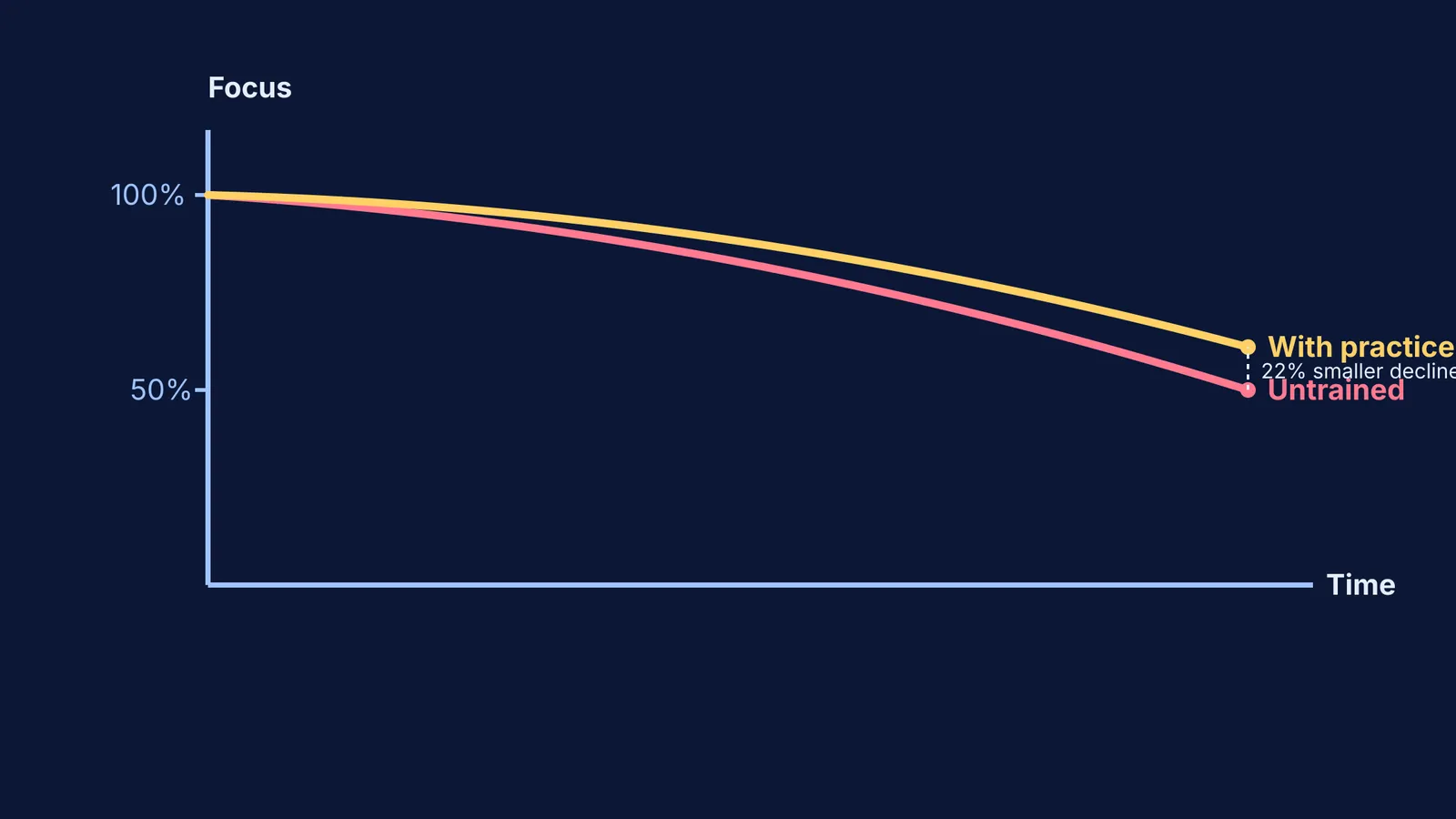
A 2022 study by the National Bureau of Economic Research proved that cognitive endurance is a highly trainable skill. Researchers asked primary school students to practise cognitively demanding tasks, such as solving maths problems. The results were striking: the students who practised showed a 22% smaller decline in their performance during long, continuous academic tasks compared to those who did not. Building endurance in one area transferred directly to better focus in others, suggesting that the act of effortful thinking itself builds the capacity to learn.
When students are tackling long passages or difficult problem sets, having a structured guide can help them maintain focus without burning out early. Fermi's AI tutor teaches rather than just answering questions: it holds a line of reasoning across a session, notices where a student is stuck, and decides whether to explain, ask or show.
How does daily reading volume help?
Frequent practice is the most reliable way to stretch a child's endurance. This compounding benefit is known in psychology as the "Matthew Effect" in reading, first described by Dr Keith Stanovich in 1986.
Stanovich showed that children who read well tend to read more, which exposes them to more vocabulary and builds their cognitive stamina, making them even better readers. Conversely, children who find reading tiring tend to avoid it, missing out on the daily practice that would build their endurance and closing the gap. Setting up a family quiet hour—perhaps by balancing TV and family entertainment—where everyone reads can help normalise this daily volume and break the cycle of avoidance.
How to build reading stamina from short to longer texts
You can borrow principles from physical endurance training to help your child read longer passages without fatigue.
Start with 'just right' texts: If a book is too difficult, the brain uses all its energy just trying to decode the words. Stamina is best built using texts where the child can easily decode almost every word, leaving their mental energy free for comprehension and sustained attention.
The 'Add One Minute' method: Find out how long your child can currently read before losing focus—even if it is just five minutes. Set that as the baseline. After a few days of successful reading at the baseline, increase the target by a single minute. This slow progression prevents frustration.
Count pages instead of time: For children who get anxious, constantly checking a visual timer breaks their concentration and increases cognitive fatigue. Ask them to read a specific number of pages instead of reading for a set number of minutes.
Use paper for long texts: Research comparing reading on screens vs paper shows that paper is often better for deep, sustained comprehension, as digital devices inadvertently encourage scrolling and skimming. Building this offline stamina is a key part of how to solve an unseen English passage quickly.
If your child is studying for higher-level exams and facing dense, text-heavy chapters, breaking the material down into logical pieces is essential. The Fermi Concept Library covers every concept in physics, chemistry, biology, mathematics and computing, each with its own lesson and its place in the map, so students can navigate complex subjects without feeling overwhelmed. If you are unsure where to begin with new study habits, you might consider setting up a routine for learning physics at home with AI to help build a structured, stress-free schedule.


