

On this page
When a child opens a book with a timer running next to them, their focus shifts immediately from the story to the ticking clock. What should be an immersive journey into another world becomes a mechanical chore to finish before bedtime. Many schools require parents to sign off on nightly reading sheets, hoping that mandatory tracking builds discipline. In practice, turning pages into an audited assignment often produces the opposite result.
Why do mandatory reading logs fail?
A reading log is designed to foster regular reading habits, but making it a compulsory requirement often undermines the very behaviour it seeks to encourage. In a 2012 study published in the Journal of Research in Education, researchers Sarah S. Pak and Allyson J. Weseley examined 112 second- and third-grade students over two months. Students assigned to mandatory reading logs, which required twenty minutes of nightly reading verified by a parent signature, showed significant declines in their attitudes toward recreational reading. In contrast, students who were given voluntary logs maintained or improved their enthusiasm for reading.
When tracking is enforced through mandatory minutes and parent verification, children lose their sense of autonomy. Reading stops being a self-chosen pleasure and turns into external compliance. Children adapt by adopting defensive strategies: they select shorter, simpler books to satisfy the page or minute requirement as quickly as possible. This reaction illustrates what psychologists call the overjustification effect, where external requirements displace intrinsic interest.
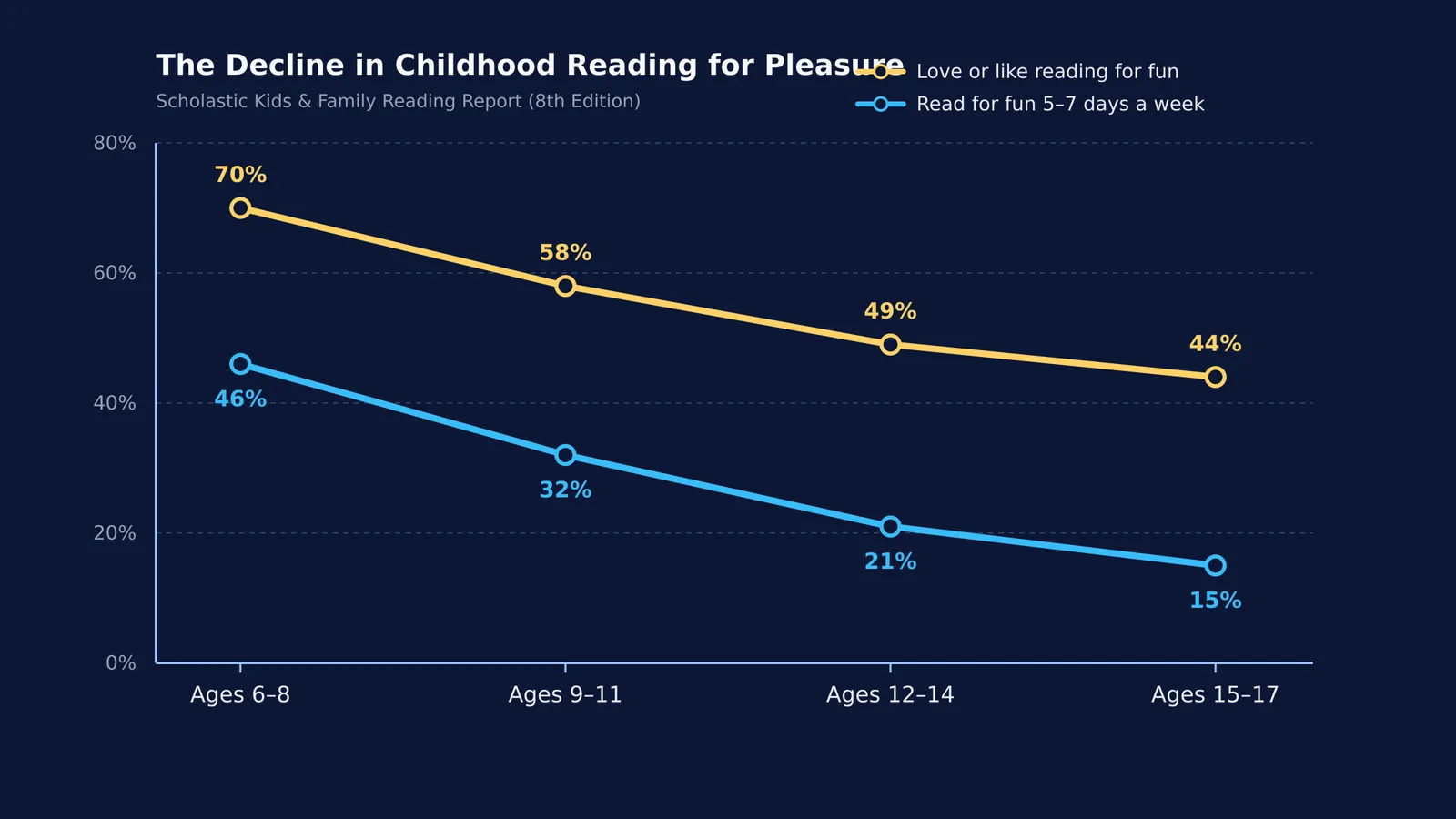
This dynamic mirrors broader patterns in childhood reading. According to the Scholastic Kids & Family Reading Report, only 28% of children aged 6 to 17 read books for fun five to seven days a week. Reading engagement drops sharply as children grow older, a pattern researchers call the Decline by Nine. While 46% of children aged 6 to 8 read frequently for pleasure, that figure falls to 32% among 9- to 11-year-olds, 21% among 12- to 14-year-olds, and just 15% among teenagers aged 15 to 17. Similarly, 70% of 6- to 8-year-olds report loving or liking reading for fun, dropping to 46% for children aged 12 to 17. Crucially, 89% of children say their favourite books are the ones they chose for themselves.
Should my child keep a reading log?
Yes, but only if your child controls the notebook and decides what goes inside it. A reading log should serve as a personal journal of discovery, never a tool for adult surveillance.
When you shift the purpose from logging minutes to capturing thoughts, the notebook becomes a source of pride. Children can look back across months and observe their own tastes developing, whether they notice a sudden fascination with mystery novels or realise they have finished an entire fantasy series. This sense of ownership aligns directly with autonomy-supportive parenting, where parents provide structure and encouragement while allowing children to direct their own choices. Parents can also learn how to help children learn without pressure, creating a home atmosphere where curiosity thrives without constant supervision.
Effective learning tools adapt to where a student actually is, rather than imposing rigid external rules. When a student brings a topic, Fermi's AI tutor works out what they already know and builds a plan for the session. A supportive reading routine operates on the same principle: it flexes around the child's stamina, curiosity and reading level instead of demanding an arbitrary daily quota.
How can parents use a reading log to build a habit?
If you choose to introduce a reading journal at home, reframe the purpose entirely. The objective is to celebrate the journey of reading, not to measure elapsed time.
Track finished titles instead of clocked minutes. Have your child note the title, author and date completed. Logging books rather than minutes removes the urge to watch the timer and keeps their attention focused on completing the narrative.
Record reflections rather than formal summaries. Avoid asking for school-style comprehension paragraphs. Encourage your child to jot down a memorable line, sketch a favourite character, or assign a simple star rating out of five.
Model the habit as a shared family activity. Keep your own reading notebook on the coffee table. When children see adults recording books, it demonstrates that reading for pleasure is a rewarding lifelong pursuit rather than a school task.
Celebrate abandoned books without criticism. If your child logs a book as abandoned because the storyline dragged, treat that as valuable self-knowledge. Deciding that a book is not right for them is an essential part of becoming an independent reader.
A notebook is neutral; the intention behind it determines whether it inspires enthusiasm or resistance. When you place the pen in your child's hand and step back, the reading log stops being a chore and becomes a record of their growing mind.


