

On this page
Most families stop reading aloud once a child can read alone. Scholastic's Kids & Family Reading Report found that reading aloud at home peaks at age five, and the reason parents give most often for stopping is that children can read on their own. That reason makes sense, but it mixes up two different skills: reading the words, and understanding a long, complicated story.
Should I still read aloud to my 10-year-old?
Yes, if they will let you. Most 10-year-olds can read nearly every word on the page, but a rich novel asks for more: following a plot across chapters and working out what a character means but does not say. When you do the reading, your child can put more of their attention on the meaning.
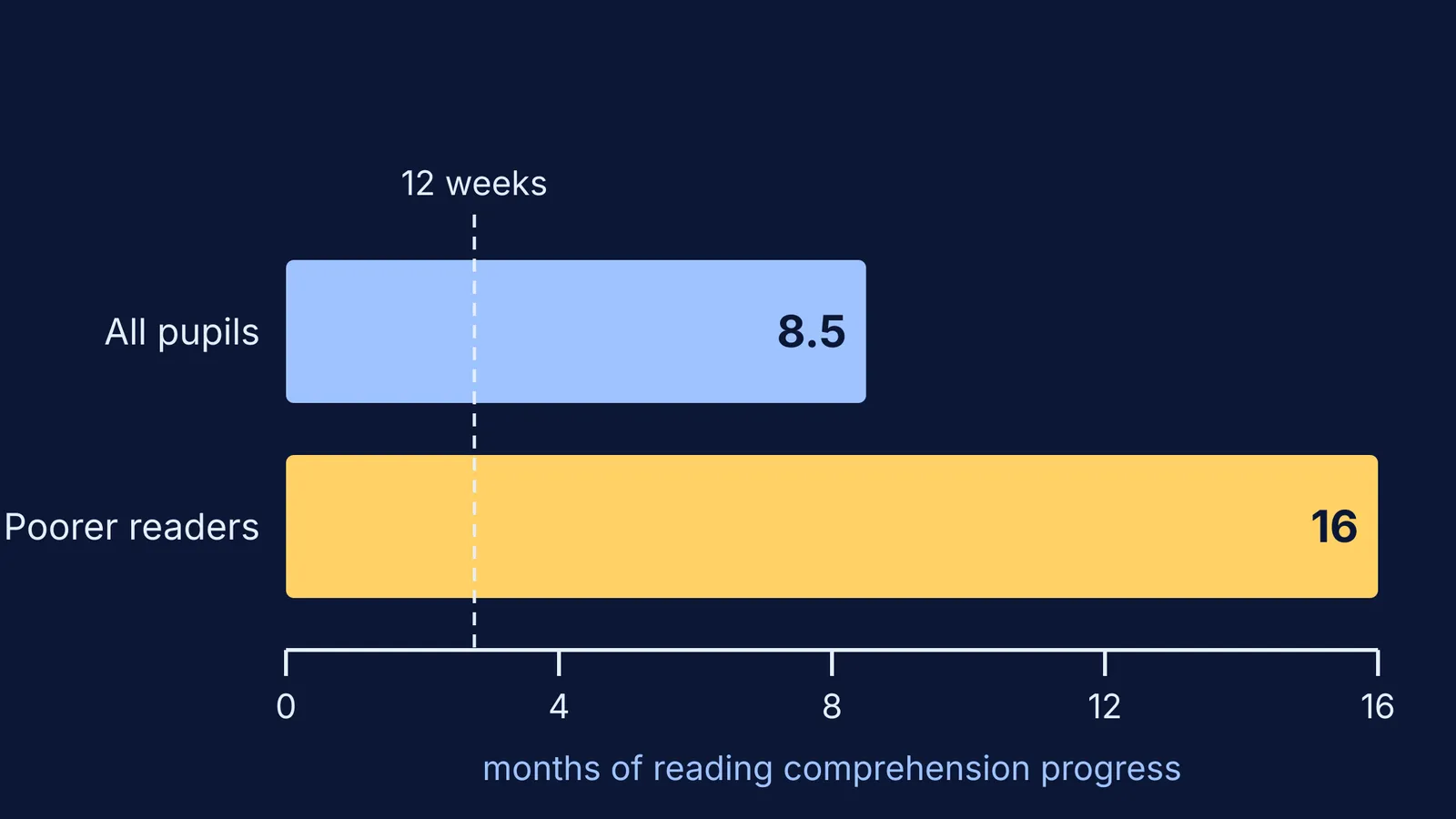
The clearest evidence comes from classrooms. In a 2019 study in the journal Literacy, Jo Westbrook and colleagues describe 20 English teachers in the South of England who read two whole challenging novels aloud, at a faster pace than usual, over 12 weeks with their average and poorer readers aged 12 to 13. Students made 8.5 months' average progress on standardised reading comprehension tests. The poorer readers made 16 months' progress. The authors write that simply reading challenging novels aloud repositioned "poorer readers" as "good" readers, giving them "a more engaged uninterrupted reading experience over a sustained period".
That was a school study, not a home one, so it does not promise the same result at your dining table. It does show what to copy: whole books, harder than the child would choose, read at a steady pace without testing them every page.
Does reading aloud stop helping at a certain age?
It changes, rather than stops. A study of 612 students in Grades 2, 4, 6 and 8 by researchers at the University of Cyprus, published in Reading Psychology in 2005, found that the gap between children's listening and reading comprehension shrank as grades went up. By Grade 8, students understood texts better when they read them than when they heard them.
What that means for you:
Ages 8 to 10: reading aloud lets your child enjoy books they could not yet manage alone. This is the age to reach furthest above their own reading.
Ages 11 to 13: many can read the same book themselves. The value moves to the talk around the book and to books harder still, such as classics with old-fashioned language.
If your child is younger than this, our guide to dialogic reading with young children covers the earlier years.
How do I pick a book harder than they read alone?
Aim for one step up: richer language and a longer plot, but themes that suit their age. Use this checklist in the library or bookshop.
Start from what they choose. Take the last book they finished alone and look for longer sentences, more characters or a less familiar setting.
Do the first-page test. Read the first page aloud. If they follow it with a word or two explained, it is in range. If every sentence needs explaining, wait a year.
Check the themes. Harder should mean richer language, not older content. Skim the blurb and reviews.
Mix the shelf. Alternate novels with narrative nonfiction, and include Indian writers and books in your home language.
Give them a veto. Try three chapters. If they still dislike it, choose again.
A worked example: your 10-year-old reads funny diary-style books alone. Read aloud R. K. Narayan's Swami and Friends instead. The school-day setting is familiar, but the English is richer and the jokes take a moment to land, which gives you something to talk about.
What does a 15-minute evening routine look like?
Keep it at the same time each night, after dinner and before screens go off, with phones in another room.
Minutes 0 to 2, recap. Ask, "Where did we stop?" Let your child tell it. This is a quick bit of recall, not a quiz.
Minutes 2 to 12, read. Read with expression and keep going. If a hard word blocks the meaning, explain it in a phrase and carry on.
Minutes 12 to 15, talk. Ask one question, then stop at a cliffhanger so they want the next night.
Questions that work for this age:
"Why do you think she did that?"
"What would you have done?"
"Who do you trust in this story so far?"
"What do you think happens next?"
Books often raise questions that send you outside the story. When a chapter makes your child ask why the monsoon comes when it does, or how a ship stays afloat, the Fermi Concept Library covers every concept in physics, chemistry, biology, mathematics and computing, each with its own lesson, so the two of you can look it up together.
For more on building the habit, see what PISA data shows about reading for pleasure, or set up a family quiet hour for shared study and reading. Pick tonight's book before dinner, and start with the first page.


