

On this page
How do you make a rainbow with water and a mirror?
You do not need a glass triangular prism to show your child how sunlight splits into a spectrum of colours. With a shallow bowl of water, a flat pocket mirror, and a sheet of white paper, you can build a working liquid prism on a sunny windowsill in under two minutes.
Here is the setup checklist:
Fill a shallow dish half-full with clean tap water.
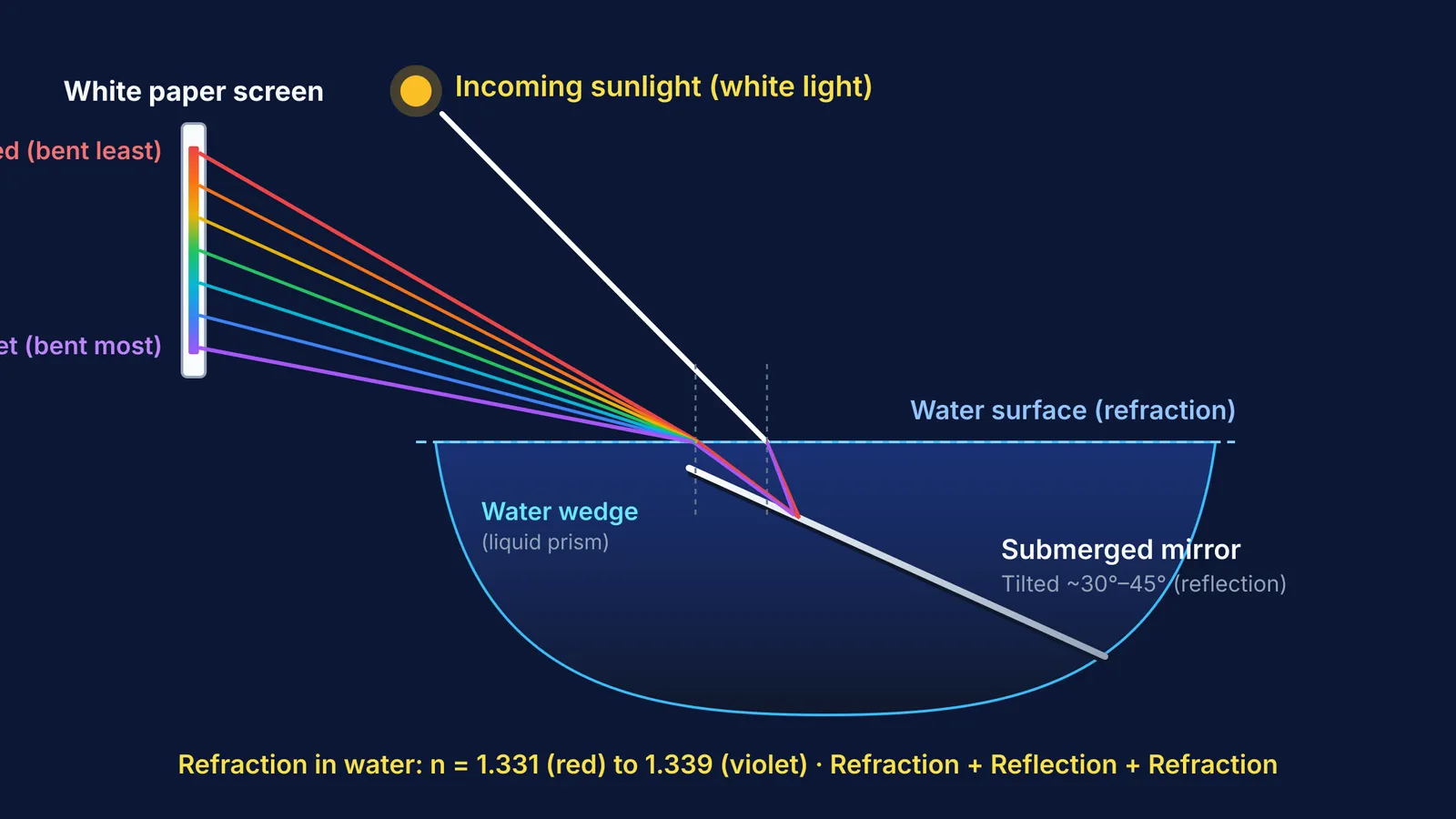
Place a small flat mirror inside, leaning it against the rim at roughly 30° to 45°.
Aim direct sunlight through the water onto the submerged mirror, or use a focused white torch in a dark room.
Hold a sheet of white paper slightly in front of the bowl to catch the reflected beam, or aim it at a pale wall.
Adjust the mirror tilt until a sharp colour band appears: red at one edge, violet at the other.
In an optics investigation published in *The Physics Teacher*, researchers Cristiano Monteiro de Barros Cordeiro and Eric Fujiwara (2022) demonstrated that this partially submerged mirror configuration produces measurable chromatic dispersion comparable to laboratory glass prisms. The experiment mirrors the classic practical featured in CBSE and NCERT science curricula, connecting kitchen curiosity to mirrors and shadows in school science.
Why does water split white light into colours?
Sunlight looks white or pale yellow, but it is actually a mixture of all the colours in the visible spectrum. Each colour travels as an electromagnetic wave with its own wavelength, ranging from roughly 700 nm for deep red down to about 400 nm for violet.
When light enters water from air, it slows down because water is an optically denser medium. This change in speed causes the light ray to bend, a process called refraction. However, water does not slow every colour by the exact same amount.
According to baseline optical measurements by George M. Hale and Marvin R. Querry (1973) in *Applied Optics*, the refractive index of water across the visible spectrum varies from 1.331 for red light (700 nm) to 1.339 for violet light (400 nm) at 25 °C (reaching 1.344 at cooler room temperatures). Because violet light encounters a higher refractive index, it slows down more and bends at a sharper angle than red light.
This wavelength-dependent bending is called chromatic dispersion. The sunlight strikes the water surface, refracts, hits the submerged mirror, reflects upward, and refracts a second time as it exits into the air. The two refractions compound the angular separation between the colours, fanning them out onto your paper screen. This process is identical in principle to the dispersion of white light by a glass prism and explains how raindrops form natural rainbows outdoors.
How does an old CD make a rainbow without water?
If you do not want to work with water, an old compact disc (CD) or DVD creates an even brighter rainbow through an entirely different physical mechanism called diffraction.
A compact disc stores digital data in microscopic spiral tracks. As Alan J. DeWeerd (2016) documented in *The Physics Teacher*, standard audio CDs have a track pitch of 1.6 micrometres, creating roughly 625 grooves per millimetre. These tightly spaced tracks act as a reflection diffraction grating.
When white light strikes the shiny surface, waves bounce off adjacent grooves and interfere in the surrounding air. Waves in phase reinforce each other, while waves out of phase cancel. Because different colours have different wavelengths, each colour constructively interferes at a distinct angle defined by the grating equation, d sin θ = m λ.
This produces an intriguing contrast with the water prism:
In the water prism (refraction), violet light bends the most and red bends the least.
On a CD (diffraction), red light diffracts at a larger angle than violet because of its longer wavelength.
Tilting a CD under a desk lamp projects sweeping arcs of colour onto the ceiling, letting you compare refraction and diffraction side by side. When students want to explore how light bends through different angles and media without spilling water across the desk, Fermi Simulation Lab provides interactive simulations for ideas that are easier to see than to read.
What should you say to explain the physics simply?
Children learn far more when parents ask guiding questions rather than lecturing. In a study on family STEM learning in *Frontiers in Psychology*, Ian L. Chandler-Campbell, Kathryn A. Leech, and Kathleen H. Corriveau (2020) found that inquiry-based questioning prompts children to generate significantly more causal explanations and scientific content than passive fact-sharing. Foundational research by Kevin Crowley and colleagues (2001) in *Science Education* similarly showed that informal parent-child dialogue turns everyday demonstrations into enduring scientific understanding.
Here is an inquiry script you can follow during the experiment:
Before turning on the light: "What colour do you think sunlight really is? Is it white, yellow, or multiple colours combined?"
When the rainbow appears: "Look at the colour band on the paper. Where have you seen that exact sequence before?"
Exploring the mechanism: "Why did colours appear only when we tilted the mirror underwater, but not when we shone the torch onto a dry mirror?"
Connecting the big idea: "White light is like runners moving together. When they enter water, violet slows down most and turns sharply, while red keeps going straighter. As they exit, they spread out into a rainbow."
This simple framing turns a ten-minute kitchen activity into an active physics discovery that stays with your child throughout school.


