

On this page
Many parents wonder if learning to code requires an expensive coaching class or a dedicated computer science teacher. The short answer is no. With modern resources, a motivated teenager can pick up programming basics entirely from home.
The CBSE Class 11 Computer Science syllabus now uses Python as its core language, covering fundamentals from loops and lists to data analysis. But even if your child is not taking computer science at school, Python is an excellent foundation for problem-solving in physics, mathematics and biology.
Should my teenager learn Python on their own?
Yes. According to the 2024 Stack Overflow Developer Survey, Python is the number one language chosen by people learning to code, and it is used by 51% of all professional developers worldwide.
The language reads much like plain English. Instead of memorising brackets and complex syntax like in C++ or Java, a student can focus on the logic of the problem. This low barrier to entry means teenagers can go from writing their first line of code to building a working project in a few days. Learning to write code teaches teenagers how to break problems down step-by-step—a practice formalised decades ago by pioneers like Donald Knuth in his analysis of algorithms, and built on the mathematical rules of George Boole's algebra of logic.
What are some free ways for teenagers to learn Python?
The best way to learn programming is by writing code, not just watching videos. Here is how a teenager can start for free:
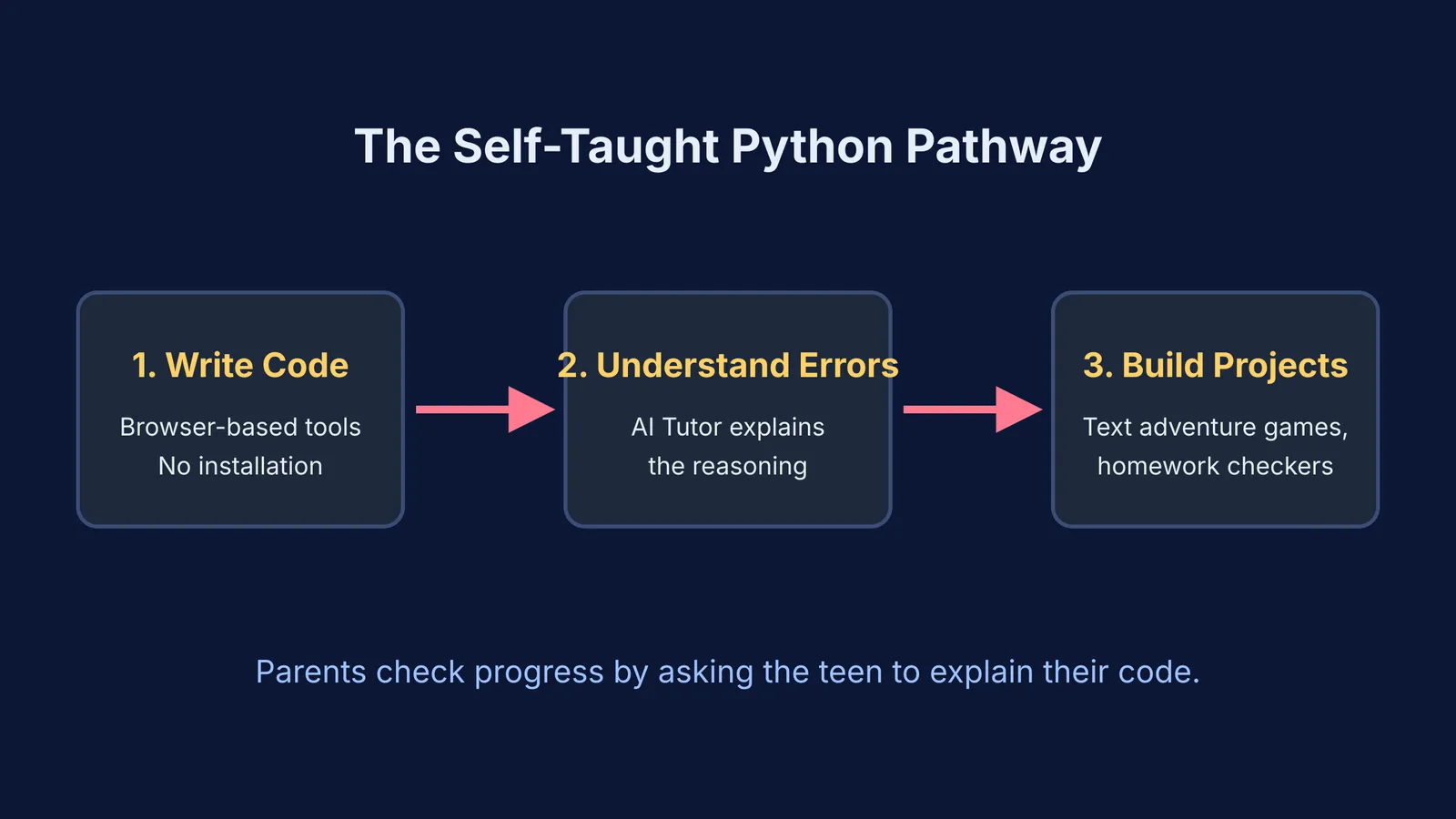
Browser-based editors: Platforms like Code.org offer a Python Lab where high school students can write and run real Python code directly in their browser.
Official tutorials: The Python Software Foundation provides a free, comprehensive tutorial on Python.org that covers everything from basic math to advanced data structures.
Concept mapping: Before writing code, it helps to understand the underlying logic. The Fermi Concept Library explains computing and mathematics concepts, each with its own lesson and its place in the broader subject map.
When self-teaching, hitting an error message can be frustrating. This is where an AI tutor makes a difference. Instead of pasting the error into a search engine and copying the answer, Fermi's AI tutor works out what they already know, builds a plan for the session, and teaches through it—checking understanding as it goes and explaining the reasoning rather than just printing an answer.
What are some project ideas to keep teenagers engaged?
Following tutorials gets boring quickly. Active learning through projects keeps teenagers motivated because they are building something they care about.
A text-based adventure game: Using simple `print()` and `input()` statements, they can write a story where the player's choices change the outcome. This teaches them conditional logic and how to store player state in variables.
A homework checker: A Python script that calculates the roots of a quadratic equation or checks the answers for a physics kinematics problem. It forces them to translate mathematical formulas into code.
Data analysis: If they love a particular sport, they can use Python to read a spreadsheet of player statistics and find out who the top scorer is. Modules like the `csv` library make it simple to handle real-world data.
A study timer: A script that uses the `time` module to run a 25-minute Pomodoro timer, alerting them when it is time to take a break. This gives them a practical utility they can use every day.
How can parents check teen programming progress?
You do not need to know how to code to support your teenager's learning. Here is a practical framework to check their progress without taking over:
Ask them to explain it to you: Programmers use a technique called "rubber duck debugging", where they explain their code line-by-line to an inanimate object to spot logical flaws. Let them explain their code to you. If they can describe what a function does in plain English, they understand it.
Focus on the output: Ask to see what the program does. Did the text adventure game run without crashing? Did the homework checker print the right number?
Celebrate the bugs: Tell them that error messages are normal. A screen full of red error text means the computer is giving them clues on how to fix the logic, not that they have failed.
Set a routine: Consistency matters more than marathon sessions. Coding for 30 minutes, three times a week, builds stronger mental models than trying to learn everything on a Sunday afternoon.
Programming is an exercise in persistence. By providing the right free tools and asking them to demonstrate their projects, you can help them build a skill that will serve them well in any scientific or technical career.


