

On this page
In Karnataka, the shift from 10th standard to the Pre-University Course (PUC) is the first time students choose a specialized academic path. For parents, understanding the subject combinations and how they tie into entrance exams like the Karnataka Common Entrance Test (KCET) and the National Eligibility cum Entrance Test (NEET) is essential for keeping the right doors open.
How the PUC Science stream works
The Karnataka PUC is a two-year program (1st PUC and 2nd PUC) that corresponds to Classes 11 and 12. In the Science stream, the curriculum requires students to take four core subjects alongside two languages.
English is mandatory, while the second language is usually Kannada, Hindi, or Sanskrit. The four core subjects determine which higher-education pathways a student can take. The transition from 10th standard science to 1st PUC involves a steep increase in depth and difficulty, especially in physics and chemistry.
Which subject combination should you choose?
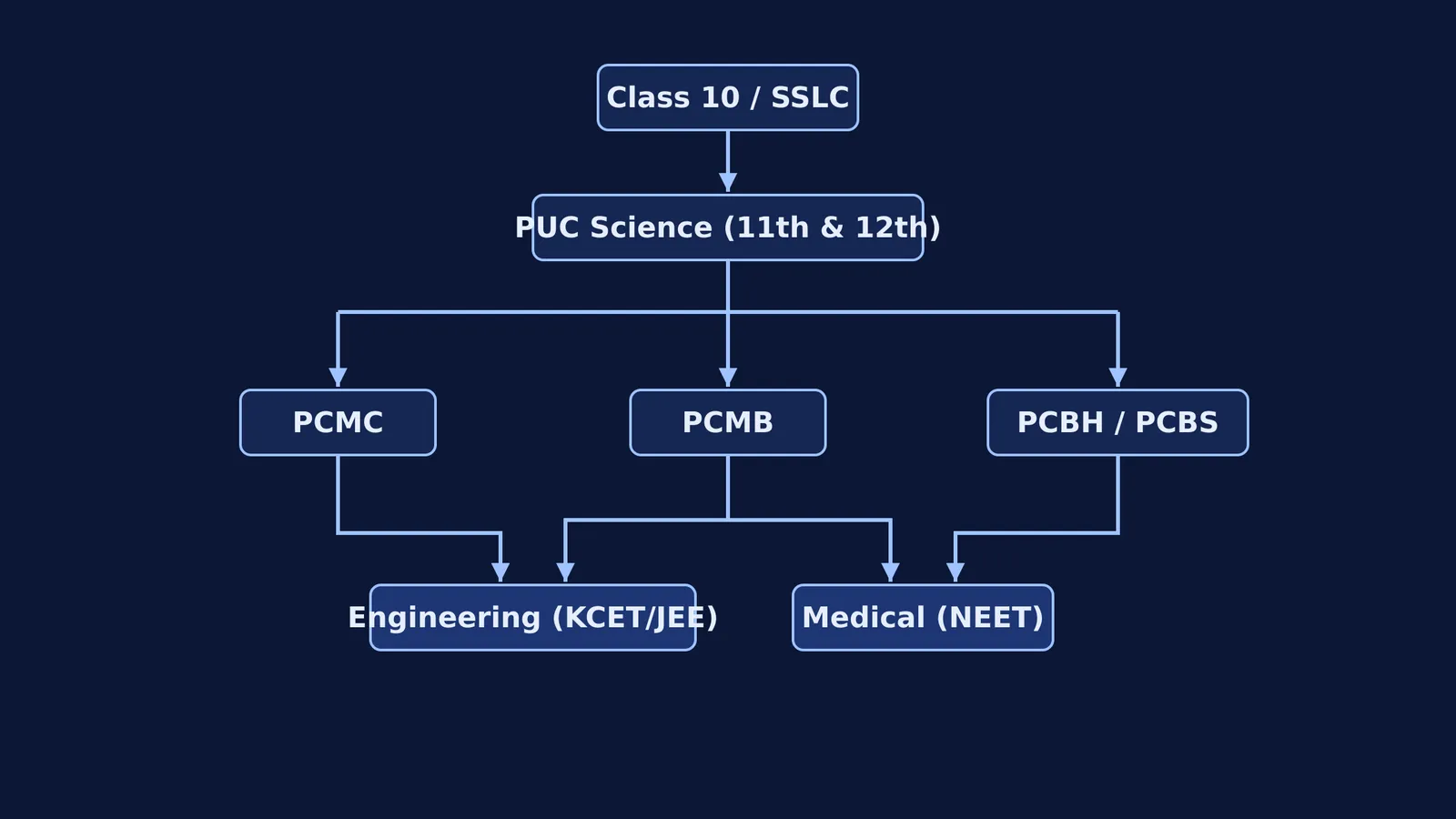
When applying for 1st PUC, students must select a four-subject block. The most common Science combinations are known by their acronyms:
PCMB (Physics, Chemistry, Mathematics, Biology): This is the most versatile option. It keeps the student eligible for both medical and engineering pathways. However, balancing the heavy syllabuses of both mathematics and biology is demanding, as they require very different study approaches.
PCMC (Physics, Chemistry, Mathematics, Computer Science): This is the standard route for students who are certain they want to pursue engineering, software, or IT.
PCME (Physics, Chemistry, Mathematics, Electronics): Similar to PCMC, this focuses on engineering, specifically electrical and electronics branches.
PCBH / PCBS (Physics, Chemistry, Biology, Home Science / Statistics): These combinations drop mathematics entirely, making them suitable for students entirely focused on medicine, nursing, or life sciences.
A checklist for parents before deciding:
Is the student aiming for a specific career, or do they want to keep their options open?
How did they perform in 10th standard Mathematics? (PCMB and PCMC require strong mathematical foundations).
Are they prepared for the heavy memory load of Biology alongside the problem-solving load of Physics and Mathematics?
What are the eligibility rules for KCET?
KCET is the state-level exam for engineering, agriculture, veterinary science, and pharmacy seats in Karnataka. The competition is intense, and the subjects you choose in 1st PUC dictate which exams you can take two years later.
To be eligible for a B.E. or B.Tech degree through KCET, a student must have studied Physics and Mathematics as compulsory subjects in PUC. A general category student needs a minimum aggregate of 45% in their core subjects, while the requirement for SC/ST/OBC categories is 40%.
For B.Sc. Agriculture or Veterinary Science, Mathematics is not strictly required, but Biology is mandatory. Therefore, a student with a PCMC combination cannot write KCET for an agricultural seat, while a PCMB student is eligible for both.
How does the new NMC rule change NEET eligibility?
NEET-UG is the sole entrance exam for MBBS, BDS, and AYUSH courses across India. Historically, students had to complete two continuous years of Physics, Chemistry, Biology, and English in Classes 11 and 12 to sit for NEET. This forced 10th standard students to make a hard choice between a math-heavy or biology-heavy track.
In late 2023, the National Medical Commission (NMC) relaxed these rules. Now, candidates who passed Class 12 with Physics, Chemistry, and Mathematics (PCM) can still appear for NEET-UG if they study Biology or Biotechnology as an additional subject later. This means a student who takes PCMC in 1st PUC and later changes their mind about engineering is no longer permanently locked out of medicine, provided they complete the additional biology requirement.
How can you support your child through 1st and 2nd PUC?
The workload in 1st PUC can be overwhelming, and a common problem is students hitting a plateau despite studying hard. If your child is struggling with the jump in difficulty, focusing on how to build a study routine that lasts is more effective than just adding more hours. A routine that balances school, extra classes, and self-study is essential for preventing burnout before the 2nd PUC board exams.
Often, students understand the theory but get stuck on numerical problems because they lack the underlying conceptual framework. This is where Fermi's AI tutor can help. Rather than just handing out the final answer, the tutor works out what the student already knows, builds a plan for the session, and teaches through the problem step-by-step. If there are broader gaps in their understanding, the Fermi Concept Library offers dedicated lessons for every concept in physics, chemistry, biology, and mathematics to help them catch up.
Whether they choose PCMB or PCMC, deciding between coaching, online classes, or self-study should depend on how the student learns best. For students aiming high in both KCET and NEET, understanding why JEE aspirants plateau can also provide valuable lessons on maintaining momentum across the two-year PUC journey.


