

On this page
An eight-year-old in Class 3 is at a developmental sweet spot. They are moving beyond concrete counting and beginning to understand planning and trade-offs. While it might seem too early to worry about financial literacy, giving them a small, regular allowance is one of the most effective ways to teach them the value of money.
Should a Class 3 child get pocket money?
Yes, and starting early is better than waiting until they are teenagers. A 2013 study by researchers at Cambridge University, commissioned by the UK Money Advice Service, found that the core "habits of mind" around money—like delayed gratification, self-regulation, and planning ahead—are largely formed by age seven. Giving an eight-year-old pocket money provides a practical arena to test these habits.
Furthermore, having open conversations about money at home matters significantly for their future capabilities. The OECD's PISA 2022 Financial Literacy assessment reported that 15-year-old students who regularly talk to their parents about money score 12 points higher on average than those who do not. Pocket money acts as a natural conversation starter for these discussions.
How much pocket money should an 8-year-old get?
Keep the amount small, but give it weekly. A month is simply too long for an eight-year-old to plan ahead, whereas a weekly schedule provides four distinct opportunities a month to practice budgeting and experience the consequences of their choices. An amount between ₹50 and ₹100 per week is a good starting point, though the exact amount matters far less than the consistency with which it is given.
Physical cash (such as ₹10 and ₹20 notes, or coins) is crucial at this stage. Young children are tactile learners. Having a physical representation of their money helps them actually see their savings stack grow or shrink. This makes the abstract concept of value much easier to grasp than a digital number on a screen or a parent's phone.
What are the best rules for saving and spending?
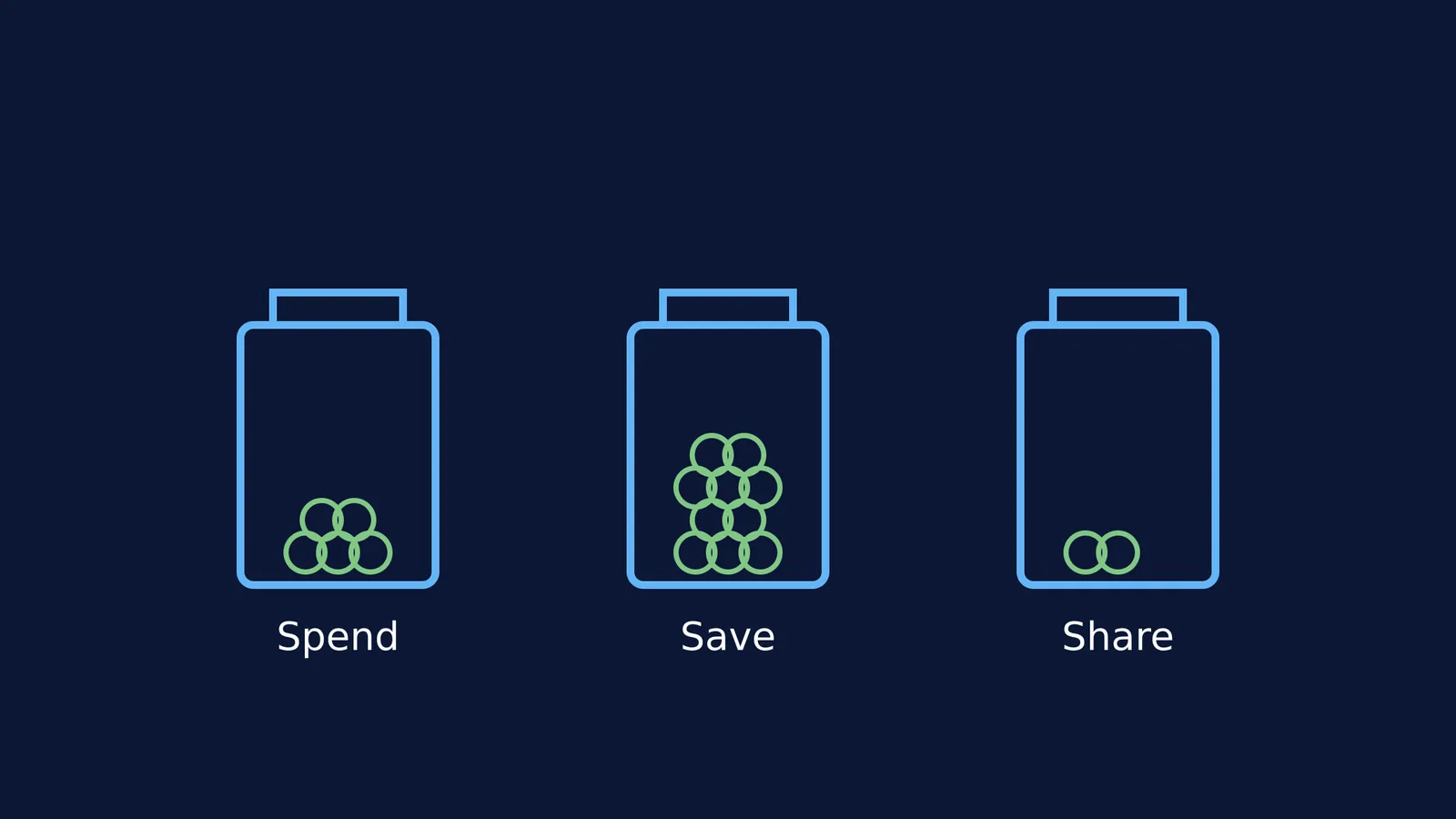
Instead of a single piggy bank where money disappears into a void, many financial educators recommend the three-jar method. Give your child three clear containers or envelopes:
Spend: For immediate, small treats like a chocolate, a packet of stickers, or a fancy pen.
Save: For a larger item, like a board game or a toy, that takes three or four weeks to afford.
Share: A small portion to give to charity, or to save up to buy a birthday gift for a sibling or friend.
This simple structure teaches them to allocate limited resources. For example, if they receive ₹60 a week, they might put ₹30 in Spend, ₹20 in Save, and ₹10 in Share. Over a month, they can watch their Save jar grow to ₹80.
If they spend all their "Spend" money by Tuesday and ask for more, stick firmly to the schedule. It is far better for them to make a ₹50 mistake now and feel the disappointment of missing out on a weekend treat, than to make a ₹50,000 credit card mistake as an adult. When they buy a cheap toy that breaks the very next day, they learn about quality versus price through their own experience, rather than through a parental lecture.
Connecting money to learning
When children start working out how many weeks it takes to save for a desired toy, or calculating how much change they should receive at the shop, they are doing real, practical mathematics. However, if they struggle with the basic arithmetic needed to count their coins or calculate their change, the process can become frustrating rather than empowering.
This is where the right educational support helps. If your child is stuck on the school maths behind addition, subtraction, or basic multiplication, Fermi's AI tutor can work out what they already know and build a plan for the session, teaching them through the problem rather than just giving the answer. For a clear explanation of arithmetic concepts, the Fermi Concept Library offers a lesson for every concept in mathematics, each with its place in the map.
By combining practical experience with strong foundational maths skills, you are setting them up for a lifetime of confident financial decisions. If you are looking to build other positive habits at home, you might find our guides on how to build a study routine that lasts and how parents can help children learn without adding pressure helpful.


