

On this page
Many parents who have asked a teenager to put the phone down have said it while holding their own. Research on screens at home now looks beyond the child's phone to the habits of the whole household.
Does my phone use affect my child's study habits?
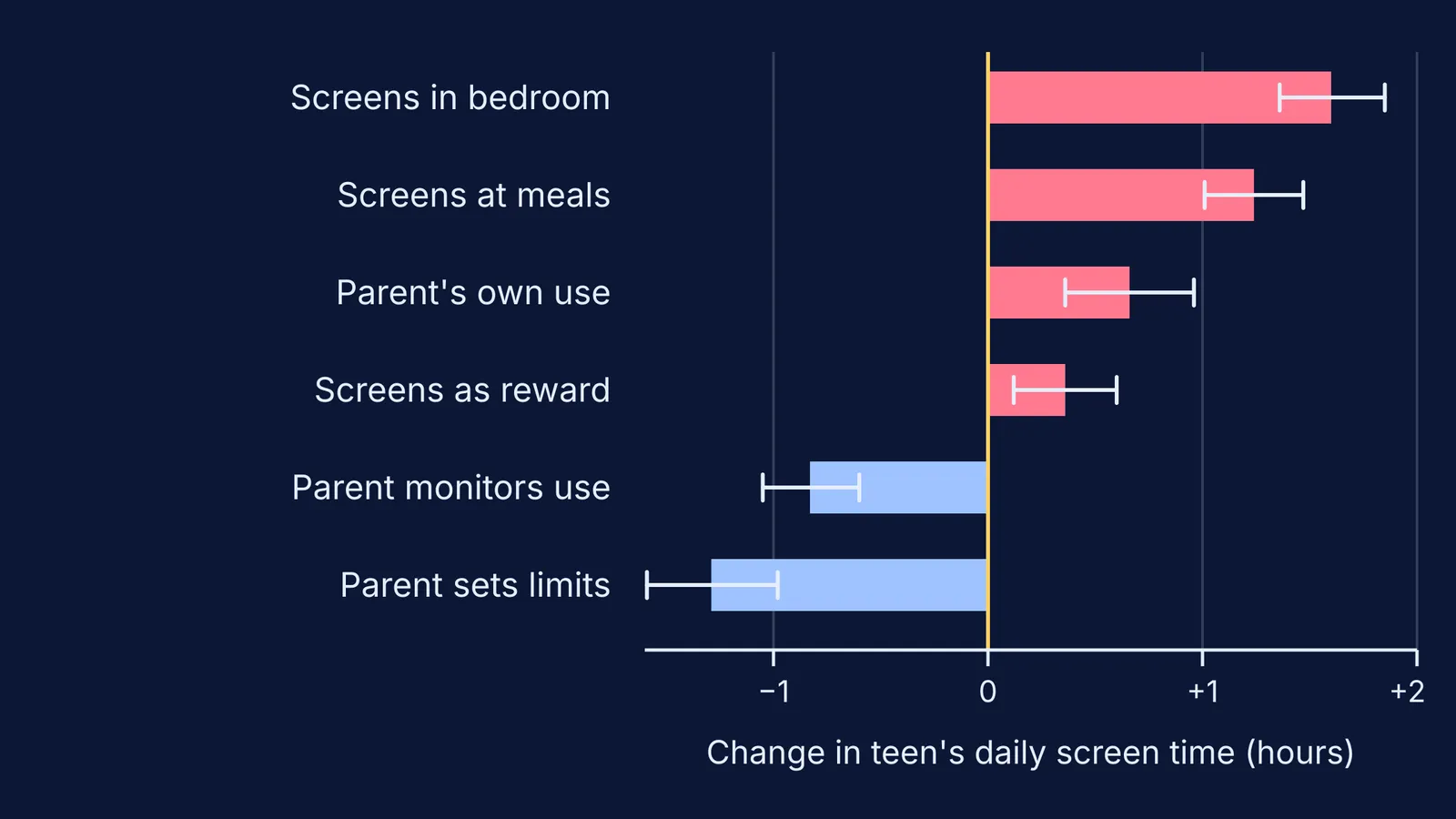
Some of the largest recent evidence comes from the US Adolescent Brain Cognitive Development (ABCD) Study. In a 2024 paper in Pediatric Research, Jason Nagata and colleagues studied 10,048 adolescents aged 12 to 13, asking parents about six household screen habits. It measured screen time, not homework or grades.
The full results give each habit a number. For every step up a four-point agree–disagree scale, a teen's daily recreational screen time changed by:
1.60 hours more for screens in the child's bed or bedroom at night
1.24 hours more for screens at family meals
0.66 hours more for parents using screens while with their child
0.36 hours more for using screens as a reward or punishment
0.83 hours less for parents keeping track of screen time
1.29 hours less for parents setting limits
The teens reported an average of 8.67 hours of recreational screen time a day. A 2026 follow-up in Acta Paediatrica of 7,947 of the same adolescents found the pattern held a year later: parents' own screen use and mealtime screens predicted more teen screen time, while monitoring and limits predicted less.
Two honest caveats: these are US families, and the studies show links, not proof that a parent's phone causes a child's habits. But these are household habits, so they are yours to change too. In a UCSF news release, Nagata, a paediatrician at UCSF Benioff Children's Hospitals, advised parents to "avoid screens in bedrooms and at mealtimes. Also, try to practice what you preach."
Can a phone nearby distract from homework?
Phones can pull attention even when they belong to someone else. Across OECD countries, 59% of 15-year-olds said other students' phones, tablets or laptops diverted their attention in at least some maths lessons, and students distracted by peers' devices scored significantly lower in maths, according to the OECD's summary of PISA 2022.
UNESCO's 2023 Global Education Monitoring Report cites a meta-analysis of students in 14 countries that found a small negative effect of phone use on education outcomes, and a larger one at university. These findings come from schools, not homes, but a parent answering WhatsApp beside the homework table may be a similar pull.
Why should phones charge outside the bedroom?
A meta-analysis in JAMA Pediatrics pooled 20 studies covering 125,198 children with an average age of 14.5. Using a media device at bedtime was linked to more than twice the odds of not getting enough sleep (odds ratio 2.17). Just having access to a device at night, without using it, was also linked to inadequate sleep (odds ratio 1.79).
In a Pediatrics study of 2,048 fourth- and seventh-graders, children who slept near a small screen such as a phone reported 20.6 fewer minutes of weekday sleep than those who never did.
A two-week phone plan for the whole family
Start with the changes that touch study most directly, and make each one a rule for adults too.
Phone-free homework hour. Pick the hour your child usually studies, say 7 to 8 pm. Every phone in the house, yours included, goes into one basket. If work means you must stay reachable, keep calls on and silence everything else.
One charging spot outside bedrooms. A shelf in the hall or kitchen. Phones dock there by a fixed time, such as 10 pm, and stay till morning. If the objection is "I need it as an alarm", a basic alarm clock solves it.
No phones at dinner. It is the easiest of these for parents to go first.
Agree the rules together. The 2024 paper's authors note that a family media plan may work better when parents and children agree the rules. Stick three rules on the fridge.
Keep phones out of rewards and punishments. Using screens to control behaviour was linked to more screen time, not less.
Review on day 14. Ask each person, adults included, what was hard, and keep what worked.
To keep notifications quiet on your teen's own phone, set up Focus mode on a teen's phone. For television in a board year, see whether to stop TV during board exams. If the bigger worry is motivation, read why a Class 9 child may not seem serious about studies.
If your child often stalls at the start of the hour, Fermi's AI tutor can work out what they already know and build a plan for the session, so they begin with a clear next step.
If phone use comes with low mood, worry or sleep trouble that doesn't lift, talk to your family doctor or call Tele MANAS, the government's free mental health helpline, on 14416. Tonight, put your own phone in the basket first.


