On this page
Most parents only interact with their child's teacher when something goes wrong: a dropped test score, an incomplete notebook, or a disciplinary complaint. In many Indian schools and coaching centres, these interactions are compressed into brief slots during crowded parent-teacher meetings or typed hastily into class messaging groups. Over an academic year, this crisis-driven pattern turns communication adversarial, leaving teachers defensive and parents frustrated.
Treating the relationship as an active, year-round partnership shifts this dynamic. When parents and teachers collaborate with mutual respect, students gain a coherent support system between home and school. Building that alliance does not require elaborate gifts or constant check-ins; it grows from small, consistent habits that establish predictability, dignity, and shared goals.
Why does trust between parents and teachers matter so much?
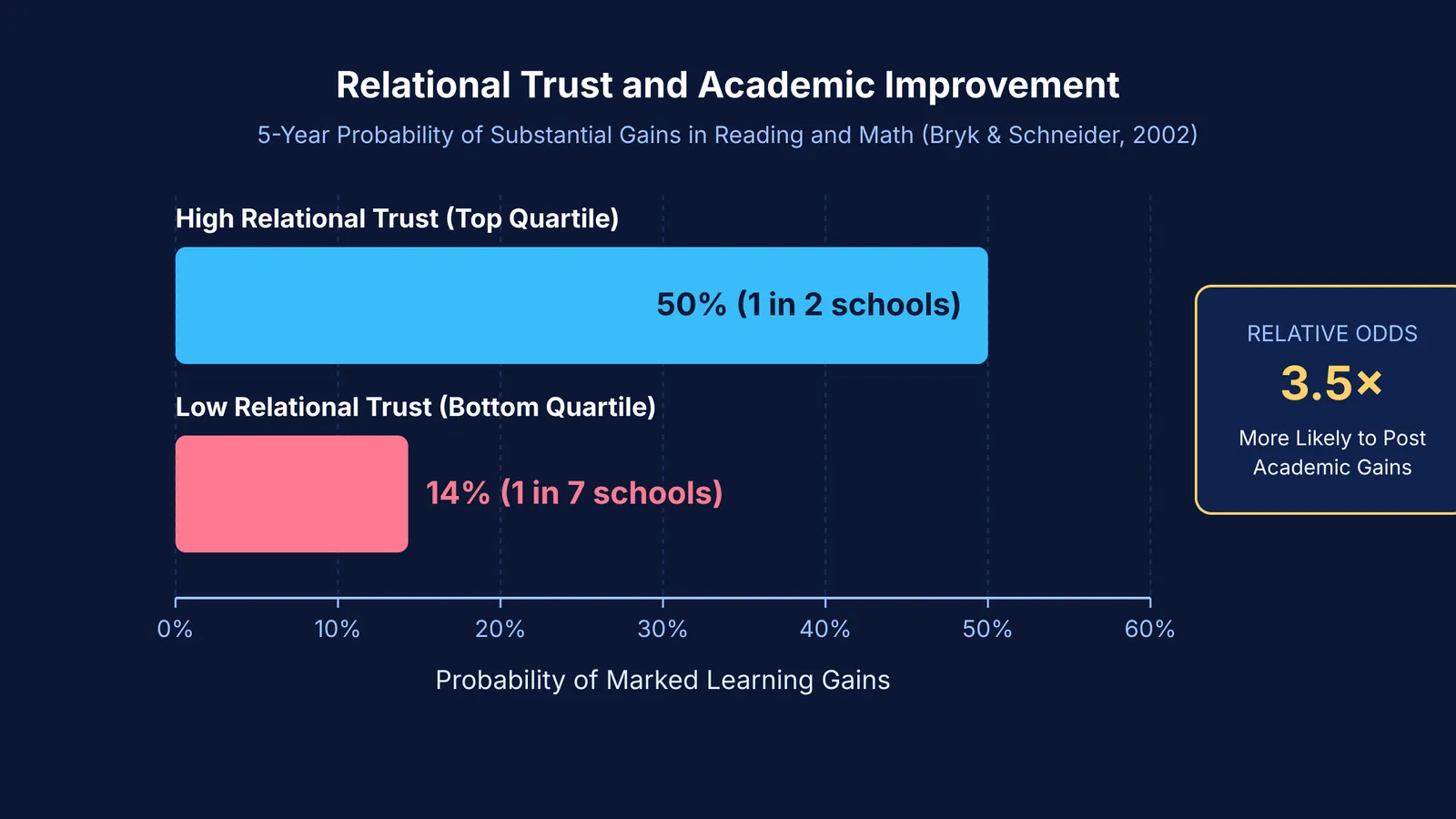
Trust is not just a pleasant social atmosphere; it directly influences classroom achievement. In their 10-year study of 400 Chicago elementary schools, researchers Anthony Bryk and Barbara Schneider discovered that schools with high levels of relational trust were three times more likely to show marked improvements in reading and mathematics than schools with low trust (Trust in Schools). Relational trust acts as the social connective tissue that allows academic standards to take root.
In the *Review of Educational Research*, researchers Megan Tschannen-Moran and Wayne K. Hoy identified five foundational facets of trust in schools: benevolence, reliability, competence, honesty, and openness. In parent-teacher partnerships, benevolence is the cornerstone. When a teacher knows that a parent assumes positive intentions, conversations about weak areas shift from assigning blame to designing solutions.
That partnership yields measurable behavioral benefits. A randomized field experiment conducted by Matthew A. Kraft and Shaun M. Dougherty in the *Journal of Research on Educational Effectiveness* found that frequent, constructive teacher-family communication increased the odds of students completing homework by 40% and reduced instances where teachers had to redirect student attention by 25%. When home and school speak the same language, children waste less energy testing boundaries and focus more on learning. Knowing how parents can help children learn without adding pressure starts with making the teacher an ally in that effort.
How do small daily habits build trust with teachers?
Grand gestures on Teacher's Day do far less to build rapport than three everyday habits practiced across the term:
Send specific, timely notes of thanks. According to the OECD's *TALIS 2018 Results*, addressing parent concerns is cited as a significant workplace stressor by 44% of female teachers and 35% of male teachers across dozens of education systems. Because most messages educators receive are complaints, a short note recognizing an engaging science demonstration or patience with a difficult algebra concept stands out. Be specific: naming the exact topic or encouraging remark your child shared at home proves you notice their dedication.
Respect schedules and meeting limits. Punctuality signals respect for an educator's constrained time. Arrive early for scheduled conferences with written questions rather than improvising on the spot. Arriving prepared with thoughtful parent-teacher meeting questions that lead to real follow-up shows you value their professional insight.
Observe professional communication boundaries. Unless an emergency occurs, avoid sending late-night text messages or weekend inquiries about routine homework. Sticking to official school communication channels during working hours protects a teacher's restorative personal time.
Why should you always raise concerns privately?
When an issue occurs—whether an unexpected grade penalty, missing homework marks, or a social dispute—the instinct of many parents is to vent immediately in informal parent WhatsApp groups or confront the teacher at the school gate. Public complaints force educators into defensive reputation management. They erode mutual goodwill and expose your child to unnecessary peer scrutiny.
Raising concerns privately in a scheduled one-on-one meeting or a direct, polite email preserves the teacher's professional dignity. In an intervention study published in the *Economics of Education Review*, researchers Matthew A. Kraft and Todd Rogers found that targeted, improvement-oriented communication produced an 8.8 percentage point increase in students earning course credit, cutting course failures by 41%. Private conversations allow both sides to focus squarely on improvement rather than public defense.
When reviewing marks, pairing private inquiry with reading a report card beyond the marks helps you ask about diagnostic skill gaps rather than arguing over individual percentages.
What should you say to a teacher when an issue arises?
To keep discussions constructive when a disagreement occurs, use a three-step framework:
State your observation neutrally: Begin with an objective fact rather than an interpretation or accusation.
Ask for their context: Acknowledge that the classroom environment provides information you cannot see from home.
Propose a joint experiment: Agree on a concrete habit to test over the coming weeks.
Here is how that shift sounds in practice:
Avoid: "Why did you fail my son on this physics assignment? He worked all evening on it."
Try: "Rohan found the derivations on Monday's physics assignment challenging and felt discouraged by his score. Could you clarify where his method broke down so we can reinforce that specific concept at home?"
When stubborn homework problems create friction at home before you can speak with an educator, the Fermi Problem Library offers worked problems with a step-by-step solver that explains the reasoning rather than printing an answer, helping your child identify where their steps failed.
Approaching your child's teacher as a partner transforms school from a test of endurance into a team effort that supports your child for years to come.