On this page
Class 9 is when many families first argue about olympiads: do they build real thinking, or do school marks come first? You can manage both if you choose carefully and plan the week.
Should a Class 9 student focus on olympiads or school studies?
It depends on the olympiad.
The National Standard Examination in Junior Science (NSEJS) is pitched at roughly the CBSE Class 10 science level, with equal weight on biology, chemistry and physics, according to the IAPT 2026-27 student brochure. For a Class 9 student, much of NSEJS preparation is school science taken a little deeper and a year early, so it tends to support your school science too.
The maths olympiad is different. The IOQM 2026 official page says mathematical olympiads "reward out-of-the-box thinking and the ability to reason logically rather than extensive mathematical knowledge", and draws on number theory, geometry, algebra and combinatorics. Much of that sits outside the textbook, so IOQM practice is extra time on top of school work.
So school marks are the floor, one well-chosen olympiad is usually affordable, and two is the limit for most Class 9 students.
Which olympiads can you take in Class 9?
Two routes into the national olympiad programme are open in Class 9. Dates are from the 2026-27 cycle: the 2026 IOQM is over and NSEJS enrolment has closed, so preparation you start now counts toward next year's papers.
IOQM (maths): open to students in Classes 8 to 12 within the age limits on the IOQM page. The 2026 paper was held on 6 September 2026. HBCSE lists RMO on 15 November 2026 and INMO on 17 January 2027 as later stages.
NSEJS (junior science): run by IAPT, held on 22 November 2026, for students born between 1 January 2012 and 31 December 2013, per the IAPT brochure. The paper has 48 single-answer questions (with a one-mark penalty for a wrong answer) and 12 multiple-answer questions. Enrolment ran from 21 August to 14 September 2026, usually through your school.
Senior NSEs (physics, chemistry, biology, astronomy): not for Class 9. HBCSE's eligibility page says you must be in Class 10, 11 or 12.
A simple way to choose:
You enjoy puzzles and get stuck on maths problems for fun: IOQM.
You like all three sciences: NSEJS, which also helps school science.
Strong at both and school marks are comfortable: both, but only one gets weekday time.
School marks are slipping: one olympiad, or none this year. Class 10 has another chance.
How many hours a week should olympiad prep take?
A simple plan: about two-thirds of study time for school, one-third for the olympiad, decided in advance so it doesn't depend on mood.
Method matters as much as hours. A review of 10 learning techniques by Dunlosky and colleagues rated practice testing and distributed practice (spreading study over time) as the two with high utility, and rereading and highlighting as low. So olympiad time should be short, spread-out problem sessions and past papers, not reading. HBCSE's past papers page has past IOQM papers with answer keys, and junior science olympiad (INJSO, the stage after NSEJS) papers with model solutions.
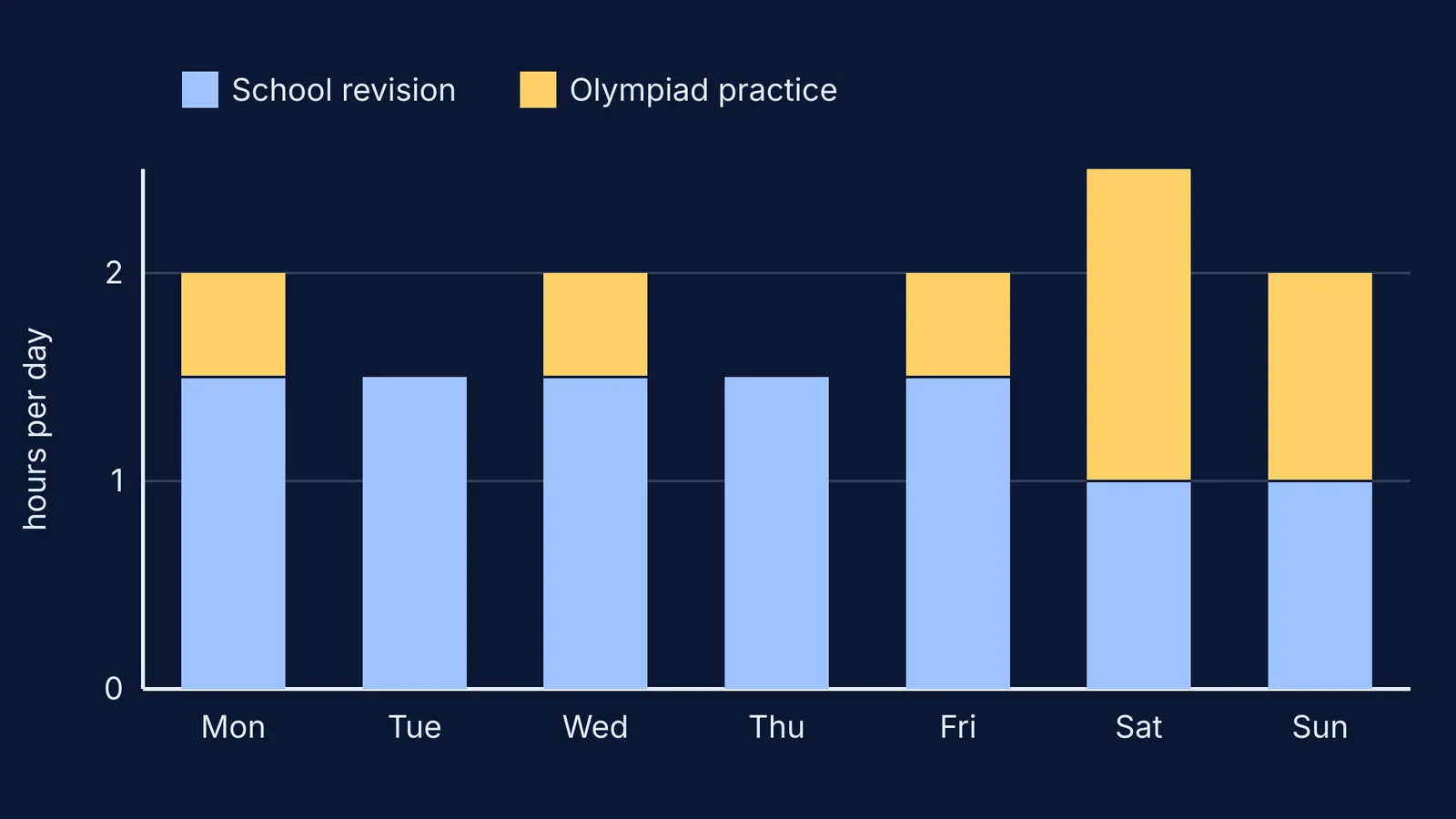
A sample week (the chart above):
Monday, Wednesday, Friday: 90 minutes school (homework, then recall), 30 minutes olympiad problems.
Tuesday, Thursday: 90 minutes school only.
Saturday: 60 minutes school, 90 minutes on one timed past paper or problem set.
Sunday: 60 minutes of weekly school recall, 60 minutes retrying the week's olympiad mistakes. The rest is free.
That comes to 9.5 hours of school revision and 4 hours of olympiad work, so olympiad time is just under a third of the week. In school exam weeks, cut olympiad time to one 20-minute set on alternate days, then return to the plan.
Keep sleep fixed. The American Academy of Sleep Medicine consensus says teenagers aged 13 to 18 should sleep 8 to 10 hours per 24 hours on a regular basis. Late-night olympiad sessions that cut into sleep are a poor trade.
When a past-paper solution makes no sense, the Fermi Problem Library has worked problems with a step-by-step solver that explains the reasoning rather than printing an answer.
What should parents say about olympiads?
Aim for a calm agreement, not a lecture:
"Which one olympiad sounds most fun to you, and why?"
"Let's decide the weekly hours together now, so we don't argue about it every night."
"Your school marks are the base. If they drop for a month, we pause the olympiad, not stop it."
Review the plan monthly, not after every test. If stress shows up as lost sleep, low mood or dread before school, talk to the class teacher or school counsellor; you can also call Tele MANAS, the government's free mental health helpline, on 14416 (telemanas.mohfw.gov.in).
If you are not sure where to begin on a weak topic, Fermi's AI tutor can work out what you already know and build a plan for the session.
Pick your one or two olympiads, and write the week's hours on paper before Monday.