

On this page
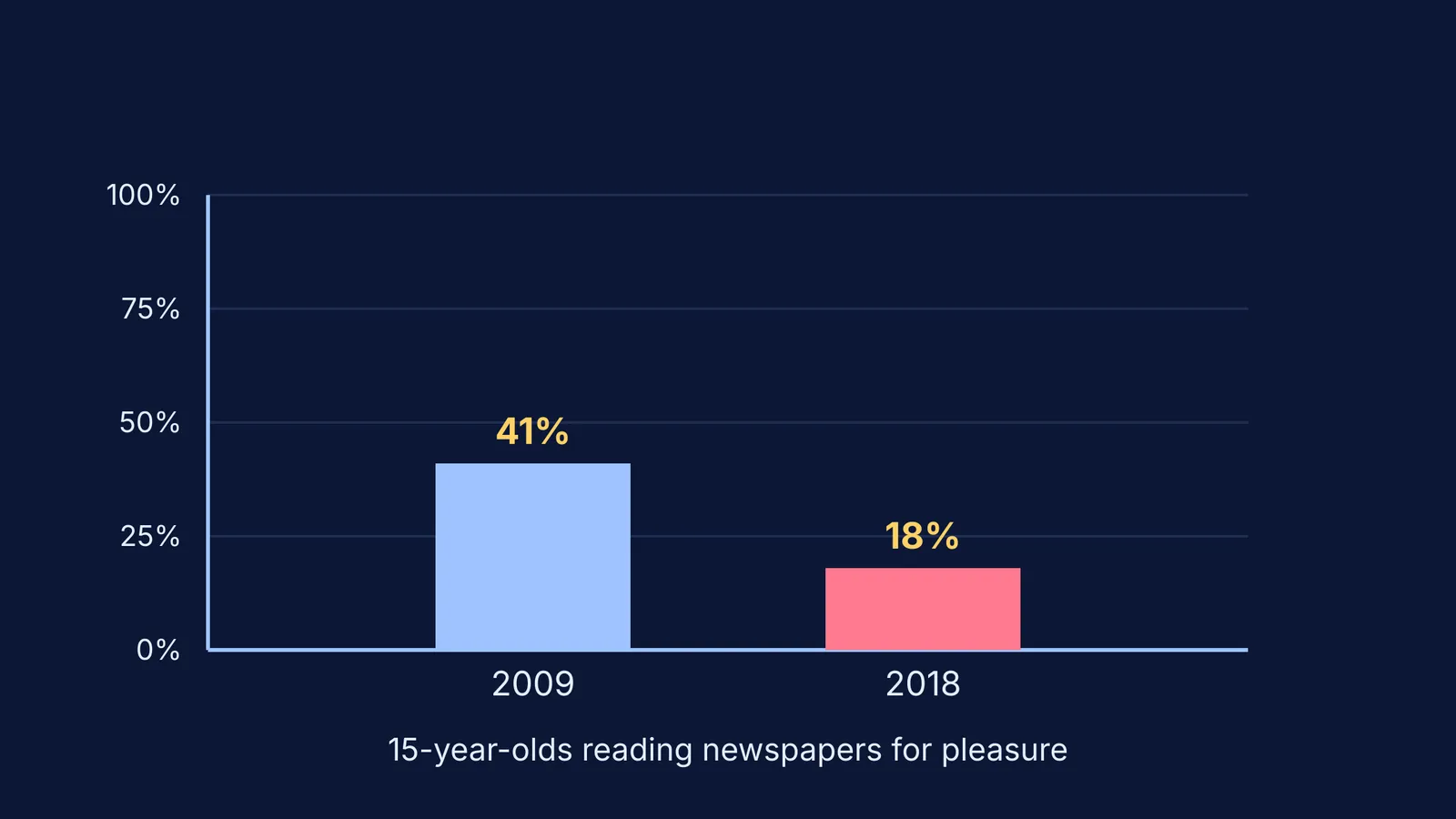
In Class 6, around the age of 11, the academic demands placed on a student begin to change. They are no longer just "learning to read"; they are expected to "read to learn". However, voluntary reading habits are changing rapidly. According to the OECD's 2018 PISA assessment, only 18% of 15-year-olds across OECD countries reported reading newspapers for pleasure several times a month. This is a massive collapse from the 41% who did so in 2009.
While digital media and video content have largely replaced print, actively reading news articles remains one of the most effective ways to build a student's cognitive stamina. When children read fiction, they follow a narrative arc that naturally pulls them along. Informational texts, like news reports, require a different type of reading strategy. Students must learn to extract the "who, what, where, when, and why" efficiently, which is exactly the skill tested in reading comprehension exams. Setting up a structured, brief daily reading habit at home can give your child an enormous advantage in their later school years.
Should my class 6 child read newspaper?
Yes, they absolutely should. The primary academic benefit of reading the news is exposure to "tier-two" vocabulary. These are high-utility, cross-disciplinary academic words like *analyse*, *consequence*, *emerge*, *significant*, and *negotiate*. A Class 6 student will rarely hear these words in casual conversation or encounter them in dialogue-heavy fiction, but they are essential for answering long-form questions in science and humanities subjects.
Newspapers provide these complex words in their natural, "living" context. When an 11-year-old reads about a "negotiation" during a trade dispute or the "consequences" of an unusual climate event, they learn to parse meaning from the surrounding sentences. Seeing these words applied in real-world scenarios makes them far easier to remember and use in their own school essays.
Which newspaper sections are best for Class 6?
You do not need to drop a thick broadsheet on the breakfast table and ask your child to read it cover to cover. In fact, starting with the front page is often a mistake. Front pages are dominated by high-stakes politics, complex economic policies, and crime, which can be overwhelming or simply boring to a younger reader.
Instead, introduce them to the sections that naturally align with their interests. The science, technology, and sports pages are excellent entry points. These articles tend to have clearer narratives, feature exciting discoveries, and use precise, descriptive language. If a science story about a new satellite orbit or a synthetic material sparks a question you cannot answer, the Fermi Concept Library can explain the physics and chemistry behind the headlines. Focusing on these specific sections ensures the reading experience remains positive and intellectually stimulating.
How to talk about the news with an 11-year-old?
Discussing current events requires a careful balance of honesty and reassurance. At 11 years old, children are transitioning into formal operational thinking. They can understand abstract concepts and systemic issues, but they still lack the broad adult context needed to weigh risks accurately.
The American Academy of Pediatrics (AAP) advises parents to actively filter and frame the news for their children. Instead of exposing young children to repetitive, graphic images on television or social media, they suggest sharing only the basic facts.
You can also reassure them by pointing out the "helpers" in any negative news story. By explaining that authorities are taking action, parents help shift the child's focus away from the disaster itself and towards human resilience and problem-solving, which greatly reduces anxiety.
How to build a 15-minute news routine?
To build a sustainable habit, try a 15-minute "one story a day" method rather than an open-ended reading session. Sit down with your child and let them pick the article. This taps into the principles of autonomy-supportive parenting, making them far more likely to engage with the text because they chose it themselves.
Read the article together, either silently or taking turns reading paragraphs aloud. Once they finish reading, ask them three simple, open-ended questions:
What happened in this story?
Why does this event matter?
What do you think about it?
These questions encourage critical thinking without feeling like a test. By keeping the discussion brief and focused on their personal opinions, you help children learn without pressure. Over time, this 15-minute daily habit transitions reading the news from a required chore into a genuine act of reading for pleasure, equipping them with the vocabulary and global awareness they need to succeed.


