

On this page
When students study alone in their rooms, they often hit a wall on a tough problem and switch to watching videos instead. A study circle in your housing society or apartment building changes that dynamic. By rotating the hosting duties among a few families, you create a dedicated time for active learning while sharing the load.
Why start a study group for kids in your society?
Peer learning forces students to articulate what they know. When one student explains a concept to another, they must organise their thoughts and identify their own knowledge gaps. This active engagement yields real results. A study published in Advances in Physiology Education found that moving from traditional study to peer-led collaborative learning improved mean course scores from 76% to 89%.
Working alongside peers also creates natural accountability. Children are less likely to procrastinate when they have committed to solving a mock test or a problem set with their neighbours every Thursday evening. It also builds the crucial habit of learning by teaching.
How to structure a weekly study circle?
Finding the right mix of students is the first step. Look for neighbours who are preparing for similar milestones—for instance, three students in Class 11 starting their JEE Main prep, or a few Class 10 students aiming for the board exams.
A practical framework for your circle:
Rotate the venue: Each family hosts once a month, which means no single parent is overwhelmed. The host parent provides a quiet space, a large table, and light snacks, just as you might set up for a family quiet hour.
Set a clear agenda: Do not leave the two hours open-ended. Ask the students to agree on a goal beforehand, such as "Solve 30 kinematics problems" or "Review the carbon compounds chapter". A concrete goal prevents the session from turning into a purely social hangout.
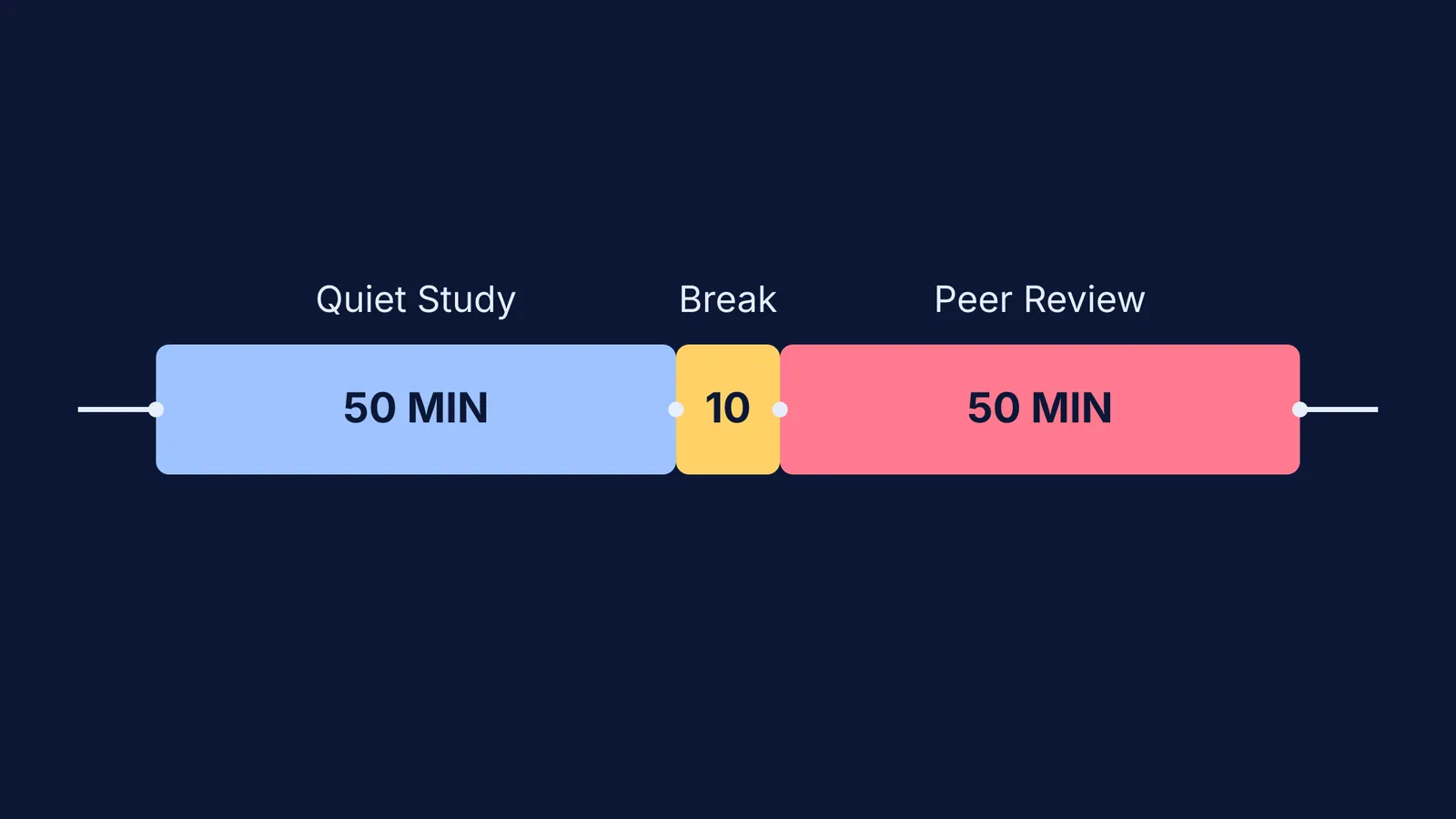
Use the 50/10 rule: Study quietly for 50 minutes, take a 10-minute break for snacks and chat, then do another 50 minutes of collaborative review where they check each other's work.
How to handle different learning speeds in the group?
One common concern for parents is that the children might have different aptitudes or be at different points in the syllabus. This is actually a feature, not a bug, of peer learning.
When a student who is slightly ahead explains a concept to a peer, they solidify their own understanding and practice translating complex ideas into plain language. The student receiving the help benefits from an explanation delivered in the relatable language of a peer, rather than the formal language of a textbook. To keep this dynamic healthy, ensure the group rotates roles. The student who is strong in biology can lead the discussion on cell structures, while another who excels at maths can take the lead on calculus word problems.
What are the ground rules for parent hosts?
The parent's job is to facilitate, not to teach. If you try to teach the subject, the children will wait for you to feed them the answers instead of wrestling with the material themselves.
The parent host checklist:
Remove distractions: Collect all phones in a basket at the door. If they need a device for online resources, ensure it is a laptop or tablet set strictly to study tools.
Provide the board: Put a whiteboard or a few large sheets of paper on the wall. Students think better when they can stand up and draw out a problem together.
Intervene only on process: If the group gets stuck or starts arguing, do not solve the physics problem for them. Ask process questions like, "What is the first principle here?" or "Where did you get stuck?"
How can an AI tutor support the group?
Even the best peer groups sometimes reach a complete standstill where nobody knows the next step. This is where an AI tutor acts as a safety net, preventing frustration from derailing the session.
If the group is stuck on a complex physics numerical, they can turn to the Fermi Problem Library. Instead of printing the final answer and ending the discussion, Fermi's AI tutor explains the reasoning step-by-step. It holds the line of reasoning across the session, noticing where the students are stuck, and decides whether to explain or ask a guiding question.
For ideas that are hard to picture, like rotational mechanics or magnetic fields, the group can open the Fermi Simulation Lab. Running an interactive simulation together gives them a shared visual reference, sparking better peer discussions and deeper understanding.
By combining the social accountability of a neighbourhood group with the targeted help of an AI tutor, you can build a sustainable, effective study routine for your children.


