

On this page
You do not need a national park to do field science. The lane outside your building has trees changing through the year, insects at work on a flowerpot, a shadow that swings round a lamp post, and a sky that looks different every afternoon. Your child needs a notebook, a pencil, a one-metre stick and about 45 minutes. The part that makes it science comes at the end: turning one thing they noticed into a question they can test.
Why take a science walk in the city?
A 2019 integrative review by Ming Kuo, Michael Barnes and Catherine Jordan in Frontiers in Psychology concluded that "in academic contexts, nature-based instruction outperforms traditional instruction", and that nature may help learning by improving attention, stress levels, self-discipline and interest. The same review counts over fifty studies pointing to nature's role in developing pro-environmental behaviour. The experiences it covers range from wilderness trips to plants in a preschool, not one-off neighbourhood walks, so treat the walk as a habit, not a one-off.
A walk also trains the first step of science: noticing carefully enough to ask a good question. For more on that, see our guide to encouraging curiosity by asking questions instead of just answering them.
What should kids look for on a nature walk?
Give the walk four stops, each with a few lines in the notebook.
Leaves. Choose one tree you pass every day. Note whether it has new leaves, old leaves, flowers or fruit, and sketch one leaf. SeasonWatch, a Nature Conservation Foundation project, invites schools and individuals in India to record exactly this, because "trees tell the tale of changing seasons through their leaves, flowers and fruits."
Insects. Stand still for two minutes beside one plant and note what lands, crawls or flies past, and what it was doing (feeding, carrying, resting).
Shadows. Stand the stick upright on flat ground, mark the tip of its shadow with chalk, measure the length and write down the time.
Clouds. Sketch the sky and describe it in your own words. The WMO International Cloud Atlas sorts every cloud into one of ten main groups called genera, such as cumulus, stratus and cirrus.
How do you set up a nature notebook?
Keep every entry the same shape so walks can be compared. At the top: date, time, place and weather. Then three headings:
I notice: what you saw, heard or measured, with numbers where you can.
I wonder: any question at all, even a silly one.
I could test: filled in only for the one question you choose.
Parents, your job is mostly to ask. Three prompts cover most walks: "What do you notice?", "What do you think would happen if…?" and "How could we find out?" Resist giving the answer, even when you know it.
How do you turn one observation into a question?
Most "I wonder" questions start with "why", and those are hard to test on a pavement. Rewrite them as "what happens to one thing when another changes". A worked example from the shadow stop:
Notice: "At 4 pm the stick's shadow was longer than my arm."
Wonder: "Why do shadows change?"
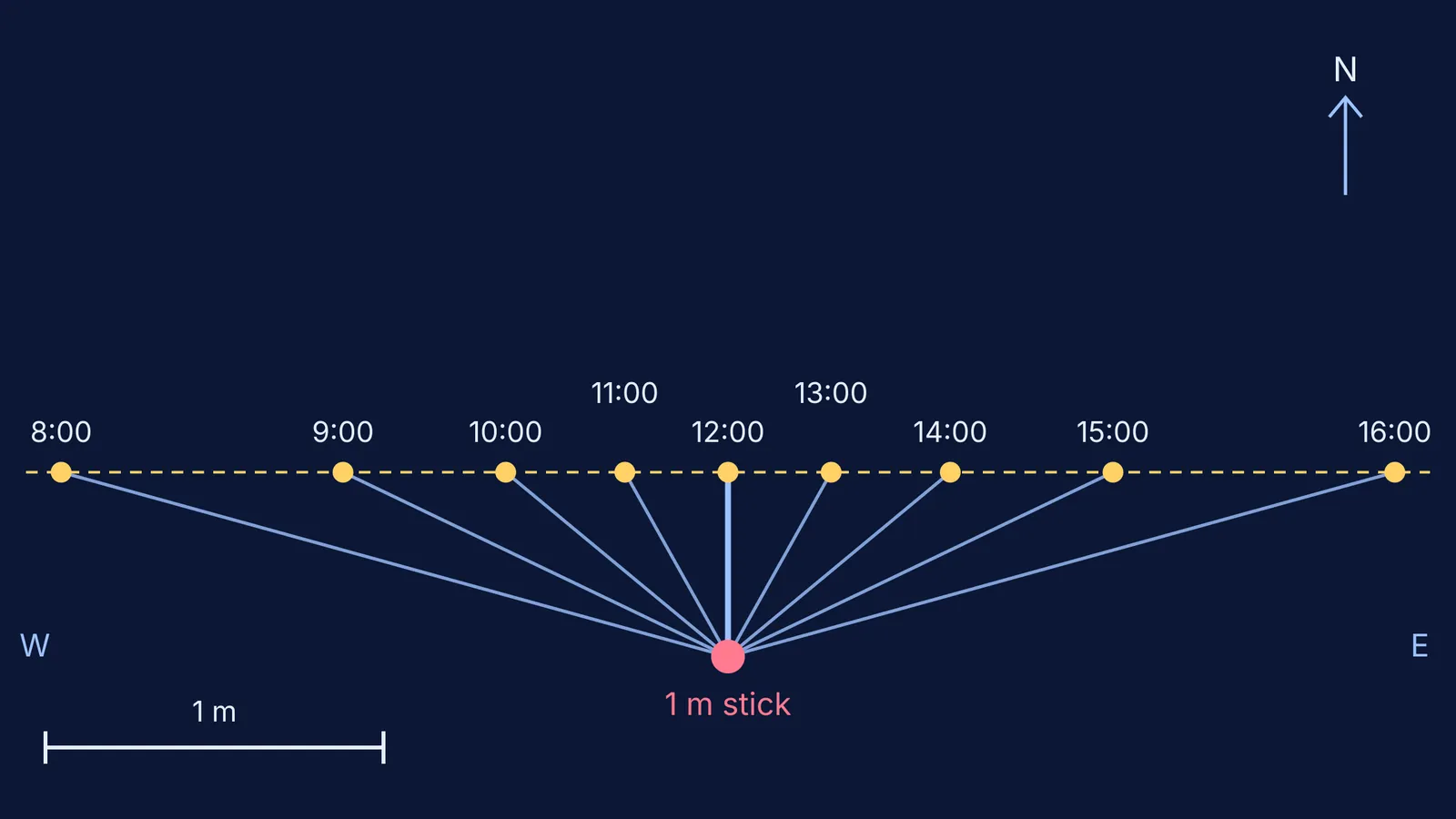
Make it testable: "How do the length and direction of the shadow change between 9 am and 4 pm?" One thing changes (time); two are measured (length and direction).
Predict: write a guess first, such as "shortest at lunchtime."
Check: on a Sunday, mark the shadow tip every hour and measure each one.
The diagram at the top shows what we calculated for a one-metre stick in Delhi on the March equinox: the noon shadow is about 55 cm and points due north, the 9 am shadow (local solar time) is about 1.26 m and points west-north-west, and the tips fall on a straight east-west line. Your child's numbers will differ with date and city, which is a new question in itself. In India south of 23.5 degrees latitude, the Astronomical Society of India explains, the noon Sun is exactly overhead twice a year and a vertical stick casts no shadow: Zero Shadow Day.
The same steps work at the other stops. "Do more ants visit the sunny pot or the shady one in ten minutes?" is a testable insect question. "Does our tree have more new leaves in April than in October?" turns one sketch into a project across months.
What comes after the walk?
Back home, let your child explain their test to someone who was not there. If the shadow question leads to why the Sun's path changes through the year, the Fermi Simulation Lab has interactive simulations for ideas that are easier to see than to read. On rainy days, try these five safe kitchen science experiments, or take the notebook on a science museum or planetarium visit.
Pick your tree this week, and take the same walk again in a month.


