

On this page
When a child moves from a small school—where every teacher knows their name and the building is familiar—to a sprawling secondary school campus, the change in scale can be overwhelming. The physical environment is larger, the academic expectations are different, and the social landscape is vastly more complex. If your child comes home exhausted and overwhelmed during the first few weeks, it is a normal reaction to this transition.
Helping them adjust requires more than just asking how their day went. It involves giving them practical tools to navigate the space, build a predictable routine, and establish social anchors.
Why do children moving to a big school feel lost?
The sense of feeling lost is both physical and emotional. In a small school, a student’s day is highly structured, and they often stay with the same group of peers for most subjects. A large school introduces moving between classes, managing a locker or multiple bags, and interacting with a much wider age range of students in shared spaces like cafeterias and hallways.
This shift can leave students feeling disconnected. According to the OECD's PISA 2018 report, 16% of 15-year-old students across member countries reported feeling like an outsider or left out at school. When students feel like they do not belong, their academic engagement and mental well-being often decline.
If your child is also managing academic pressure, such as balancing Class 12 board exams with JEE preparation in a highly competitive environment, the added stress of a new, impersonal school can easily compound their anxiety. They need structured support to regain their footing.
How to help your child map out their new routine?
The first step to feeling at home in a large building is knowing where things are and what to expect. Predictability reduces anxiety and helps students feel in control of their day. Here is a framework to help them build their routine:
Map the physical space: Before the term gets too busy, walk the school grounds with your child if the school allows it. Trace the route from the entrance to their main classrooms, the cafeteria, and the bathrooms. Having a physical map in their planner or phone gives them a fallback if they forget the layout during the rush between classes.
Rehearse the daily routine: Walk through a typical day step by step. Discuss when they will pack their bag, what time they need to leave the house, and how they will manage their homework when they return. A consistent home routine provides a stable foundation when the school day feels chaotic.
Set a study schedule: A new school often brings a heavier workload. Help them draft a school holiday study plan or a weekly evening schedule that leaves room to rest.
Fill the concept gaps: Larger schools often follow a different syllabus sequence, which can leave a transfer student feeling behind. If they are overwhelmed by catching up, the Fermi Concept Library has a lesson for every concept in physics, chemistry, biology, mathematics and computing, allowing them to fill gaps at their own pace.
Why is finding one friend so important?
Parents often worry about their child finding a "group" of friends or fitting in with the popular crowd, but research shows that a single strong connection is often enough to anchor a student in a new environment.
A study of 593 UK children published in the British Journal of Educational Psychology found that keeping the same best friend across the transition to secondary school is linked to higher academic attainment and lower levels of conduct problems. Furthermore, the 2017 Gallup Student Poll of nearly 800,000 students found that 70% of students strongly agreed they have a best friend at school, making it the highest driver of student engagement.
One friend provides a reason to show up, someone to sit with at lunch, and a peer to ask for advice when they are confused about a class assignment. Encourage your child to focus on finding one person they connect with, perhaps through a shared interest, a school club, or a study group, rather than worrying about broad popularity.
How long does school transition adjustment take?
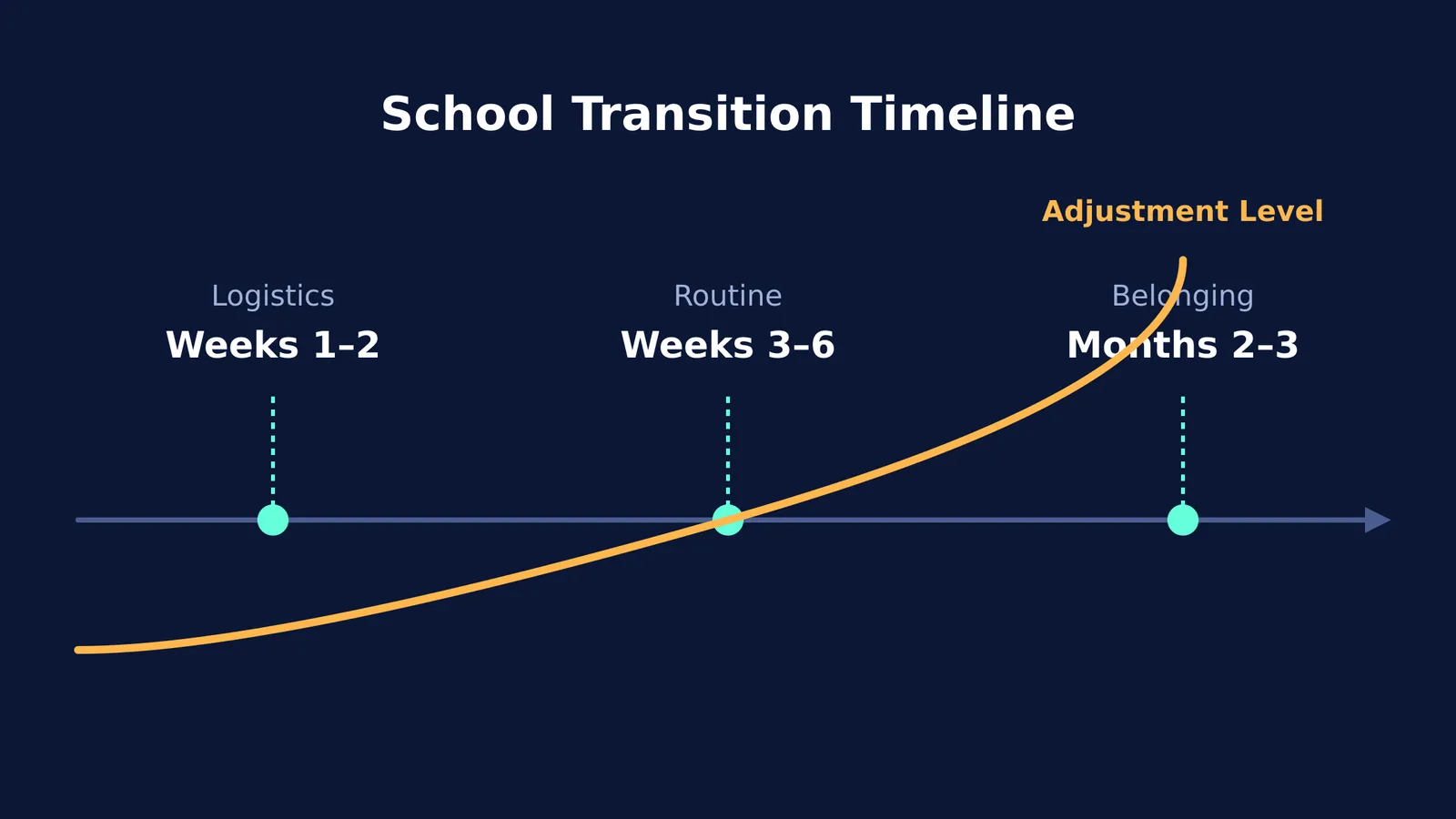
Adjustment is not immediate, and expecting a child to settle in within a week sets them up for failure. The transition generally follows a timeline:
Weeks 1–2 (Logistics): The focus is purely on surviving the schedule, finding classrooms, and learning the rules. High fatigue and irritability after school are common.
Weeks 3–6 (Routine): The daily rhythm becomes familiar. The student starts to recognize faces, navigate the hallways without a map, and identify safe adults, like a supportive teacher or counselor.
Months 2–3 (Belonging): True emotional adjustment—feeling like an "insider" rather than a visitor—often takes a full academic term.
Be patient during this period. Offer a listening ear without immediately trying to "fix" every social complaint. If your child's distress persists well beyond the first term, or if they show signs of severe withdrawal, it may be worth seeking professional support or contacting an official helpline like Tele MANAS (14416). You can also learn more about exam stress in teenagers and when to get help.
By focusing on the basics—a physical map, a steady routine, and the search for just one friend—you can help your child shrink a large school down to a manageable size.


