On this page
If you belong to a minority community in India, the Ministry of Minority Affairs offers financial support to help keep your child in school and fund their higher education. These schemes are divided into Pre-Matric and Post-Matric scholarships, depending on the student's current class.
Navigating the rules can be confusing, especially since the government updated the class eligibility in the 2022-2023 academic year. Here is a clear overview of who qualifies and what you need to apply.
What are the minority scholarships for school students?
The Government of India provides these scholarships to students from six notified minority communities: Muslim, Christian, Sikh, Buddhist, Jain and Parsi (Zoroastrian). The primary goal is to reduce dropout rates and support families with the everyday costs of education, including admission fees, tuition fees and a daily maintenance allowance.
This financial backing ensures that students from minority backgrounds have equal access to quality education, reducing the economic pressure on their families. The maintenance allowance, which varies for day scholars and hostellers, helps cover daily expenses like books and transport.
The schemes are split into two main age groups:
Pre-Matric Scholarship: This now covers students studying in Classes 9 and 10.
Post-Matric Scholarship: This covers Class 11, Class 12, and extends to undergraduate and postgraduate degrees.
Students cannot hold this scholarship alongside any other government scholarship. Generally, only two students from the same family can receive the funding at the same time.
Who is eligible for the Pre-Matric Scholarship?
The Pre-Matric Scholarship is designed to support students during the final, often most critical, years of secondary school. To qualify, a student must meet three main conditions:
They must be enrolled in Class 9 or Class 10.
They must have secured at least 50% marks in their previous final examination.
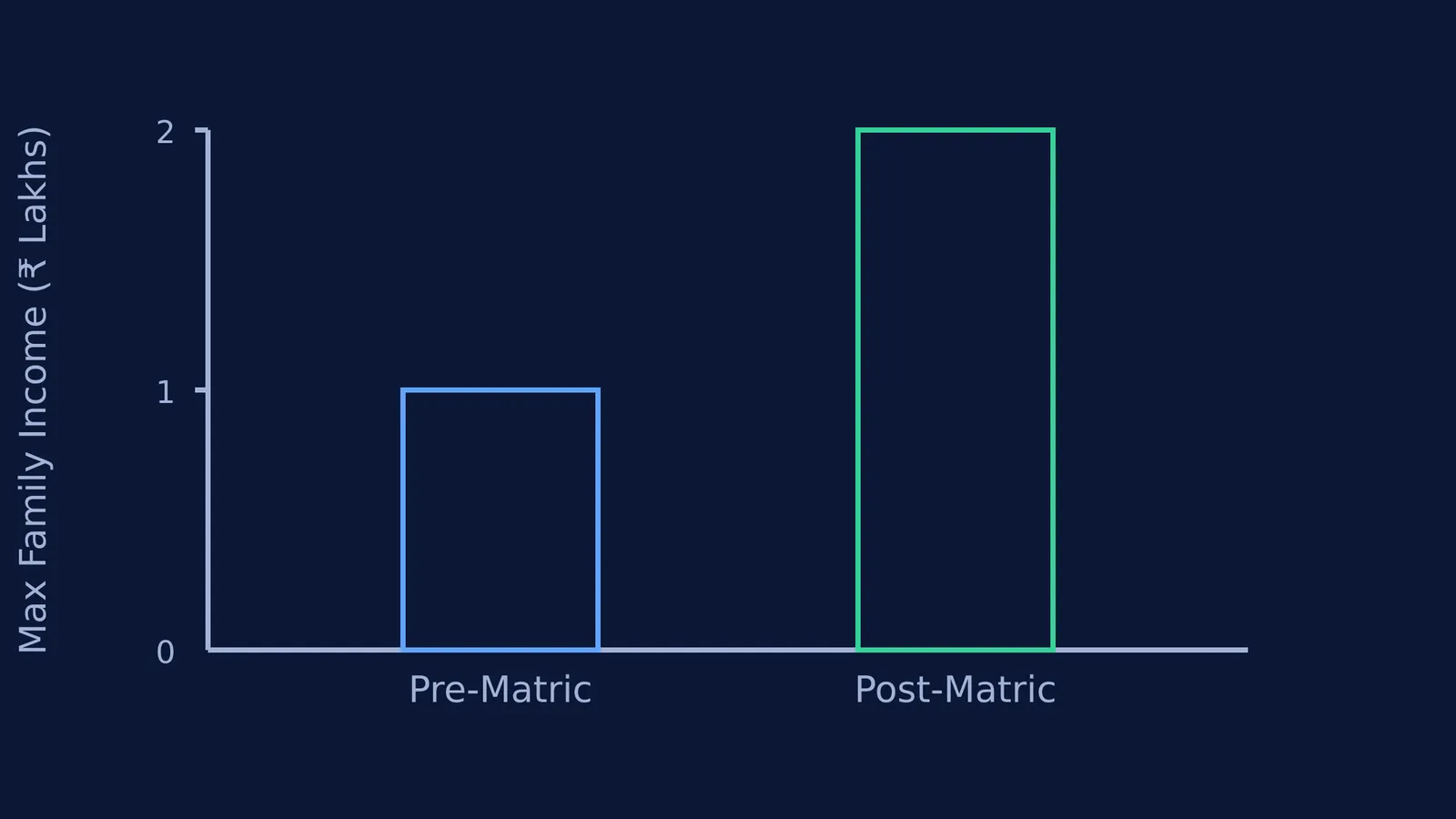
Their annual family income from all sources must not exceed ₹1 Lakh.
Before the 2022-2023 academic year, the Pre-Matric scheme also covered Classes 1 to 8. The government discontinued the scholarship for these earlier years because elementary education is already provided free of cost under the Right to Education (RTE) Act. Under the RTE Act, students in Classes 1 to 8 already receive free education, uniforms and mid-day meals. The ministry stated that this change aligns the minority scholarship with similar welfare schemes for other categories, ensuring resources are directed where they are needed most.
Who is eligible for the Post-Matric Scholarship?
The Post-Matric Scholarship supports students who have successfully completed Class 10 and wish to continue their education in higher secondary school or university. The academic requirement remains identical: the student must have scored at least 50% in their previous final exam.
However, because higher education is inherently more expensive, the financial threshold is slightly higher. For the Post-Matric scheme, the annual family income from all sources must not exceed ₹2 Lakh.
If your child has concept gaps in science or maths, Fermi's AI tutor can work out what they already know and build a plan for the session, so they sit down to a clear next step. When they are stuck on a specific homework question, the Fermi Problem Library has worked problems with a step-by-step solver that explains the reasoning.
How can families apply for minority scholarships?
All applications are processed centrally through the National Scholarship Portal (NSP). Starting from the 2024-2025 cycle, the government introduced a One-Time Registration (OTR) system to make future renewals easier and reduce paperwork.
Application Checklist To ensure your application is processed smoothly, gather these documents before you open the portal:
One-Time Registration (OTR): Complete this on the NSP to generate your student's unique ID. This is a new requirement meant to simplify tracking across multiple academic years.
Academic records: A self-attested copy of the previous year's marksheet, showing the required 50% score.
Financial proof: An official income certificate issued by your state or union territory's designated authority. This must clearly state that the family income is below the ₹1 Lakh or ₹2 Lakh threshold.
Community proof: A self-declaration of belonging to a minority community.
School documents: A fee receipt for the current course year and a bonafide student certificate from the institution to prove current enrolment.
Identification: The student's photograph, domicile certificate, and details of an Aadhaar-linked bank account where the funds will be deposited directly via Direct Benefit Transfer (DBT).
The application window typically opens in July. Deadlines usually fall in mid-November for Pre-Matric and late November or December for Post-Matric schemes, though families should always check the official NSP website for the exact dates.
Supporting your child through school involves both financial planning and academic encouragement. Whether they are tackling dispersion of white light by a glass prism in physics or naming carbon compounds in chemistry, the combination of a government scholarship and focused study tools can give them the foundation they need to succeed in their board exams and beyond.