On this page
Why teach Roman numerals to a Class 4 child?
Why do primary schools still teach Roman numerals when the Hindu-Arabic system (1, 2, 3) is far more efficient? For a Class 4 student, learning Roman numerals is fundamentally an exercise in mental arithmetic and mathematical logic. When a child sees that 9 is written as IX (10 minus 1) and 11 is written as XI (10 plus 1), they actively practice mental subtraction and addition with every number they read.
Studying an additive numeral system also helps children appreciate the elegance of modern arithmetic. The Roman system has no symbol for zero and no place value; each symbol represents a fixed value regardless of its position. Trying to add or multiply large numbers without zero illustrates why modern mathematics relies on place value.
What are the rules of Roman numerals for Class 4?
The CBSE Class 4 Mathematics syllabus expects children to read and write Roman numerals up to 100. Students only need five of the seven traditional symbols: I (1), V (5), X (10), L (50) and C (100). The symbols D (500) and M (1000) are reserved for higher classes.
Instead of memorising a long conversion chart, children only need three consistent rules:
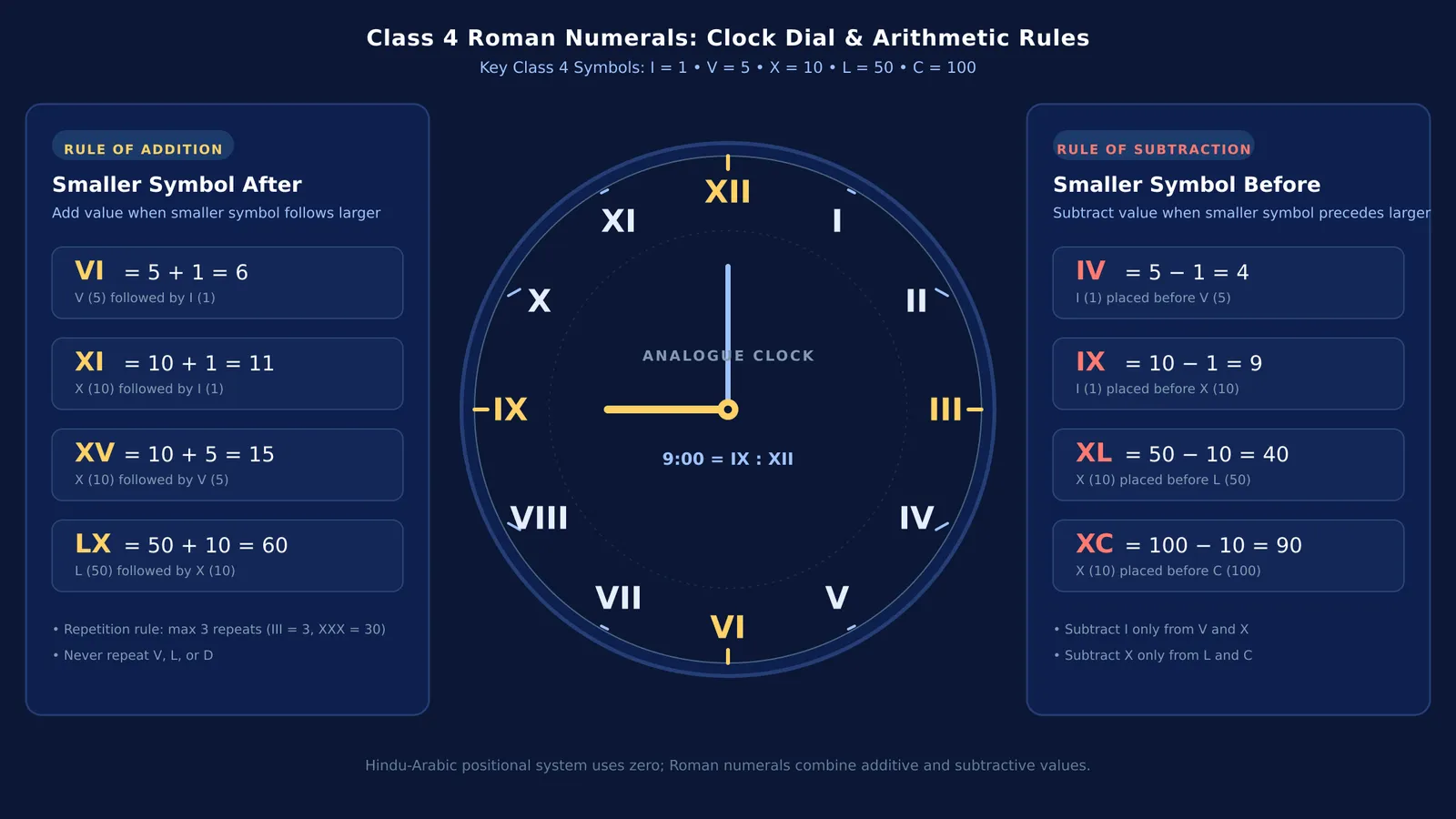
The rule of repetition: Repeating a symbol up to three times adds its value (such as III for 3 or XXX for 30). The symbols V, L and D are never repeated.
The rule of addition: Placing a smaller symbol after a larger symbol adds its value. For example, VI is 5 + 1 = 6, and LX is 50 + 10 = 60.
The rule of subtraction: Placing a smaller symbol before a larger symbol subtracts its value. For example, IV is 5 − 1 = 4, and XC is 100 − 10 = 90.
To keep subtraction manageable, two strict conventions apply: I can only be subtracted from V and X, and X can only be subtracted from L and C.
What hands-on activities help children learn Roman numerals?
Rote drills often make these guidelines feel arbitrary. A 2025 study of 55 fourth-graders found that active, visual instruction significantly improved learning outcomes; students using animated visual media achieved a mean post-test score of 84.8%, while the control group taught using conventional lecture methods averaged 73.3%. Visual and tactile activities help children internalize the system faster:
Build numbers with matchsticks: Roman numerals were carved into stone monuments, which is why every symbol consists of straight strokes. Give your child a handful of toothpicks or flat wooden craft sticks. Constructing V with two sticks joined at the base and X with two crossed sticks transforms an abstract rule into a tangible puzzle.
Craft a paper plate clock: Analogue clock faces remain the most visible everyday application of Roman numerals. Have your child write numerals I through XII around the rim of a paper plate and fasten two card-stock hands with a split pin. Call out times like 4:00 or 9:00 for them to set. Note that many traditional clocks display IIII instead of IV for aesthetic symmetry, which makes an engaging puzzle for discussing the subtraction rule.
Run a chapter treasure hunt: Once a child masters numbers up to 12 on a clock, look for Roman numerals in everyday media. Check chapter headings in classic books, monuments, or the Roman copyright year in film credits.
How do you help a child avoid common Roman numeral mistakes?
The most common trap for fourth-graders is attempting illegal subtractions, such as writing IL for 49 instead of XLIX. Remind your child to break composite numbers into tens and ones first: 49 is 40 + 9, which translates to XL (40) plus IX (9).
Another frequent point of confusion is subtraction ordering. If your child struggles with the logic of subtraction, the Fermi Concept Library has every concept in physics, chemistry, biology, mathematics and computing, each with its own lesson and its place in the map. For more focused practice, the Fermi Problem Library has worked problems with a step-by-step solver that explains the reasoning rather than printing an answer.
For more ways to build number confidence at home, see our guide on maths talk with young children and what to do when your child says they are bad at maths.