

On this page
Makar Sankranti brings roofs and parks alive with brightly coloured kites, fighting the breeze for altitude. Beyond the cultural celebration and the friendly aerial duels, a kite on a string is a perfect, self-contained laboratory. It turns invisible concepts into something a child can feel pulling at their fingertips.
Here is how you can use the Makar Sankranti tradition to talk about the science of flight, complete with the fundamental forces and a practical building challenge.
What keeps a kite in the air?
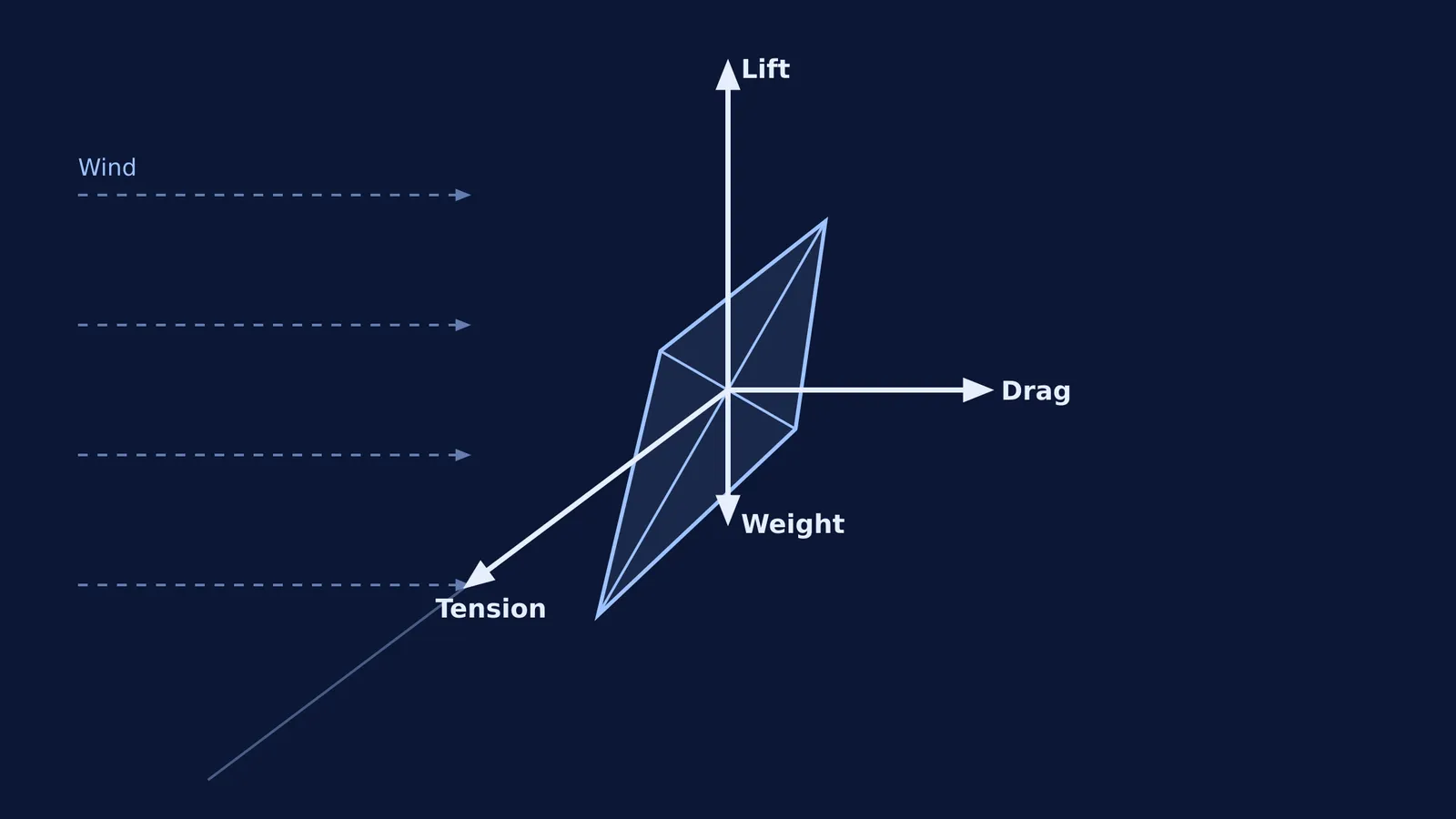
A kite flying steadily in the sky is in a state of equilibrium. For it to hover without falling or flying away, four fundamental forces must balance perfectly:
Lift: The upward force generated by the wind moving over the kite. According to NASA's Beginner's Guide to Aerodynamics, the lift L is calculated as L = C_l × A × (ρ × v²) / 2, where v is the wind velocity and ρ is the air density.
Gravity (Weight): The downward pull of the Earth.
Drag: The horizontal air resistance pushing the kite back in the direction of the wind.
Tension: The pull of the string acting as an anchor.
Unlike an aeroplane, which uses an engine for forward thrust to create airflow, a kite relies on the tension of your string. When you pull the string, you hold the kite against the wind. This creates relative airspeed, generating the lift needed to counteract gravity. If you want to dive deeper into how strings transfer force, our guide on simple pendulum string tension explores the maths.
How does the angle of attack create lift?
The way a kite is tilted into the wind is called the *angle of attack*. This angle is controlled by the bridle—the loop of string connecting the kite's frame to your main flying line.
When the kite leans back against the wind, it deflects the incoming air downwards. By Newton's third law of motion, every action has an equal and opposite reaction: pushing the air down pushes the kite up. Simultaneously, the air moving over the top of the angled kite travels faster, creating a zone of lower pressure. This pressure difference, known as Bernoulli's principle, "sucks" the kite upward.
If the angle is too steep, the air becomes turbulent, creating massive drag and causing a stall. If it is too shallow, the kite generates insufficient lift. At sea level, air density is approximately 1.229 kg/m³; a kite's lift coefficient can be computed using aerodynamic models published by NASA, which adjust for its geometry and angle of attack.
How do you balance the forces of flight?
When your child holds the string, they are actively solving equilibrium equations. The string pulls downwards and forwards. We can split this tension into two components:
Vertical tension (T_v) pulls down.
Horizontal tension (T_h) pulls into the wind.
For steady flight, the vertical forces must cancel out (Lift = Weight + T_v), and the horizontal forces must balance (Drag = T_h). If your child is studying mechanics and wants to calculate the exact tension on the string, Fermi's AI tutor can draw the force diagrams and hold a line of reasoning across a session to help them work it out. If they are curious about how pulling a string rotates an object, they can look at our breakdown of a spool pulled by its string.
How do you build a simple sled kite?
Instead of just buying a kite, build a simple sled kite to turn the festival into an active experiment. Sled kites do not need rigid cross-sticks, making them robust for beginners.
What you need:
A large plastic dustbin liner
Two straight sticks or wooden dowels (about 60 cm long)
Sticky tape
A ball of strong string
Ribbon or old cloth for a tail
The method:
Cut the plastic bag into a large pentagon or "sled" shape (a rectangle with an isosceles triangle at the top).
Tape the two dowels vertically along the sides of the rectangle to form the frame.
Punch a hole in each of the two top corners.
Tie a loop of string (the bridle) connecting the two holes.
Tie your main flying string to the exact centre of the bridle loop.
The test: Once the kite is flying, experiment with the tail. A tail does not provide lift; it provides *drag* at the base of the kite, which acts like an anchor to keep the nose pointed into the wind.
Test 1: Fly the kite with no tail. Note how it spins or loops.
Test 2: Add a 1-metre tail. Does the spinning stop?
Test 3: Add a 3-metre tail. Is the kite more stable, or does the extra weight drag it down?
By adjusting the tail, your child is directly manipulating the drag and weight variables to achieve the perfect flight.


