

On this page
Your child writes a perfect 4, then a 3 that faces the wrong way, then a backwards 7. If they are in LKG, UKG or Class 1, this is one of the most common things a young writer does, and the pattern behind it is predictable.
Is it normal for a 5-year-old to write numbers backwards?
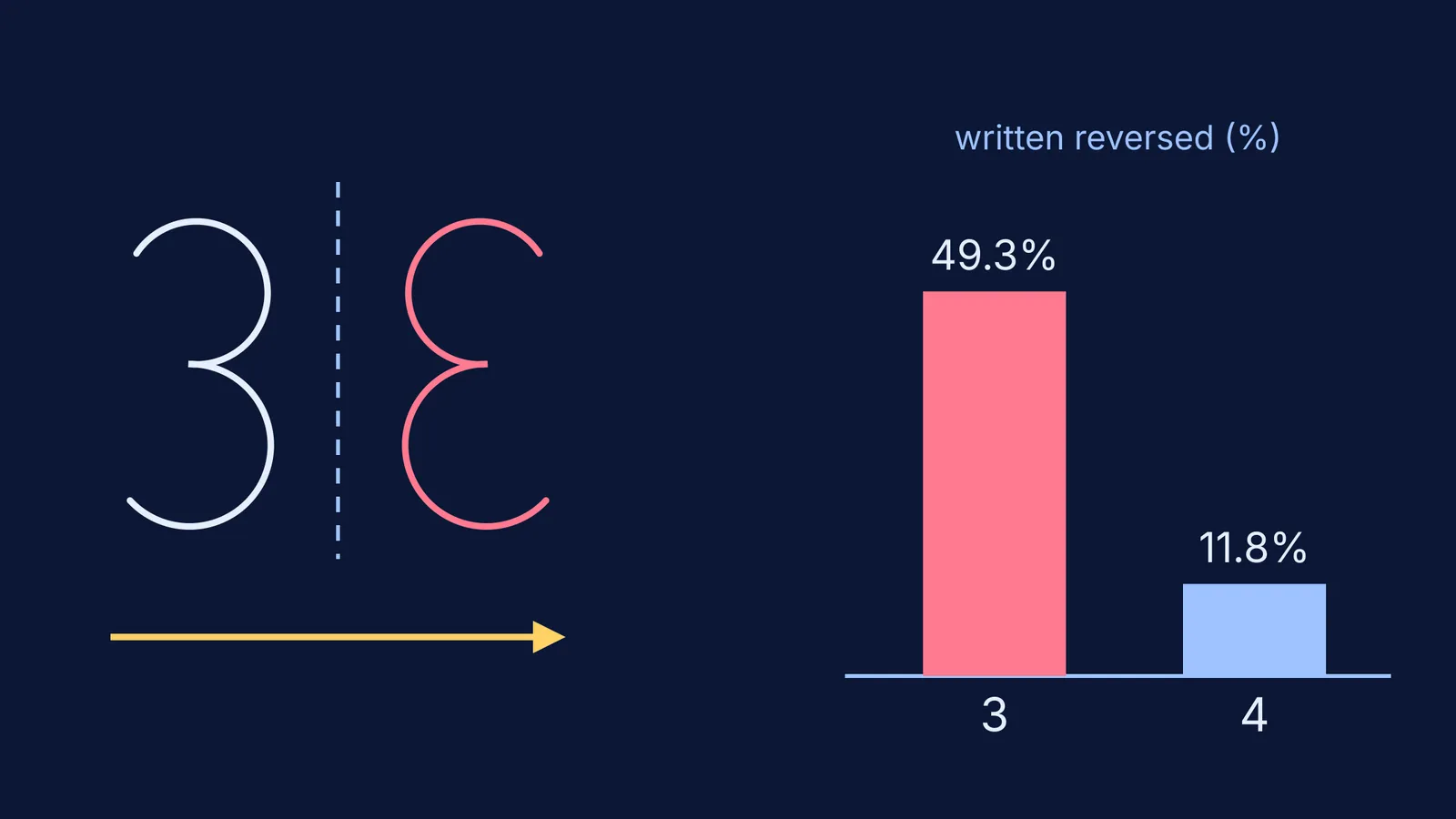
Yes. Combining several of their studies of 5- to 6-year-olds, Jean-Paul Fischer and his colleagues found the digit 3 reversed in 49.3% of writings, against 11.8% for the digit 4, in writings by 1,563 children (Fischer and Luxembourger, Frontiers in Human Neuroscience, 2018).
Copying is a different story. In one of those studies, children reversed about 0.4% of the characters they copied, compared with more than 21% of the characters they wrote from memory (Fischer and Tazouti, Journal of Educational Psychology, 2012, as reported by Fischer and Luxembourger, 2018). So your child can see the shape correctly. What they have not yet stored is which way it faces.
Handedness is not the cause either. Fischer, an emeritus professor of psychology at Université de Lorraine, notes that right-handed children reverse characters almost as often as left-handed ones (The Conversation).
Why do children reverse 3, 7 and 9 but rarely 4?
Fischer's explanation is about writing direction. In languages written from left to right, children most often point characters toward the right. That is why left-facing characters such as J, Z, 1, 2, 3, 7 and 9 are reversed considerably more than others (The Conversation).
Why is the direction missing at all? The brain tends to treat a shape and its mirror image as the same object. Fischer and Christophe Luxembourger argue that this mirror generalisation deletes a character's orientation as it goes into memory, so around age five a child knows the shape of a 3 but has to improvise which way it points (Education Sciences, 2018).
Rebecca Treiman and colleagues found the same lopsided pattern for letters: 5- and 6-year-olds reversed left-facing forms like d and J more often than right-facing ones like b and C (Scientific Studies of Reading, 2014). If letters are the bigger worry at home, our guide on why children mix up b and d covers them.
Does writing numbers backwards mean dyslexia?
Not on its own. In the Treiman study, children who later became poorer readers made more errors overall when writing letters, but they were no more likely to make reversal errors, and the strength of a child's reversal pattern was unrelated to their reading 2 3/4 years later (Treiman et al., 2014). Understood, a US learning-differences site, likewise says reversing letters is not necessarily a sign of dyslexia (Understood).
How can you practise with sand and air writing?
The aim is to give the 3 a direction it can remember, through movement and a fixed starting point. Keep it to five playful minutes, and work on one number at a time, as Understood suggests for both letters and numbers.
Pick the one digit your child reverses most. Write it large on paper and put a green dot where the pencil starts.
Air writing: stand side by side and draw the digit in the air with a straight arm, saying the path aloud ("start at the top, round the tummy, round again").
Sand tray: spread rava, salt or sand thinly on a plate or thali. Your child traces the digit with one finger, starting at the dot you press in, then shakes the plate to erase.
Paper last: three copies with the green start dot, then one from memory.
Keep a printed 0-9 number strip on the table, so your child can check which way each digit faces without asking you.
If writing itself feels like a battle, read why some Class 1 children refuse to write before adding more practice.
When does it usually sort itself out?
Reversing letters is typical and fairly common up to second grade, and if a child is still reversing a lot by the end of second grade, it is worth speaking to their teacher (Understood). In India, that means roughly the end of Class 2.
A quick check before you worry:
Reversals mostly in 1, 2, 3, 7 and 9, and rarely when copying: typical for UKG and Class 1.
Still frequent at the end of Class 2: talk to the class teacher.
Also struggling to learn letter sounds, or reading falling behind classmates: raise it with the class teacher or school, because those signs matter more than reversals.
We build Fermi's AI tutor for older students, and it works on the same instinct: notice where a student is stuck, then decide whether to explain, ask or show. With a five-year-old, that means watching where the pencil starts before you say anything.


