

On this page
When a child watches a rocket launch, their intuition says the vehicle moves by pushing against the ground or the air, like a swimmer kicking off a wall. Even adult commentators have made this error: on 13 January 1920, *The New York Times* published an editorial ridiculing rocketry pioneer Robert H. Goddard, asserting that a rocket could never work in space because it lacked "something better than a vacuum against which to react"—a claim the paper retracted on 17 July 1969 after Apollo 11 lifted off.
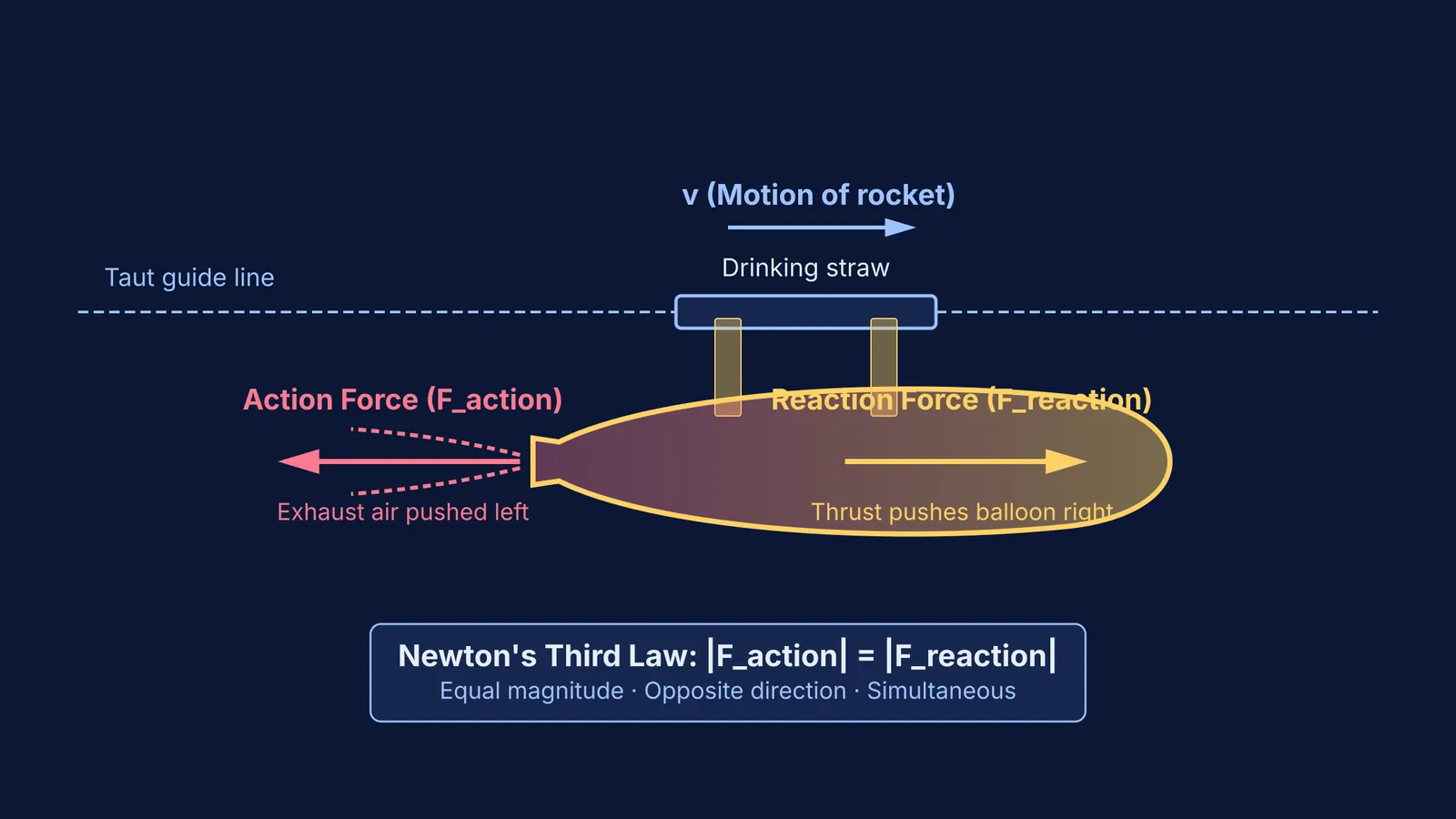
In physics education research published in the *American Journal of Physics*, Ronald K. Thornton and David R. Sokoloff (Thornton & Sokoloff, 1998) showed that students routinely misunderstand Newton's third law of motion because they assume forces require an external surface to push against. In reality, rockets push against their own exhaust. Under Newton's third law, every action has an equal and opposite reaction. High-pressure combustion forces gas molecules backwards through the rocket nozzle at high speed. Pushing that gas mass backwards pushes the rocket forwards. In fact, air in our atmosphere only creates friction and drag; rockets work even more efficiently in the vacuum of space. For older students studying force pairs, see our guide to Class 9 laws of motion.
How can you demonstrate rocket thrust at home with a balloon?
You do not need a laboratory to demonstrate rocket thrust. The classic experiment detailed in the NASA JPL Simple Rocket Science lesson takes five minutes using household items:
Thread the guide: Pass a length of smooth string or fishing line (about 4 to 6 metres) through a straight drinking straw. Tie the string taut between two chairs.
Inflate the balloon: Blow up an oval balloon. Twist the neck and clamp it shut with a clothes peg instead of tying a knot.
Tape and launch: Tape the balloon underneath the straw. Slide the straw to one end of the line, count down with your child, and remove the peg.
Escaping air rushes backwards (action), propelling the balloon forward along the line (reaction).
Why are space rockets so tall, and why do pieces fall off?
Children watching a launch often ask why rockets look like tall towers and why sections drop into the sea.
The answer is launch mass. According to the Indian Space Research Organisation (ISRO), India's Launch Vehicle Mark-3 (LVM3) stands 43.5 metres tall with a lift-off mass of 640 tonnes. Nearly 86% of that mass—553 tonnes—is propellant distributed across two S200 solid boosters (205 tonnes each), the L110 liquid stage (115 tonnes), and the C25 cryogenic stage (28 tonnes).
Carrying empty metal tanks to space wastes immense fuel. By dropping burned-out boosters as soon as their propellant is spent—a process called staging—the vehicle sheds dead weight so the next stage can accelerate much faster. This principle drove India's early space programme, as described in our profile of A. P. J. Abdul Kalam's rocket science.
How do satellites stay in orbit without falling back down?
Once a rocket enters space, children wonder why satellites do not drop back to the ground.
Satellites do not escape gravity. According to the NASA Microgravity Overview, at low Earth orbit altitudes between 300 and 400 kilometres, Earth's gravity is still about 90% as strong as on the surface. Satellites stay in orbit because they travel sideways at roughly 7.8 kilometres per second (28,000 kilometres per hour, or 17,500 miles per hour). As gravity pulls a satellite downward, the curved surface of the Earth bends away beneath it at the exact same rate, keeping the satellite in perpetual free fall.
When curious minds want to explore these mechanics interactively, the Fermi Simulation Lab offers interactive simulations for ideas that are easier to see than to read, letting students test launch velocities and orbital paths directly. For broader revision across physics, the Fermi Concept Library organizes foundational concepts into clear, step-by-step lessons.
Where can you watch real ISRO launches with your child?
You can ground the living-room experiment by watching real launch footage on the ISRO Recent Videos archive and the ISRO Chandrayaan-3 mission page:
LVM3-M4 Liftoff and Staging: Watch the 14 July 2023 launch, spotting the exact moment two minutes into flight when the two white S200 boosters separate against the dark blue sky.
Onboard Fairing Separation: Cameras on the rocket show the protective nose cone split open once outside Earth's thick atmosphere, exposing the spacecraft to space.
Lunar Soft Landing: Revisit the 23 August 2023 Vikram landing, where reverse thrusters fired downward to cushion the touchdown at the lunar South Pole.
Pairing a hands-on balloon with real space video turns a child's question into an intuitive lesson: rockets never push against the sky; they bring their own push with them. Hands-on exploration helps children build intuition naturally. To learn how to support your child's scientific curiosity at home without turning curiosity into academic stress, read our guide on how parents can help children learn without adding pressure.


