

On this page
Living in a joint family offers a child immense love, support, and a connection to their roots. But when it comes to schoolwork, having multiple adults in the house can lead to mixed messages. A parent might set a strict homework schedule, while a grandparent might feel the child is being pushed too hard and tell them to take a break.
When children receive different instructions from the adults they trust, they struggle to know which rules to follow. This is not just a matter of household discipline; it directly affects how they learn. A 2020 study published in *Frontiers in Psychology* found that when parents and grandparents disagree on child-rearing, it reduces the child's "effortful control"—their ability to regulate their own behaviour and focus on tasks.
Conversely, predictability helps children thrive. A meta-analysis of 308 studies (Pinquart, 2016) confirmed that an authoritative environment, where rules are consistent but paired with warmth, is one of the strongest predictors of a child's academic achievement.
Why do grandparents and parents disagree on studies?
The clash usually comes from a place of love, combined with a generational gap in expectations. Grandparents often grew up in an era where the education system was less competitive, or they feel their primary role is to spoil and comfort their grandchildren, not to enforce discipline. Parents, acutely aware of today's academic demands and entrance exams, feel the urgency of building strong study habits early, though they must balance this to help children learn without adding pressure.
This difference in perspective can create a dynamic where the grandparent unknowingly undermines the parent. For example, if a child is struggling with a tough maths assignment and starts to cry, a grandparent might step in and say, "Leave it, you can do it later." This breaks the child's momentum, interrupts the learning process, and invalidates the parent's rule.
The child learns that if a task is too hard, they can seek out the more lenient adult to avoid it. Over time, this erodes their resilience and their willingness to tackle difficult subjects.
What happens when grandparents and parents disagree on studies?
When the adults in a house are not aligned, the child experiences cognitive dissonance. They want to please their parents, but they also want to accept the comfort offered by their grandparents.
In the short term, this leads to arguments and a chaotic evening where homework takes twice as long as it should. In the long term, if you are trying to build a study routine that lasts, the lack of a firm structure harms the child's ability to self-regulate. They fail to internalise the discipline required for independent learning, which becomes a severe handicap when they reach higher classes where self-study is mandatory.
How can families agree on one set of rules?
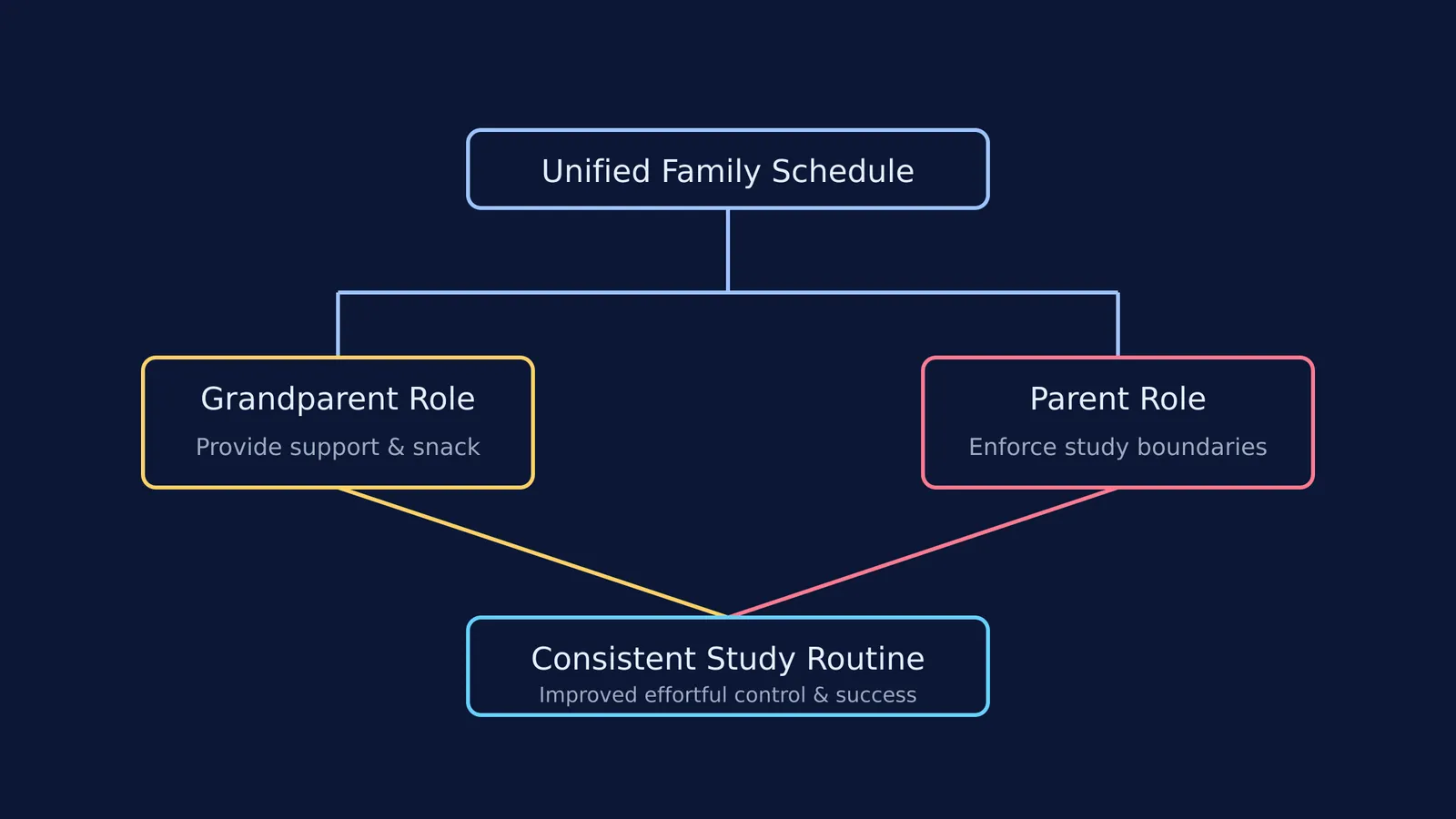
To protect the child's focus, the adults must present a united front. This does not mean the grandparents have no say, but rather that the family agrees on a baseline routine that everyone respects and enforces.
Hold a family meeting without the child: Sit down with the grandparents when the child is at school or asleep. Acknowledge their experience and love, but explain the specific academic goals you are working towards.
Focus on the schedule, not the parenting style: It is easier to agree on a timetable than a philosophy. Agree that between 5:00 PM and 7:00 PM, the child will be at their desk, and no one will interrupt them with snacks, chores, or television.
Define the roles: Give grandparents a specific, positive role in the child's education. They might be in charge of reading stories, listening to the child recite historical facts, or providing a healthy snack before the study session begins.
A script for the family talk
If you are unsure how to approach the conversation with elders, use this framework to keep it respectful but firm:
Start with gratitude: "Ma, I know how much you care about him, and he is so lucky to have you looking out for him."
State the problem neutrally: "I have noticed that when he is told he can stop studying early, he struggles to sit down and focus the next day."
Share the plan: "To help him build a habit, we are making a rule that homework happens between 6:00 PM and 8:00 PM every day."
Ask for their help: "We need your help to make this work. Could you make sure he gets his evening snack at 5:30 PM so he is ready to sit down?"
Keeping the routine consistent
Once the rules are set, the child needs a clear path forward when they study. If they are stuck on a difficult concept and the adults in the house cannot help, they might turn to each other for answers, which can restart the cycle of disagreement over how hard the child should be pushed.
Having a reliable academic resource can prevent these household debates over how a problem should be solved. For instance, if a student is confused by a physics numerical, they can use the Fermi Problem Library to work through the reasoning step by step, rather than asking an adult for the answer. When concept gaps cause frustration, the Fermi Concept Library offers clear lessons for every topic in physics, chemistry, biology, and mathematics.
If the student simply does not know where to start their revision, Fermi's AI tutor can work out what they already know and build a plan for the session, so they sit down to a clear next step instead of a blank page.
When the whole family is on the same page and the child has the tools they need to learn independently, the home becomes a place of predictable support. The child spends less energy navigating household politics and more energy on their studies, leading to better focus, less anxiety, and stronger academic results.


