

On this page
In India, students often choose their streams (science, commerce, or arts) in Class 11 based on academic scores or perceived prestige rather than the day-to-day reality of a profession. A student might prepare intensely for the NEET-UG medical entrance exam without ever seeing a doctor manage an overcrowded outpatient clinic, or push through grueling JEE Main preparation without knowing what a software engineer actually codes. Job shadowing bridges this gap. It is an observation-focused, short-term visit where a student spends a few hours to a full day watching a professional at work, allowing them to test their assumptions before committing to a multi-year degree path.
Why is job shadowing important?
Job shadowing prevents expensive mistakes in degree choices and builds long-term career readiness. According to a 2017 report by the UK charity Education and Employers, teenagers who have four or more encounters with employers while at school are 86% less likely to become NEET (Not in Education, Employment, or Training) between the ages of 19 and 24.
Furthermore, the same research shows that young adults with four or more employer encounters earn an 18% wage premium compared to peers with no such encounters. For a teenager preparing for highly competitive exams, this real-world exposure provides crucial, sustained motivation. When they see exactly what an engineer or architect does, the abstract concepts they study—whether it is visualising n-type and p-type semiconductors: carrier concentration problems or remembering Opioids, cannabinoids and coca alkaloids: NEET's drug-abuse facts—suddenly have a concrete purpose.
Can my teenager shadow someone at work?
Yes, but formal job shadowing programmes are rare in Indian high schools. As a result, parents typically must arrange these opportunities through their own informal networks. Start by making a list of friends, extended relatives, and former colleagues who work in fields your teenager is actively interested in exploring.
Keep the request low-friction. Ask for just a few hours rather than a full week, clarify that the student will strictly be there to observe, and assure the host that they do not need to prepare a formal presentation or entertain the teenager. The entire goal is to blend in and see a normal, unedited working day.
What should a student observe during the day?
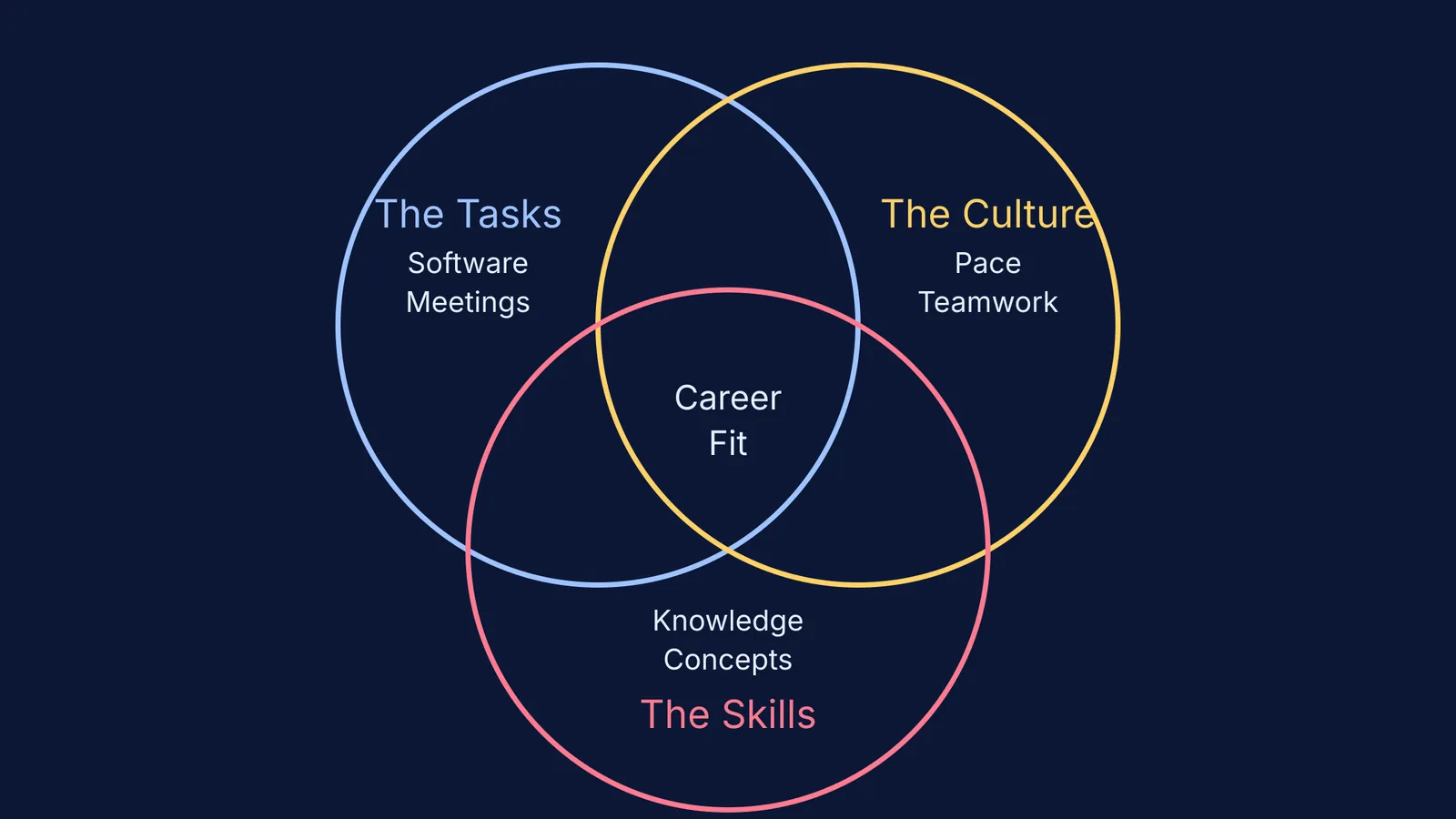
Give your teenager a structured framework before they arrive at the workplace. Remind them that they should not just look at the glamorous parts of the job; they need to see the routine and the hidden challenges. Ask them to take notes on three key areas:
The Tasks: What software and tools do they use? How much time is spent doing deep, focused work at a desk versus collaborating in meetings?
The Culture: What is the pace of work? Is the environment highly collaborative, intensely competitive, or mostly isolated?
The Skills: What underlying knowledge is actually used to solve daily problems, and how does it connect back to what they learn in school?
Often, students realise during a shadow day that a profession requires a much stronger grip on fundamental science than they had initially assumed. If a student returns from a visit and finds they have critical gaps in the physics, chemistry, or maths required for their dream role, Fermi's AI tutor can work out what they already know, build a plan for the session, and teach through it—writing on a board, drawing the figure, and checking understanding as it goes. Alternatively, if they realise they need to deepen their grasp of a specific topic before college, they can turn to the Fermi Concept Library, which covers every concept in physics, chemistry, biology, mathematics and computing, each with its own lesson and its place in the map.
How do you debrief the shadowing experience?
On the ride home, ask your teenager what surprised them most about the environment. Did they find the long periods of desk work boring? Did the fast pace and constant communication excite them? Were the professionals using the skills they expected? Even a negative reaction to the day is a massive success: realising you strongly dislike a particular career environment at age 16 is significantly better than discovering it at age 22 after completing a four-year degree.


