

On this page
Your child walks out of the exam centre quiet, or calls you upset. Session 1 of JEE Main 2027 runs on 20-24 and 28 January 2027, according to NTA's public notice of 24 October 2026, so for many families this conversation comes in late January. What you say in the next few days shapes the nine weeks that follow.
Does a bad first session ruin the JEE Main rank?
No, not on its own. For candidates who sit both sessions, the best of the two total NTA scores (not the best score in each subject) is used for the merit list, says the JEE (Main) 2027 Information Bulletin. The same bulletin says the Common Rank List is compiled only after Session 2, which runs on 2-7 April 2027.
Two details in that bulletin matter now:
Session 2 applications are open from 5 January to 3 February 2027, with a late-fee window from 4 to 7 February. Session 2 needs its own application (using the same application number if your child applied for Session 1); check that it is done.
Before results, NTA displays each candidate's question paper and recorded responses, likely for two to three days, and advises downloading and keeping a copy of the response sheet because it will not be provided later.
For a wider view of the year, see our guide to planning around JEE Main's two sessions.
What should I say to my child after a bad JEE Main paper?
Less than you think. The first evening is for food, sleep and company, not marks.
How you react to failure carries weight. Kyla Haimovitz and Carol Dweck found that parents who see failure as debilitating focus on their children's performance and ability rather than their learning, and their children tend to believe intelligence is fixed (Psychological Science, 2016).
A script for the first few days:
On the day: "That sounded like a hard paper. I'm glad you're home."
That evening: "You don't have to go through it tonight. Shall we look at it together at the weekend?"
At the debrief: "What surprised you most: the questions, the time, or how you felt?"
When marks come up: "Your better score is the one that counts, and Session 2 is in April."
Things to avoid that week: asking for a predicted percentile, comparing with classmates or cousins, and announcing a new coaching plan the same night.
How do you debrief a bad session without reliving it?
Wait a few days, then sit down with the downloaded response sheet and NTA's answer key. The aim is to sort lost marks, not to replay the exam. Our 60-minute mock test review routine works just as well on a real paper.
Put every wrong or skipped question into one of four buckets:
Concept gap: didn't know the idea.
Wrong method: knew the topic but set it up wrongly.
Slip: sign, unit, arithmetic or a misread question.
Time or panic: never reached it, or skipped it in a rush.
An illustrative example: 18 questions wrong or unattempted, made up of 4 concept gaps, 5 wrong methods, 6 slips and 3 lost to time. Re-reading whole chapters does little for most of these. Slips and time need timed practice and a checking habit; the concept gaps become a short topic list; the wrong-method questions need worked solutions studied step by step.
What does a good plan for Session 2 look like?
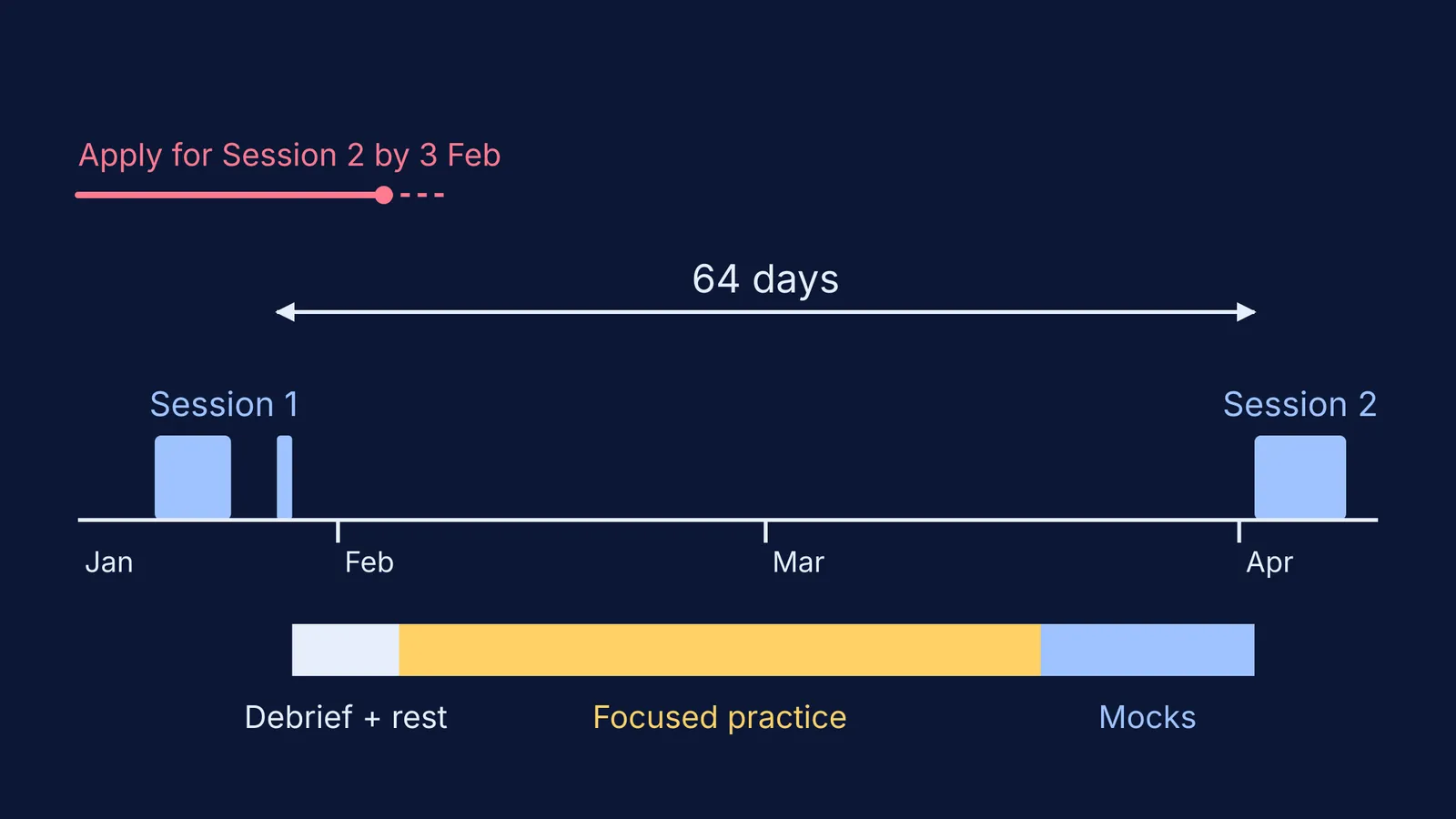
The gap between the last day of Session 1 (28 January) and the first day of Session 2 (2 April) is 64 days, a little over nine weeks, going by the dates in the NTA bulletin.
Week 1, recovery: normal sleep, light revision, time with friends, and the debrief.
Weeks 2-7, focused practice: clear the concept gaps a few at a time and take one timed mock a week, sorted into the same four buckets.
Weeks 8-9, exam rhythm: full mocks at the time of your child's shift (NTA's shifts start at 9 am or 3 pm), with lighter days just before the exam.
If wrong-method mistakes top the tally, the Fermi Problem Library has worked problems with a step-by-step solver that explains the reasoning rather than printing an answer.
In the days before Session 2, a few minutes of writing can help. Gerardo Ramirez and Sian Beilock found that students who wrote briefly about their worries just before an exam did better on it (Science, 2011).
When should parents look for outside help?
Some disappointment is normal. If your child stops eating or sleeping properly, withdraws from everyone, or talks about feeling hopeless, speak to your family doctor or a counsellor rather than pushing on with revision. Tele MANAS, the free 24x7 national mental-health helpline launched by the Ministry of Health and Family Welfare, is on 14416 or 1800-891-4416 (IIT Kanpur counselling service). Our guide to exam stress in teenagers and when to get help covers the signs in more detail.
For tonight, set the reminder for the response sheet. Everything else can wait for the weekend.


