

On this page
Why do pre-boards and January JEE Main clash so heavily?
Every January, Class 12 engineering aspirants face an intense calendar crunch. School pre-boards and practical examinations scheduled under the Central Board of Secondary Education collide directly with Session 1 of JEE Main conducted by the National Testing Agency. This creates cognitive conflict: schools demand long subjective derivations, structured definitions, and neat diagrams with step marking, while JEE Main demands rapid problem filtering, numerical precision, and disciplined negative-marking control across 75 objective and numerical questions.
Attempting both without a structured plan leads to panic. Some students abandon pre-boards entirely, risking attendance disputes and internal assessment penalties; others postpone JEE preparation entirely until April. That delay carries a hidden cost: Session 1 historically offers a less crowded percentile curve than Session 2, and securing a solid benchmark score in January relieves immense psychological pressure before the final February board exams begin.
How should students divide time between subjective boards and objective JEE?
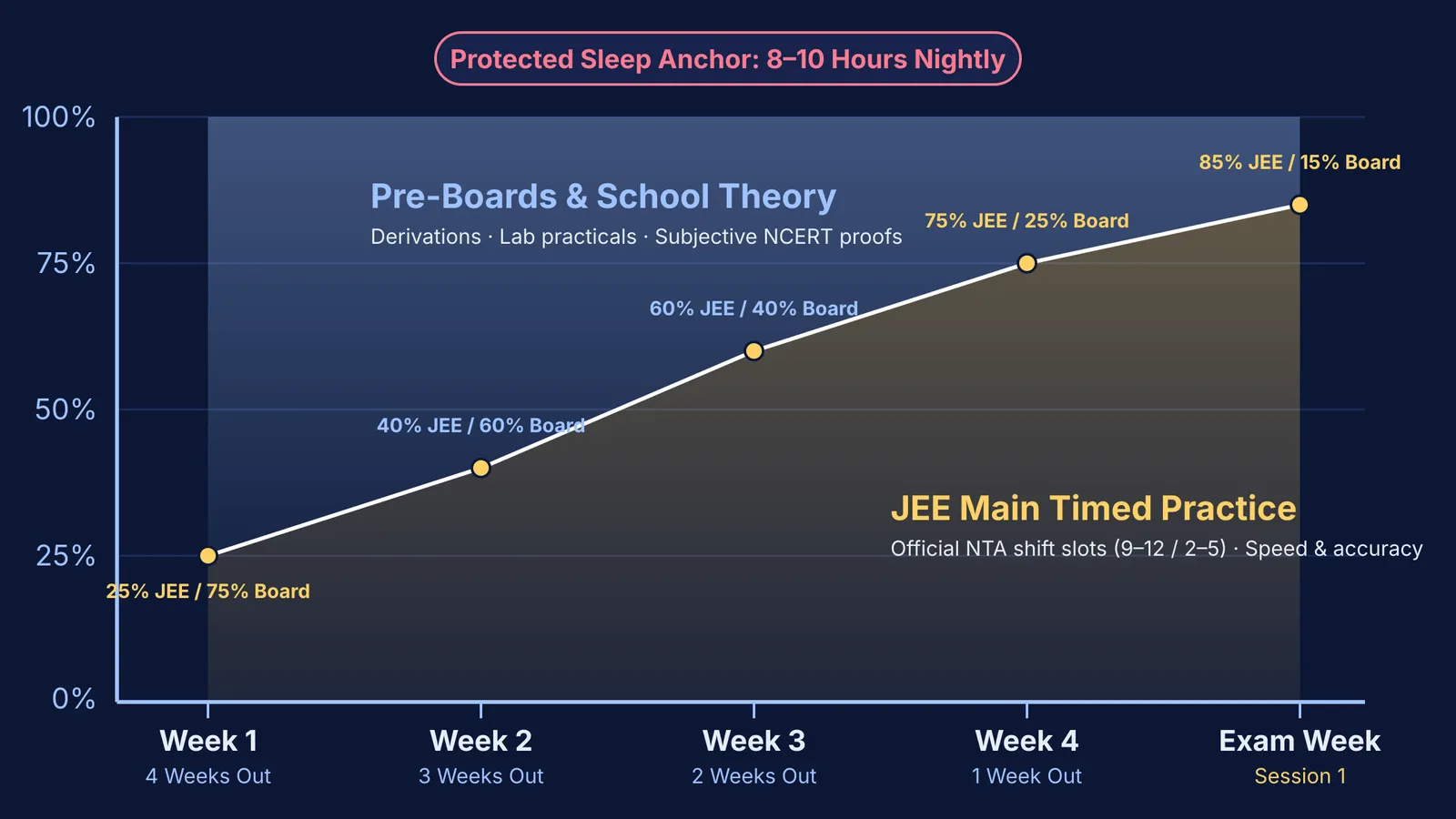
The solution is cognitive separation rather than fragmented multitasking. Rather than alternating between formats every hour, students should divide their day into two distinct cognitive modes:
Morning objective block: Dedicate 9:00 AM to 12:00 PM or 2:00 PM to 5:00 PM to timed numerical problem-solving and past papers. Aligning this study window to official NTA test shifts trains the brain for peak alertness during actual examination hours.
Evening subjective block: Dedicate 6:00 PM to 9:30 PM to school syllabus needs—writing out NCERT derivations, sketching labelled practical diagrams, and reviewing descriptive chemistry mechanisms.
Family coordination makes this schedule workable by establishing predictable household quiet hours, as explored in our guide on routines that help the whole family. When school pre-boards demand quick theoretical verification while JEE requires rapid formula recall, the Fermi Concept Library covers every concept in physics, chemistry, biology, mathematics and computing, each with its own lesson and its place in the map, allowing students to check core principles quickly. For students struggling to transition from descriptive proofs to timed numerical questions, the Fermi Problem Library provides worked problems with a step-by-step solver that explains the reasoning rather than printing an answer.
What daily routines actually protect memory and test focus?
When deadlines tighten, sleep is usually the first casualty. However, late-night cramming systematically impairs calculation speed and working memory.
An expert consensus published in the Journal of Clinical Sleep Medicine emphasizes that teenagers aged 13 to 18 years require 8 to 10 hours of sleep per 24 hours to sustain cognitive functioning, memory consolidation, and emotional regulation. Parents can learn more about protecting adolescent rest cycles in our guide on how much sleep teenagers need.
Furthermore, a study using objective sleep trackers published in npj Science of Learning revealed that sleep quality, duration, and consistency accounted for nearly 25% of the variance in students' academic performance. Crucially, the researchers observed that sleep across the entire month and week leading up to an examination predicted scores, whereas sleeping well only on the single night before the test showed no correlation with grades.
When fatigue strikes and a student feels unsure which topic to review, Fermi's AI tutor can work out what a student already knows and build a plan for the session, providing an orderly path forward without cognitive overload.
How can families handle exam anxiety and logistics at home?
A student's home environment heavily shapes how they experience test pressure. In a survey of 570 adolescents preparing for competitive entrance examinations in Karnataka published in the Journal of Education and Health Promotion, 86.0% of students reported high academic stress, 87.0% experienced high perceived parental pressure, and 57.7% exhibited low general well-being.
Parents can buffer this pressure by shifting from monitoring performance to managing practical logistics and offering emotional safety. Read our guide on everyday support for exam stress for practical strategies. At home, constructive support relies on specific habits:
Replace marks interrogation: Avoid asking about mock test scores at dinner. Instead, ask what felt clear today and what household tasks can be handled on their behalf.
De-dramatise pre-board scores: School teachers intentionally grade pre-boards strictly to spur final revision. Remind your child that pre-board marks identify syllabus gaps, not their final rank.
Manage administrative logistics: Take complete charge of downloading the City Intimation Slip, printing multiple admit card copies, checking photo ID validity, and doing a trial drive to the examination centre the weekend prior.
What does a four-week family preparation plan look like?
To prevent last-minute chaos, families can align their efforts across four progressive weekly stages alongside standard Central Board of Secondary Education milestones:
Week 1 (Four weeks out): Student completes school practical files and audits weak chapters. Parents verify application credentials and establish a consistent 11:00 PM digital wind-down routine.
Week 2 (Three weeks out): Student takes two full-length previous year papers in timed morning slots. Parents protect weekend quiet hours and handle all household errands.
Week 3 (Two weeks out): Student reviews formula sheets, short notes, and previous mock mistakes. Parents confirm transport routes to the centre and prepare required stationery and documents.
Week 4 (Exam week): Halt new full-length mock tests 48 hours prior to the test. Emphasise light review, balanced meals, 8-hour sleep schedules, and reassurance that April offers a second opportunity.


