On this page
For many Indian families, discussions around choosing a stream after Class 10 still carry old assumptions. Generations of parents grew up believing that medical and engineering streams represented the only predictable pathways to financial stability and professional respect. When a teenager indicates an interest in history, political science, literature, or sociology, parents often worry about employability.
Yet higher education data reveals a very different landscape today. Understanding the modern humanities stream allows families to support their children's interests with realistic, practical career planning.
Why is the humanities stream expanding beyond traditional perceptions?
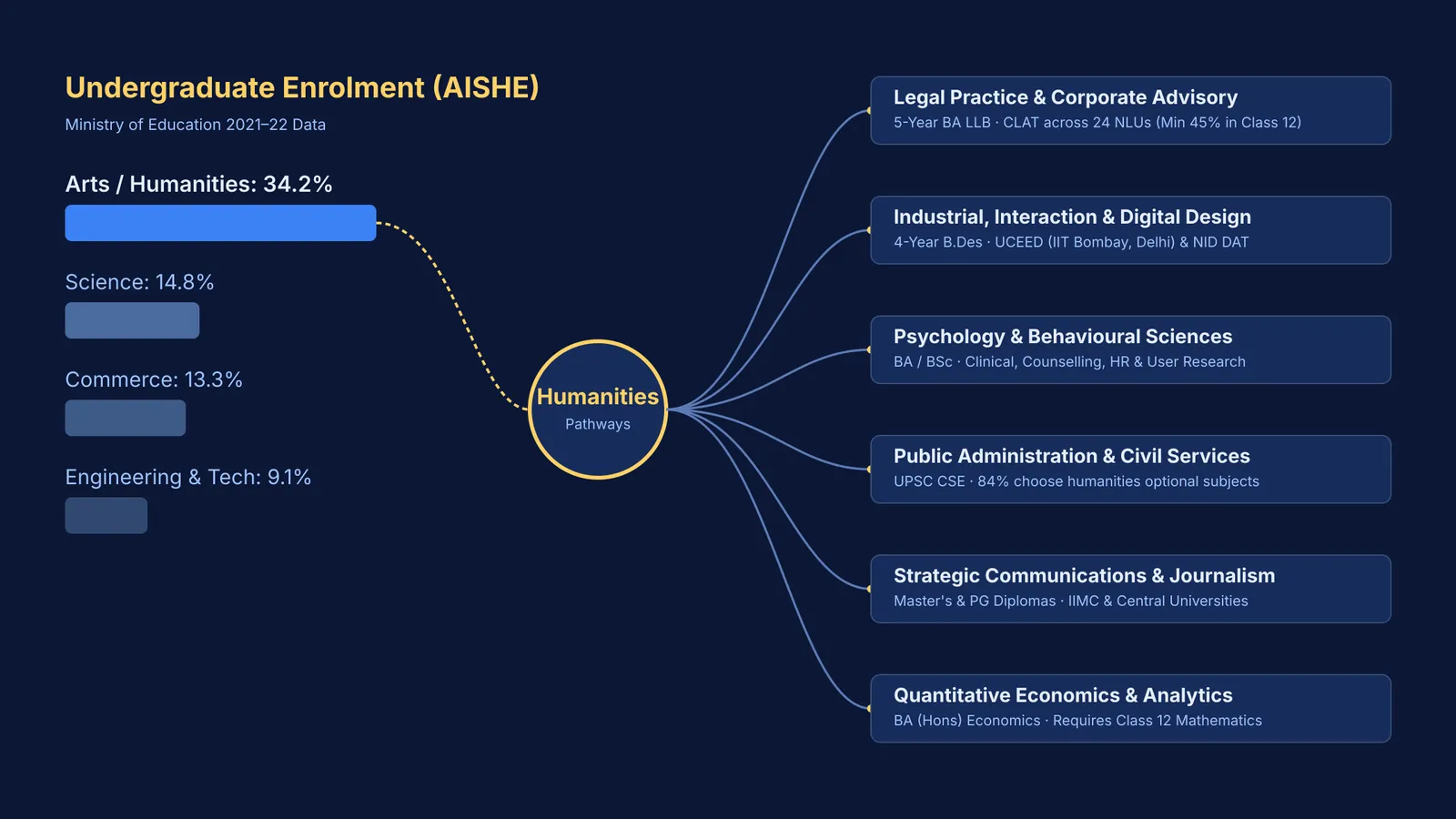
According to the Ministry of Education's AISHE 2021-22 report, the Arts and Humanities stream accounts for 34.2% of all undergraduate enrolments across India. This is more than double the share of Science (14.8%), Commerce (13.3%), or Engineering and Technology (9.1%). Far from being an obscure fallback, humanities forms the single largest segment of Indian higher education.
What has changed fundamentally over the last two decades is the professionalization of the stream. In previous decades, a Bachelor of Arts was frequently viewed solely as a stepping stone to government exams or teaching. Today, specialized undergraduate programmes in law, design, corporate communications, and behavioural science recruit directly into competitive corporate and policy roles. When facing situations when your child's career choice differs from yours, examining the specific entry points of each field provides clarity.
What are the top career paths after Class 12 humanities?
Six major professional sectors consistently attract humanities students today, each with its own training path:
Law: The legal profession in India was reshaped by the National Law University system. Through the Common Law Admission Test administered by the Consortium of National Law Universities, students from any stream can enter five-year integrated BA LLB programmes across 24 participating institutions. The eligibility rules require a minimum of 45% marks in Class 12 (40% for SC and ST candidates) and place no upper age limit on candidates. Graduates work in corporate law firms, intellectual property advisory, litigation, and international arbitration.
Industrial and Digital Design: Modern product teams and technology companies seek professionals trained in visual communication, user experience, and interaction design. Premier institutes such as the National Institute of Design and participating IITs accepting the UCEED exam conducted by IIT Bombay (including IIT Bombay, IIT Delhi, IIT Hyderabad, and IIT Indore) invite applicants from all academic streams. These four-year Bachelor of Design programmes assess spatial aptitude, observation, and creative problem solving.
Psychology and Behavioural Sciences: Psychology graduates work across human resources, school counselling, user research, and mental healthcare. In clinical settings, licensed practitioners evaluate and treat psychological disorders. For families navigating acute emotional stress or seeking immediate mental health guidance, official resources like the Ministry of Health's 24/7 toll-free helpline Tele-MANAS (dial 14416) connect callers directly to trained mental health counsellors.
Civil Services and Public Policy: Public administration remains an influential goal, but families should understand the realistic funnel. According to the 74th UPSC Annual Report, 11.52 lakh candidates applied for the Civil Services Examination in 2022, 5.73 lakh appeared for the Preliminary stage, and 1,020 were recommended for appointment. This corresponds to a final recommendation rate of approximately 0.18% of those who appeared. Notably, 84.1% of all recommended candidates chose humanities optional subjects, and candidates with humanities degrees represented 29% of successful recommendations. Because of this competitive funnel, academic advisors recommend pairing civil services aspirations with an independent professional degree.
Journalism and Strategic Communications: Digital news outlets, publishing houses, and corporate communication divisions seek graduates with rigorous research and storytelling capabilities. The Indian Institute of Mass Communication, operating under the Ministry of Information and Broadcasting, was granted deemed-to-be university status to award master's degrees in media governance, strategic communication, and digital media.
Quantitative Economics: Economics bridges social policy with corporate finance and data analytics. Under central university admissions through CUET, institutions like the University of Delhi require candidates to have passed Mathematics or Applied Mathematics in Class 12 to be eligible for the BA (Honours) Economics programme. Graduates enter market research, consulting, banking, and public policy think tanks.
How should parents plan for entrance exams and prerequisites?
Planning for humanities careers requires tracking specific entrance exams rather than relying solely on board exam percentages. National-level aptitude exams like CLAT (for law), NID DAT and UCEED (for design), and CUET UG (for central universities) test analytical reading, reasoning, and domain knowledge.
When students encounter foundational quantitative concepts in economics, statistics, or psychometrics, Fermi's AI tutor can work out what they already know and build a plan for the session, holding a line of reasoning across the topic. For students working through step-by-step mathematical derivations or microeconomic models, the Fermi Problem Library offers worked problems with a step-by-step solver that explains the reasoning rather than printing an answer.
What script can you use to discuss humanities careers at home?
When discussing streams and career options with your teenager, shifting from skepticism to collaborative inquiry reduces conflict. If your child expresses interest in arts subjects, here is a structured three-step script for your conversation:
Explore the underlying interest: "What specific subjects or topics during Class 9 and 10 made you curious, and what kind of day-to-day problems do you enjoy thinking through?"
Map the concrete outcomes: "Let us look together at two or three professions that build on those subjects, such as legal practice or UX design, and check what degrees they require."
Check the academic prerequisites: "Let us see if keeping Mathematics or an applied skill alongside your humanities subjects opens up additional university choices like economics or corporate analytics."
Approaching the discussion this way reinforces parenting that builds autonomy and real motivation while keeping practical roadmaps clear.