

On this page
In short
To manage homework for two kids in different classes, set staggered schedules so one child works independently while you help the other. According to Duke University research, a Class 7 student benefits from about 70 minutes of study, whereas a Class 2 student should max out at 20 minutes. Sit them apart, and use the older child's independent time to guide the younger one.
Finding the time and space to help two children with homework on the same evening is a common struggle in many households. When one child is sounding out words in Class 2 and the other is tackling electron dot structures in Class 10 or tracing a ray through a glass slab, the environment quickly gets chaotic. Both children genuinely need your guidance, but they need you in entirely different ways. The younger child requires constant, active participation, while the older child needs quiet focus and targeted help when they encounter a hurdle.
The key to keeping the peace and ensuring productive study time is dividing the physical space and staggering your attention based on how much time each child actually needs. This approach prevents sibling frustration and allows you to give each child the specific support required for their developmental stage.
Why does timing matter across grades?
Before building a daily schedule, you have to know exactly how long the evening shift should last. Many parents overestimate how much time younger children should spend on academics at home. The "10-minute rule," supported by Harris Cooper's research at Duke University, recommends multiplying the child's grade level by 10 to find their ideal daily homework duration in minutes. Based on this established study, a Class 2 student only needs 20 minutes of homework, while a Class 7 student can handle about 70 minutes of focused academic work.
The Indian Ministry of Education's School Bag Policy 2020 aligns perfectly with this developmental reality. The policy guidelines advise that young primary children should focus on reading and activities rather than written homework, while older primary and middle school students should have strictly limited assignments to prevent burnout.
When you understand that your Class 2 child's work will be completely over before your Class 7 child is even halfway done, the scheduling problem solves itself. The younger child requires brief, intensive support, while the older child requires a long stretch of independent work with occasional check-ins from a parent to maintain their momentum.
How do you arrange seating for different age groups?
The biggest mistake parents make is putting both children at the exact same table. A Class 2 child learns through speaking, pointing, and movement, which is highly distracting for an older sibling trying to focus on complex reading passages or mathematics problems.
Separate their physical spaces by the type of work they are doing. Set up the Class 7 child at a quiet desk in their room or a dedicated study corner in the living room where they will not be disturbed. This signals that they are entering a period of deep work and sets clear boundaries. Provide them with good lighting, all necessary stationary, and a clear workspace to minimise the need to get up and interrupt their flow.
The Class 2 child should sit with you at the kitchen table, dining area, or on the sofa. This environment is intentionally less rigid, which is perfect for a young child who needs to read aloud, ask frequent questions, and receive immediate encouragement. It also keeps the noisy, interactive learning far away from the older sibling's quiet zone.
How should you schedule turn-taking?
Start both children at the same time, but strategically front-load your active involvement on the younger child. Since the Class 7 child's workload takes more than an hour, they have plenty of independent work to start with. Creating a predictable routine helps both children know what to expect and reduces the daily friction of starting homework.
Here is a simple and effective split routine:
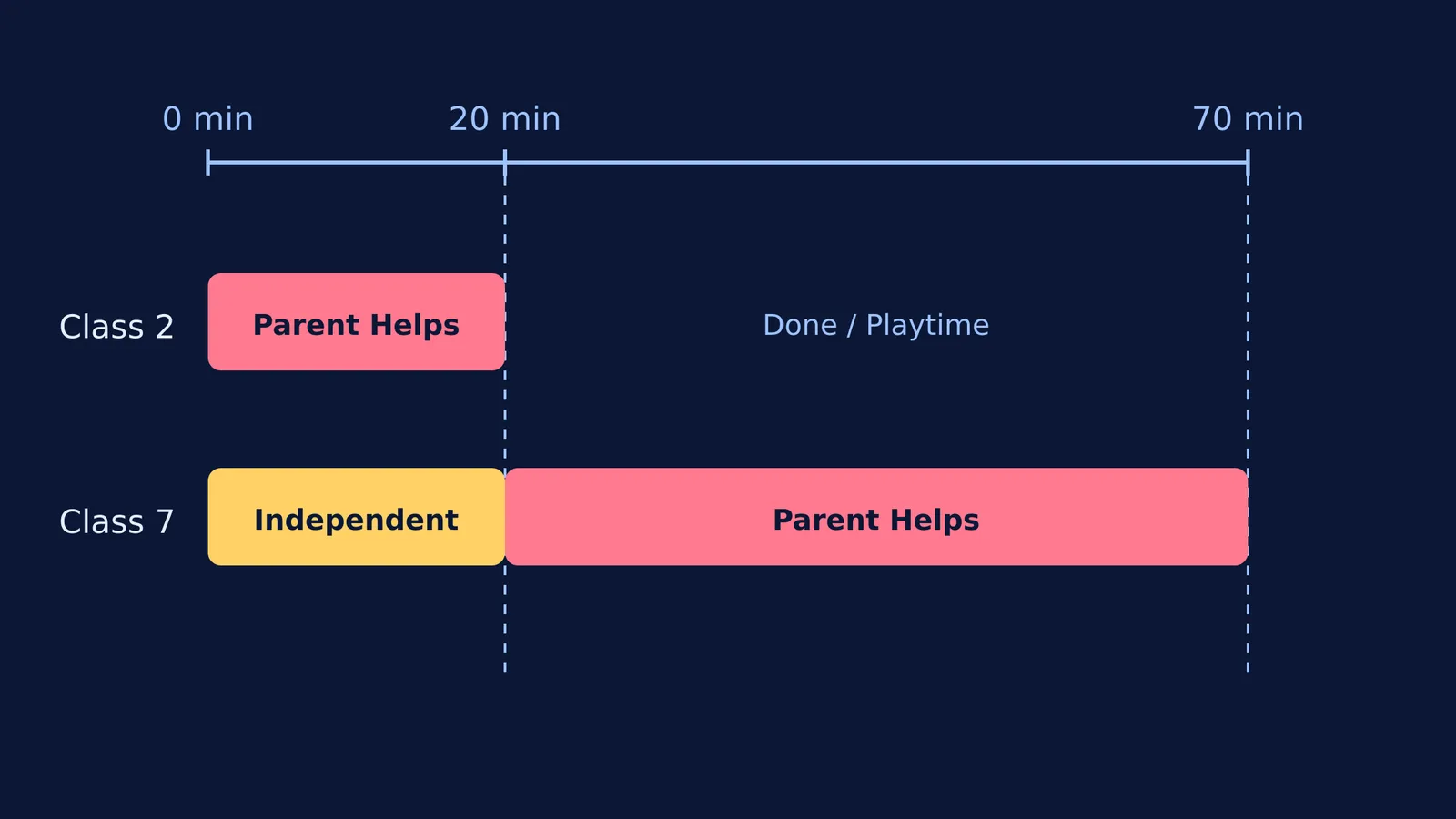
0 to 20 minutes: The Class 7 child goes to their desk to start their reading or easier assignments that they can do alone. You sit with the Class 2 child, listening to them read, playing an educational game, or helping with their short activity.
At 20 minutes: The younger child's homework is finished. They pack up their bag and go to play, read a storybook for fun, or relax in another room.
20 to 70 minutes: You transition to the Class 7 child. Now you have 50 minutes of undivided, quiet time to review what they have completed, check their work, or help them through any difficult concepts they saved for when you were free.
What if the older child gets stuck early?
The staggered schedule breaks down if the older child cannot get past the first question and interrupts your 20 minutes with the younger one. Older students need a reliable way to maintain momentum without you immediately jumping in to rescue them. Encouraging independence is a crucial part of their academic growth.
If your Class 7 child hits a block during their independent time, they can open Fermi's AI tutor. The tutor works out what they already know and builds a plan for the session, teaching through it by writing on a board, running the simulation, and checking understanding as it goes. For step-by-step guidance on a specific calculation, they can use the Fermi Problem Library to see the reasoning behind the method.
This means your older child gets a clear next step instead of staring at a blank page, and you get to finish the Class 2 homework in peace. Once you are free, you can review the concepts they worked on together and ensure they truly grasped the material before closing the books for the night.


