

On this page
It starts with a simple ping. A teacher drops a PDF into the class WhatsApp group, or a school app sends an alert about tomorrow's maths assignment.
For many families, this is the new normal. A 2023 report by ASER found that in rural India, 89% of youth aged 14–18 have access to a smartphone at home, but only 31.8% own one themselves, meaning homework often requires borrowing a parent's device. Even when students have their own phones, blending the device where they socialise with the device where they study creates friction.
The problem is not the homework itself, but the medium. When a student opens a phone to check an assignment, they are immediately met with messages, alerts and social media updates. A 2023 Global Education Monitoring Report by UNESCO suggests it can take up to 20 minutes to re-focus on a task after being distracted by a phone notification.
So how do you manage schoolwork that arrives on a device built for distraction?
Why does digital homework cause so much friction?
When homework lives on a phone, the boundary between study time and leisure time collapses. A 2024 Pew Research Center survey found that 72% of U.S. high school teachers view cellphone distraction as a "major problem" in the classroom, and the same challenge applies at home.
The friction comes from context switching. If a student has to wake a phone every time they need to check the next question, their working memory is taxed not just by the maths problem, but by resisting the urge to check the WhatsApp chat underneath it.
How can you build a "one folder, one time" system?
The most effective way to handle mobile-delivered homework is to extract the work from the device as quickly as possible. The goal is to make the phone a delivery mechanism, not a study environment.
Here is a simple routine to set up:
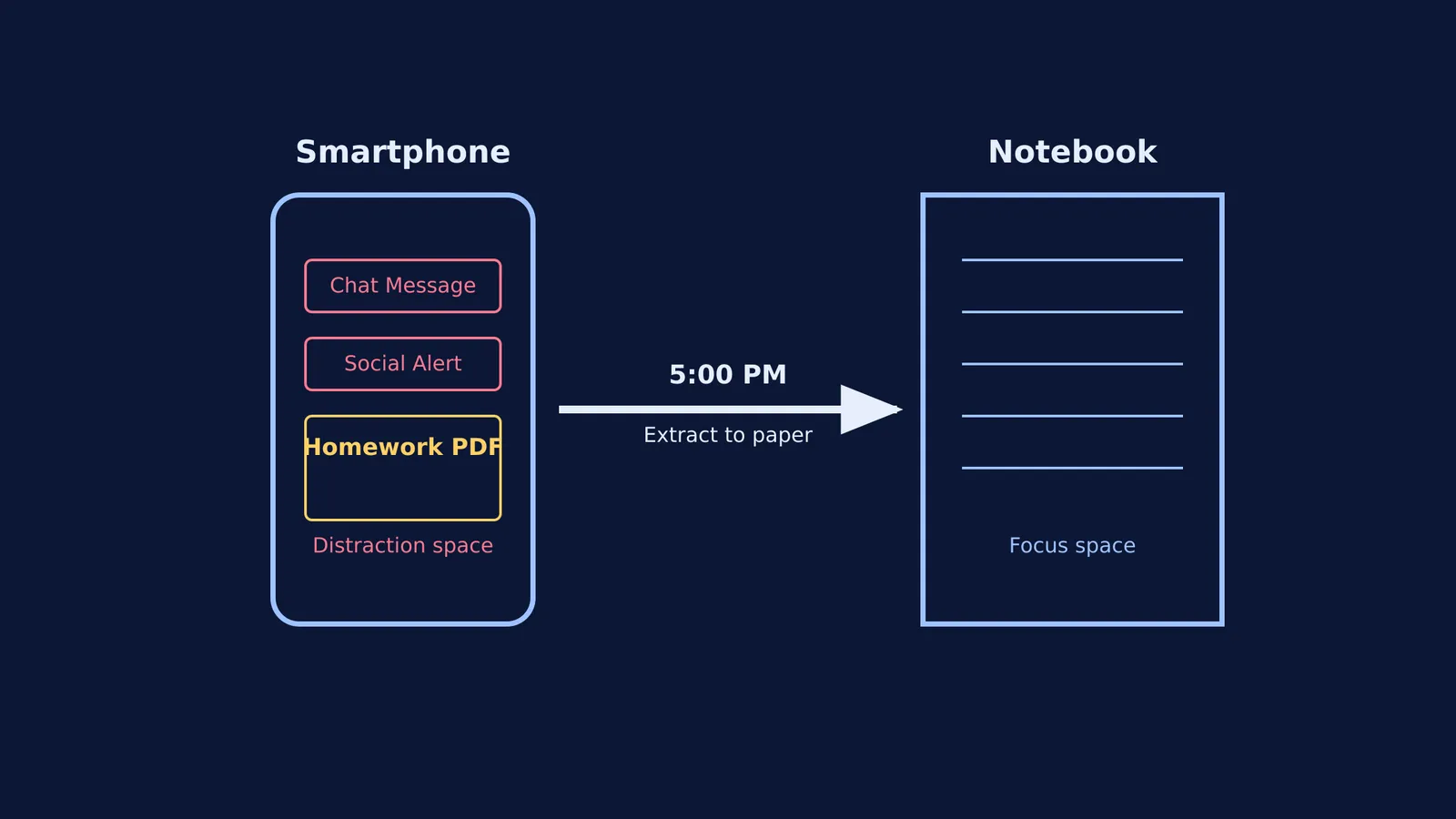
Set a fixed download time. Agree on a specific time (e.g. 5:00 PM) when the student or parent opens WhatsApp or the school app to check for assignments.
Extract the work. Do not leave the questions on the phone. Either print the PDF, or have the student immediately copy the questions into their notebook.
Put the phone away. Once the questions are on paper, the phone goes into another room on a charger.
Work offline. The student completes the assignment using their textbook, notes, and the paper they just wrote on.
Upload at the end. If the school requires a photo of the completed work to be submitted, do this in one batch at the end of the evening.
What if they get stuck and need to look things up?
Inevitably, a student will get stuck on a problem and claim they need the phone to search for the method. This is where a planned approach to digital help is vital.
Instead of handing back the phone for unstructured searching—which often leads straight to a group chat—use a focused learning tool on a larger screen if possible. For example, if they are stuck on quadratic word problems in Class 10, they can use the Fermi Problem Library. Instead of just printing an answer, Fermi's step-by-step solver explains the reasoning behind the method.
If the gap is deeper than a single question, they can spend 15 minutes in the Concept Library to review an underlying idea, such as why a lens's object and real image are at least 4f apart. By directing them to a specific platform rather than a general web search, you keep the focus on learning.
How do you talk about the new rule?
Changing the rules around phone access can cause arguments. Position the new system as a way to finish homework faster, not as a punishment.
You might explain that checking the phone makes homework take longer because of all the notifications. Instead, you can propose writing the questions down at 5 PM and leaving the phone in the kitchen, allowing them to finish the work faster and have their free time completely to themselves afterwards.
By separating the arrival of the homework from the execution of the homework, you give your teenager the quiet space they need to actually think.


