

On this page
Indian school days now stretch to seven or eight hours. Add travel time, and a 15-year-old might be out of the house longer than an adult works. When they get home, the homework starts. If evenings have become a battleground of fatigue and rushed assignments, you need a system to manage the load.
Why do homework benefits plateau?
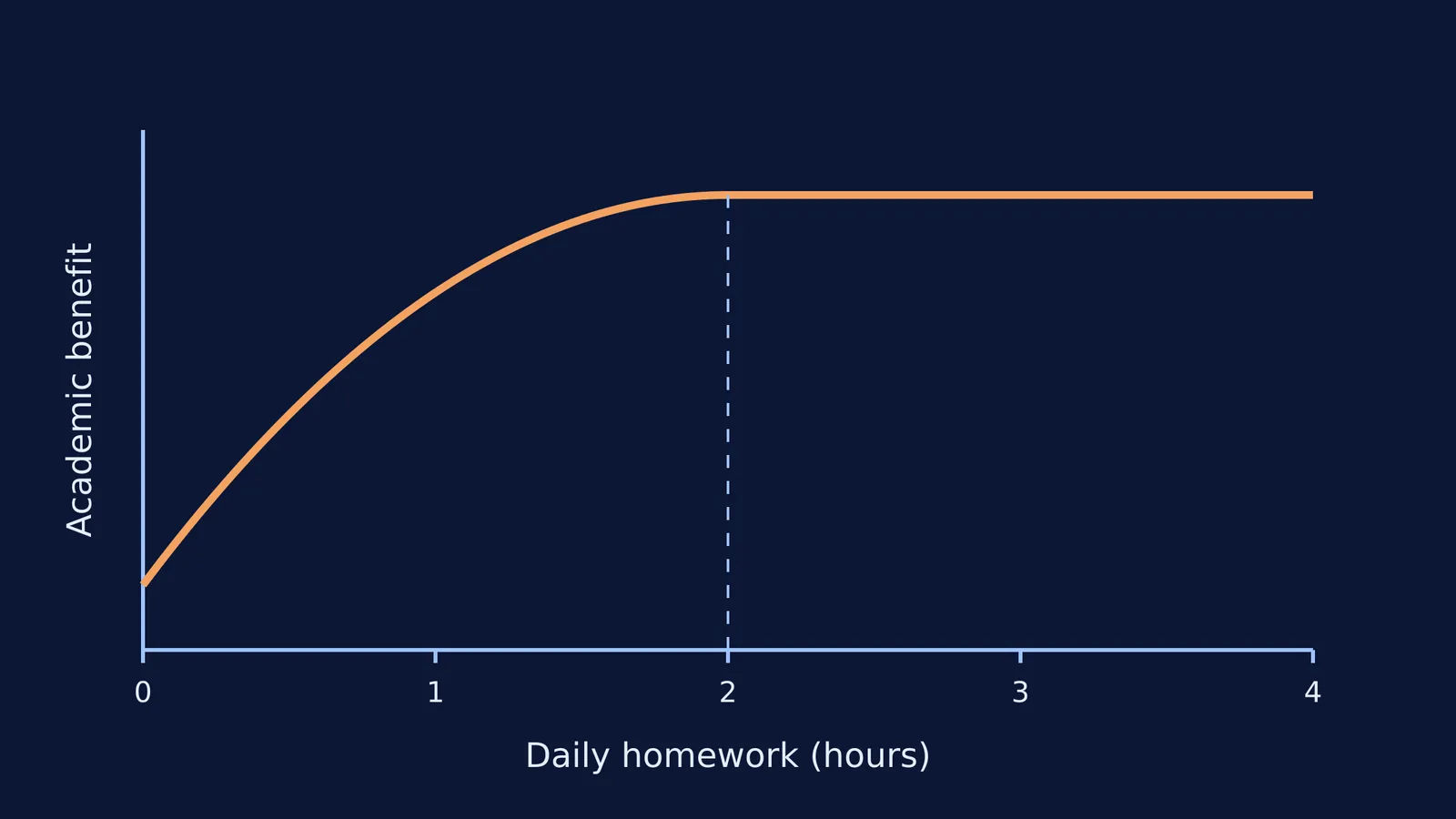
More homework does not always mean better grades. A 2006 meta-analysis by researchers at Duke University found that for high school students, the academic benefits of homework level off after about two hours per night (Cooper et al., 2006). Beyond that point, extra work does not improve test scores and often leads to burnout. The researchers supported the widespread "10-minute rule," which suggests assigning 10 minutes of homework per grade level per night—meaning 60 minutes for a sixth grader and 120 minutes for a twelfth grader. Crucially, the same study found no significant correlation between homework volume and academic achievement for elementary students, warning that excessive work at a young age can foster a negative attitude toward school.
The Programme for International Student Assessment (PISA) confirms this globally. Across OECD countries, 15-year-old students spend an average of 1.5 hours a day on homework (OECD, 2023). The PISA 2022 results showed that spending up to two hours a day on homework is linked to higher mathematics scores, but the benefit drops for those spending three hours or more. The report also emphasised that the quality of support—such as having a quiet place to study or clear teacher guidance—often matters more than the sheer volume of hours spent. Furthermore, the data revealed a socio-economic gap: advantaged students spend more time on homework on average, likely due to better home study environments and parental encouragement.
How much homework is too much?
In India, the official guidelines mirror these findings. The Ministry of Education's School Bag Policy 2020 recommends a maximum of two hours of homework per day for Classes 9 to 12 (Ministry of Education, 2020). For middle school (Classes 6 to 8), the limit is just one hour a day. For younger children, the limits are even stricter: the policy states that no homework should be assigned to Classes 1 and 2, and a maximum of two hours per week should be given to Classes 3 to 5.
The policy also stresses that homework should be creative and non-mechanical, rather than just copying text from a book. If your child is consistently working past these time limits, they are likely experiencing diminishing returns. The focus should shift from finishing every assigned page to protecting their sleep and maintaining a humane evening schedule.
How to prioritise due-tomorrow work?
When a student gets home exhausted after a full day of classes and commuting, you need a triage system. Expecting them to work at peak efficiency for another three hours is unrealistic. Here is a framework to keep evenings productive but manageable:
Sort by deadline: Only work due the very next day gets top priority. Projects due next week must wait for the weekend. This prevents the overwhelming feeling of having to tackle everything at once.
The 15-minute stuck rule: If a student is stuck on a concept—like quadratic word problems in Class 10—for more than 15 minutes without making progress, they should stop. Staring at a blank page builds frustration, not skill, and drains the limited energy they have left.
Get guided help: This is where a tutor helps. Fermi's AI tutor can work out what you already know and build a plan for the session. Rather than giving away the answer, it notices where a student is stuck and decides whether to explain, ask or show, keeping the session active and targeted.
Use step-by-step tools: For procedural homework, the Fermi Problem Library has a step-by-step solver that explains the reasoning. This keeps students moving forward when parents are unavailable to help, turning a frustrating roadblock into a learning opportunity.
When to speak to the school?
Teachers rarely know how long their assignments take, because they only see the finished product, not the struggle at the kitchen table. They also do not always coordinate with other subject teachers.
You should speak to the school if:
The total daily homework consistently exceeds two hours for a high schooler.
Your child is sacrificing sleep (getting fewer than eight hours) to finish assignments.
The work is mainly repetitive copying rather than active practice, such as writing out the dispersion of white light by a glass prism ten times.
When you contact the school, be specific. Instead of saying "there is too much homework," say, "My child spent 90 minutes on maths and 60 minutes on science last night, which pushed them past the two-hour limit recommended by the School Bag Policy." This gives teachers concrete data to adjust their planning.


