

On this page
Most toy microscopes are sold on one big number: 640x, 1200x, sometimes more. That number is the wrong thing to judge. Whether your child sees a cell or a grey blur depends on clear lenses, good light and steady focus.
What can a toy microscope actually show?
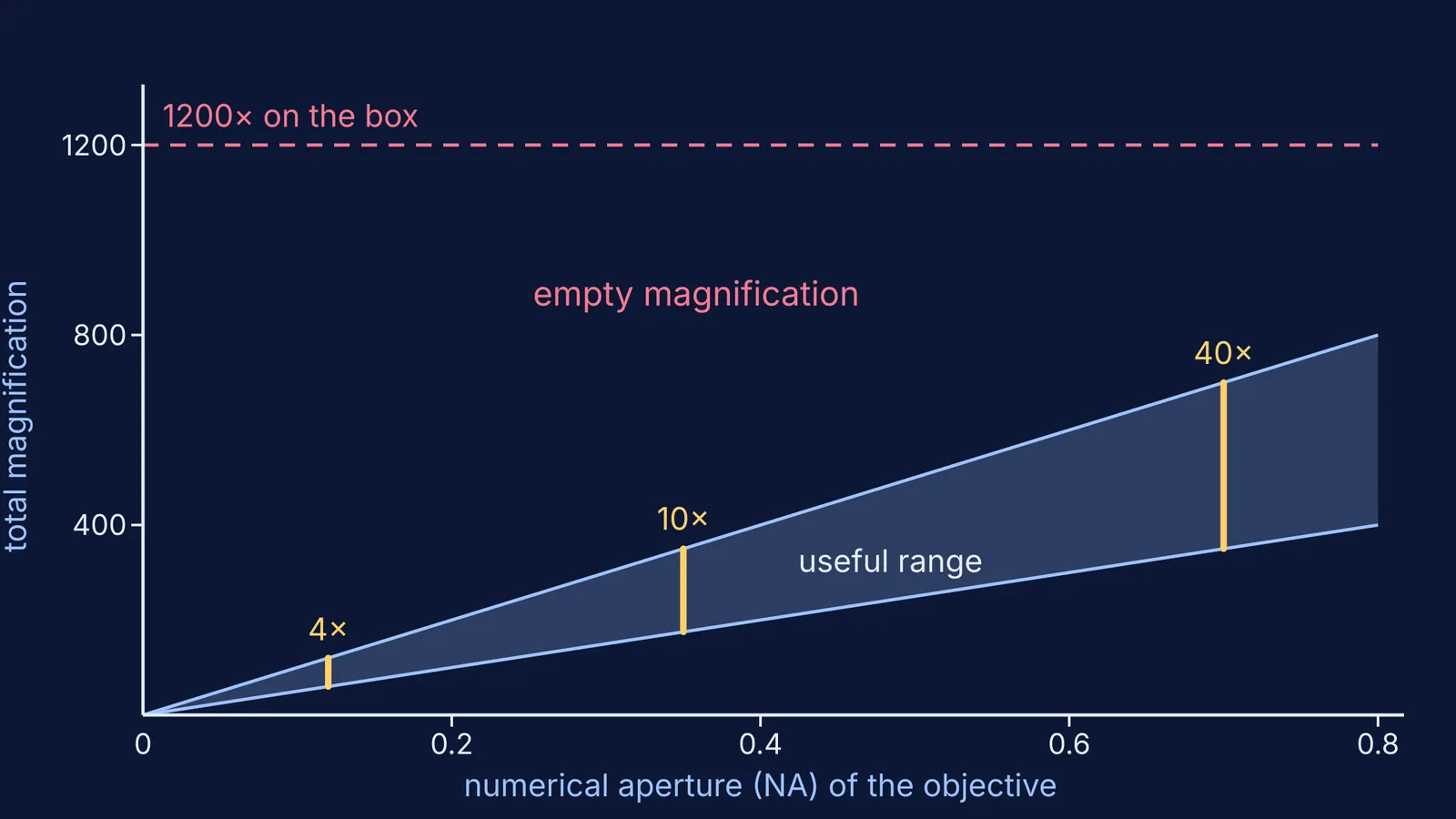
Magnification makes an image bigger. Resolution decides how much detail is in it. Nikon's MicroscopyU guide says useful magnification runs from 500 to 1000 times the numerical aperture (NA) of the objective lens. Past that range you get "empty magnification": the image grows but no new detail appears.
The same guide lists typical values: a 4x objective has an NA of about 0.12, a 10x about 0.35 and a 40x about 0.70. So even a decent 40x objective tops out near 700x of useful magnification. A plastic kit promising 1200x is mostly enlarging blur. MicroscopyU also gives the real-world best resolution of an ordinary light microscope as about 0.25 micrometres, so a home microscope will not show most viruses, however big the number on the box.
What a basic microscope at 40x to 400x does show well:
onion skin cells, neatly lined up like bricks
the pores (stomata) on a thin peel from the underside of a leaf
salt and sugar crystals, which have different shapes
a strand of hair, cotton, wool and polyester side by side
pollen dusted from a flower onto a slide
the dots that make up a printed newspaper photo
Is a toy microscope worth buying, or is a magnifier enough?
For younger children, start with a hand lens. Insects, seeds and fabric are already interesting at low power, and a magnifier goes outdoors. Move to a microscope when your child starts asking what things are made of.
When you do buy, check these before the number on the box:
Glass lenses rather than plastic ones, if the listing says.
A built-in light under the stage, so you never need sunlight.
A low-power objective (4x or 10x) for finding things, not only high power.
A focus knob that moves smoothly and holds still.
A few blank slides and cover slips, so your child can make their own.
Cheap does not have to mean poor. In 2014 Stanford researchers described the Foldscope, a microscope folded from paper with parts costing under one dollar, with magnification from under 100x to over 2,000x. In India, a Biotech Consortium India page on the Foldscope programme says the Department of Biotechnology has supported more than 400 schools and colleges in using it.
Which samples are safe to look at at home?
Everything listed above comes from the kitchen or garden. A few rules keep it safe:
Never point a microscope mirror at the sun. A UK Oak National Academy biology lesson warns that reflected direct sunlight can damage the retina. Use the built-in light or a lamp.
An adult handles blades. Peel onion skin with fingers or tweezers instead.
Skip blood, spit and anything you would need to grow, such as mould on old food. Those belong in a school lab with a teacher.
Wash hands after handling pond water or soil, and keep samples away from younger siblings.
How do you keep a simple observation log?
Drawing is not decoration in science. A 2011 paper in Science argued that drawing should be recognised as a key element in science education. Psychologists at the University of Waterloo found that drawing information boosted memory more than writing it out or picturing it.
Use a plain notebook, one page per sample:
Date and sample ("onion, inner skin").
How it was prepared (dry, a drop of water, a drop of iodine).
Lens used and total magnification (eyepiece times objective).
A circle drawn in pencil, with the sketch inside it.
Three things noticed.
One question to look up later.
Here is what a first page might look like:
Sample: onion skin in a drop of water, 10x eyepiece and 10x objective, so 100x.
Noticed: rows of long boxes; a darker dot inside some boxes; the edges look thicker than the middle.
Question: why are onion cells box-shaped when cheek cells in my textbook are round?
That question is the reward. It leads straight to cell walls, which is where Robert Hooke started: our piece on Hooke's Micrographia and the first use of the word cell tells that story, and Antonie van Leeuwenhoek, the first person to see bacteria shows how far a single lens can go.
When a log question needs a proper answer, the Fermi Concept Library has a lesson for each concept in biology, chemistry and physics, so your child has somewhere to go next.
For more low-cost science at home, try our five safe kitchen science experiments next.


