

On this page
Sitting beside your seventh-grader as they revise for a school maths exam can feel deceptively reassuring. They open their textbook to the chapter on linear equations, work through twelve problems in a row, and get nearly every answer right. Yet three days later, in the school exam hall, the same student stumbles over a basic three-step question. This sudden drop in performance rarely stems from a lack of effort. In Class 7, mathematics makes a sharp conceptual leap from concrete arithmetic to abstract reasoning, introducing negative integers, algebraic variables, and multi-step geometric proofs. Revising each chapter in isolation hides whether a child truly understands when and why to apply each technique.
Why does chapter-by-chapter revision fail in Class 7?
Most revision at home relies on "blocked practice"—completing a block of problems from one topic before moving to the next. When a child works through twenty questions under the heading "Fractions and Decimals," they do not need to figure out which mathematical operation to use; the chapter title has already made that choice for them. They practice execution, but never strategy selection.
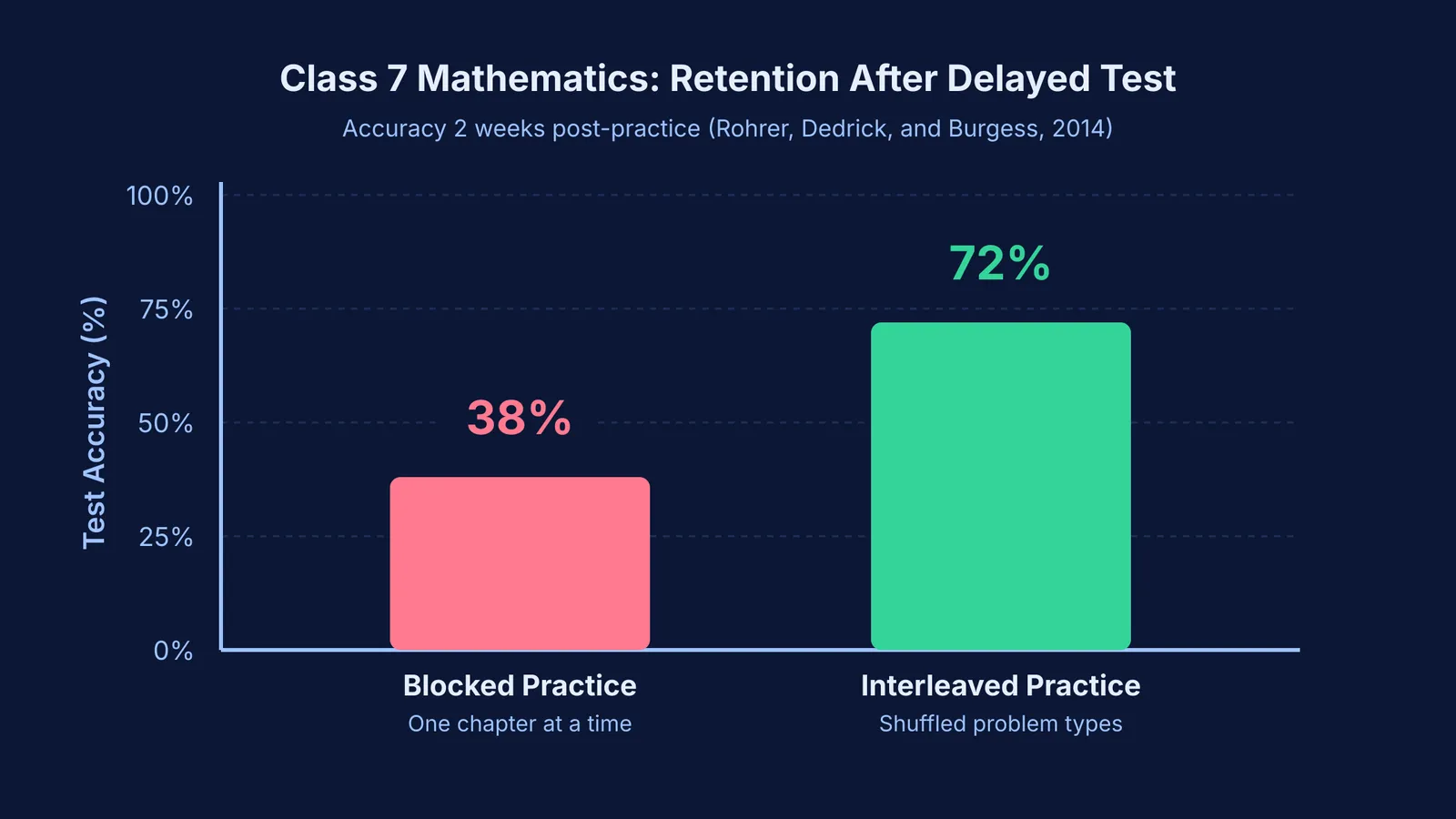
In a landmark 9-week study with 140 seventh-grade mathematics students led by Doug Rohrer, Robert F. Dedrick, and Kaleena Burgess (Rohrer, Dedrick, & Burgess, 2014), researchers compared traditional blocked practice against interleaved practice, where different problem types were mixed together. On an unannounced test two weeks after practice ended, students who practiced with mixed sets scored 72%, while those who practiced in blocks scored only 38%.
When children only review one chapter at a time, they build a fragile familiarity that collapses during a comprehensive exam. This mirrors the findings of the 2013 Dunlosky review of study techniques (Dunlosky et al., 2013), which examined 10 learning strategies and classified practice testing and distributed practice as high-utility methods, while passive rereading and isolated review delivered minimal long-term benefit.
How does mixed practice improve exam recall?
Mixed practice works because it requires discrimination. In a typical Class 7 examination paper, a question on integer multiplication sits right next to a problem on supplementary angles, followed by an algebraic word problem. The student must look at each prompt, identify its underlying structure, and retrieve the correct mathematical principle from memory.
A comprehensive meta-analysis by Steven C. Pan and Timothy C. Rickard (Pan & Rickard, 2018) found that practice testing reliably transfers learning to novel question types and new formats. You can set up mixed practice at home without special worksheets using the "Rule of Three":
Select two questions from an early topic, such as operations on integers or fractions.
Select two questions from mid-term algebra, such as setting up a simple equation or combining like terms.
Select two questions from geometry or mensuration, such as the triangle angle-sum property or perimeter of a composite shape.
Present these six problems on a single sheet of paper in shuffled order. If your child gets stuck on an unfamiliar term or theorem during this exercise, they can look up its formal definition in the Fermi Concept Library, which organizes every concept in mathematics with its own lesson and its place in the map. For multi-step questions where they cannot spot their calculation slip, the Fermi Problem Library provides worked problems with a step-by-step solver that explains the reasoning rather than printing an answer.
How do you set up a maths error notebook at home?
Solving fresh problems is only half of effective revision; understanding why mistakes happened provides the other half. Instead of having your child re-solve questions they already find easy, create a simple notebook divided into three specific error categories:
Concept gaps: The student chose the wrong formula or rule (for instance, calculating the circumference of a circle using 2πr when the question requested area πr², or assuming vertical angles are complementary rather than equal).
Calculation slips: The method was sound, but arithmetic failed (such as writing −5 − 8 = −3 instead of −13, or forgetting to multiply both terms when opening brackets in 3(x − 4)).
Reading slips: The student misread the prompt (calculating simple interest but forgetting to add the principal to find the total amount, or missing units like cm²).
Parents often experience stress when sitting through repetitive mistakes, but reacting with impatience usually triggers defensive avoidance. Understanding parents' maths anxiety helps keep the study environment calm. When you review the error log together, treat each mistake as a clue to be solved. Our guide on helping children learn without adding pressure shares phrasing to keep conversations productive.
What is a realistic 5-day revision timetable for Class 7 maths?
A focused revision schedule does not require four-hour study marathons. In Class 7, forty to fifty minutes of active retrieval per evening produces far better retention than hours of passive textbook flipping.
Day 1: Number Systems and Fractions. Complete eight diagnostic problems covering integer rules, decimal multiplication, and fraction division. Log every mistake in the error notebook.
Day 2: Simple Equations and Expressions. Solve six algebra problems, then complete a mini mixed set containing two integer problems from Day 1.
Day 3: Lines, Angles, and Triangles. Work through six geometry problems involving transversals and the exterior angle theorem, plus two algebra problems from Day 2.
Day 4: Mensuration and Comparing Quantities. Solve six problems on percentages and perimeter/area, followed by an error log re-test where your child re-attempts three flagged questions from Days 1 to 3.
Day 5: Timed Sample Test. Set a kitchen timer for 60 minutes and have your child attempt a balanced, multi-chapter sample paper in exam conditions.
End Day 5 with a supportive 15-minute review of the sample paper. Celebrating steady strategy selection over flawless speed ensures your child walks into the exam room feeling prepared, focused, and confident.


