

On this page
It is common for middle school students to stare at a blank page when asked to write an essay. The transition from writing short paragraphs to structuring an entire argument is a major leap in Class 7.
According to a 2023 meta-analysis in the *Journal of Educational Psychology*, explicitly teaching students strategies for planning and revising has a large positive effect (an effect size of 0.76) on the quality of their writing (Graham et al., 2023). Yet, these structured steps are rarely practised at home.
In fact, only 27% of eighth graders score at or above the proficient level in writing (National Assessment of Educational Progress).
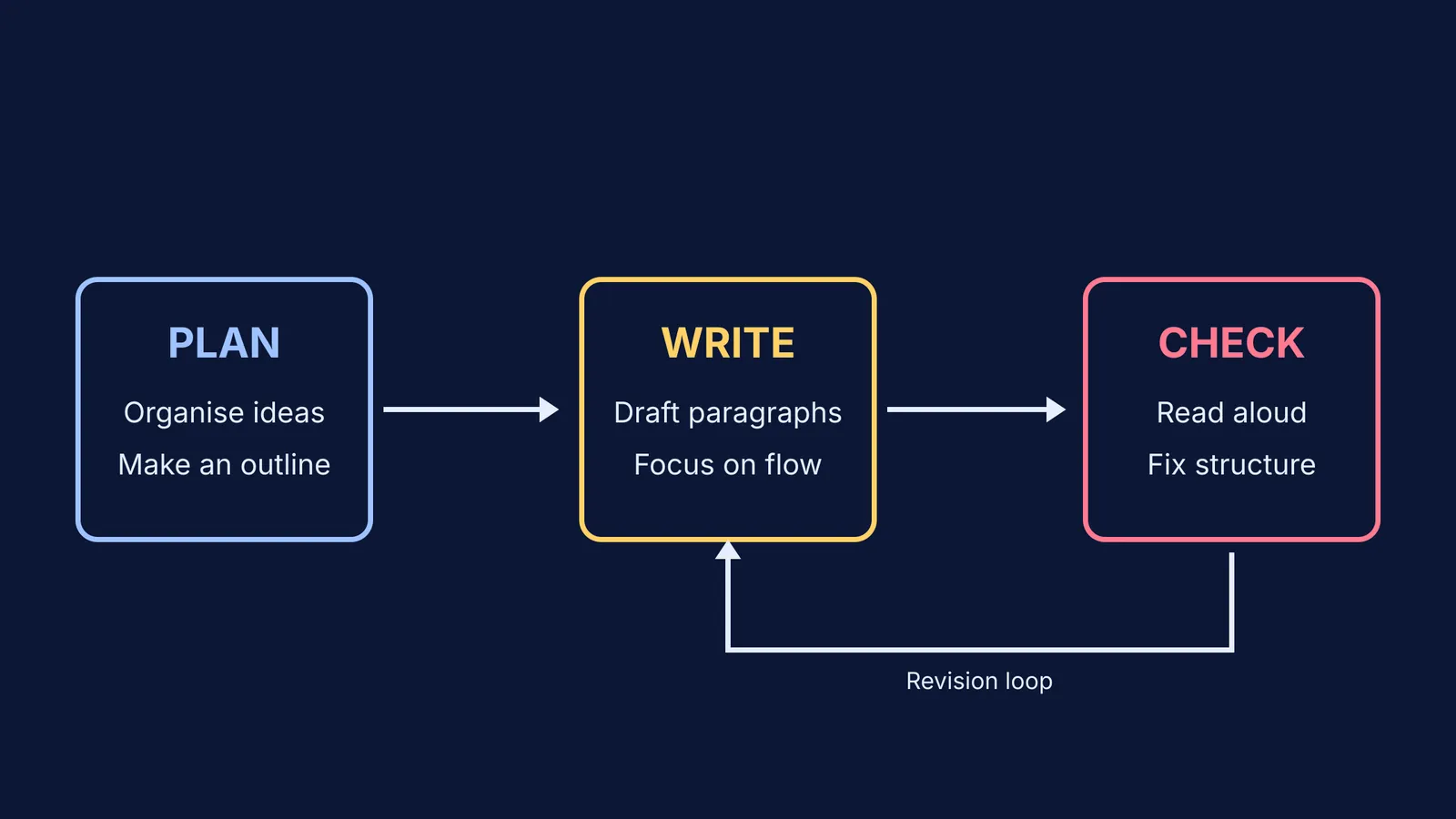
By teaching a simple plan-write-check routine, you can give your child a reliable framework that breaks the looming task into smaller, manageable steps. Here is how to structure that routine.
Why is starting an essay so difficult?
When a child sits down to write an essay from start to finish without a plan, they are trying to do three difficult things at once:
Think of good ideas.
Put those ideas in a logical order.
Spell the words correctly.
This cognitive overload leads to frustration and thin, repetitive essays. Not knowing where to start is the most common hurdle for a 12-year-old. Just as Fermi's AI tutor can work out what a student already knows and build a plan for a study session so they sit down to a clear next step, a writing plan gives your child a safe place to start without needing to write perfect sentences immediately.
How do you plan an English essay?
The first step is separating the "thinking" from the "writing." Give your child a basic template to fill out before they write full sentences. Instead of giving them a blank sheet of paper, draw a simple outline they can fill in. For a standard Class 7 essay, this is often the three-part structure:
Introduction: What is the main point (the thesis)? Give them space to write one clear sentence that answers the prompt.
Body paragraphs (2–3): What is the claim for this paragraph? What is one piece of evidence or an example from their reading to support it?
Conclusion: How does this wrap up the main point without just repeating the introduction word-for-word?
If they struggle to find the right words or get stuck on a concept for a science essay, they can use the Fermi Concept Library lessons to quickly review the subject matter they are trying to write about. For broader help organising their study time, teaching them how to plan their time, one step at a time is a great foundation.
How should a student write the first draft?
Once the outline is done, the goal of the writing stage is momentum. This stage should take up the bulk of their time.
Encourage your child to draft their essay without stopping to fix every spelling mistake, missing comma, or clumsy sentence. Tell them, "Just get the outline into paragraphs. We will fix it later." When students understand that the first draft is just a stepping stone, they are far more willing to take creative risks.
If they pause to worry about whether they used the right vocabulary word, they will lose their train of thought. A good rule of thumb is to have them leave a blank space or write a simple placeholder word and keep moving forward. This reduces anxiety, builds confidence, and helps the ideas flow naturally from one paragraph to the next.
How do you check and revise an essay?
Many Class 7 students think "checking" just means fixing punctuation or running a spell-checker. Without guidance, most students treat revision as mere surface-level editing, missing the chance to improve their argument.
True checking means looking at the structure and flow of the ideas. Before they worry about commas, have your child read their essay aloud. When they read aloud, their ear will often catch missing words, run-on sentences, and awkward phrasing that their eyes skipped over.
Help them check their work by asking structural questions rather than pointing out spelling mistakes:
"Does your second paragraph connect back to your main point in the introduction?"
"Do you have a specific example for this claim, or is it too general?"
"If I had never read the prompt, would I understand what you are arguing?"
By breaking the writing process into three distinct phases, your child learns that a good essay is built, not born. Make this revision loop a regular habit, so they expect to rewrite rather than feeling punished when asked to make changes. With practice, they will tackle their next assignment with a plan instead of a blank stare. If they struggle with structuring answers in other subjects, the same logical approach applies, such as helping your child with maths word problems.


