

On this page
The periodic table has 118 boxes (IUPAC), and most children meet it as a poster to learn from top to bottom. The table already sorts itself into families, and memory research tells you how to use them: small groups, frequent quizzing and gaps between sessions. Here is how to turn that into 15 minutes a day at home.
Why is the periodic table so hard to memorise?
IUPAC approved the name oganesson for element 118 on 28 November 2016, so the modern table runs from hydrogen (1) to oganesson (118) (IUPAC). Since 1988, IUPAC has recommended numbering the columns, called groups, simply from 1 to 18.
Short-term memory holds about four chunks at a time, according to psychologist Nelson Cowan's review of research on memory limits (Cowan, 2001). A row of 18 unfamiliar symbols is far more than that. Chunking is the fix. Once "Li, Na, K" becomes one idea (soft metals that react with water), it fills one slot instead of three.
Does grouping by families actually help?
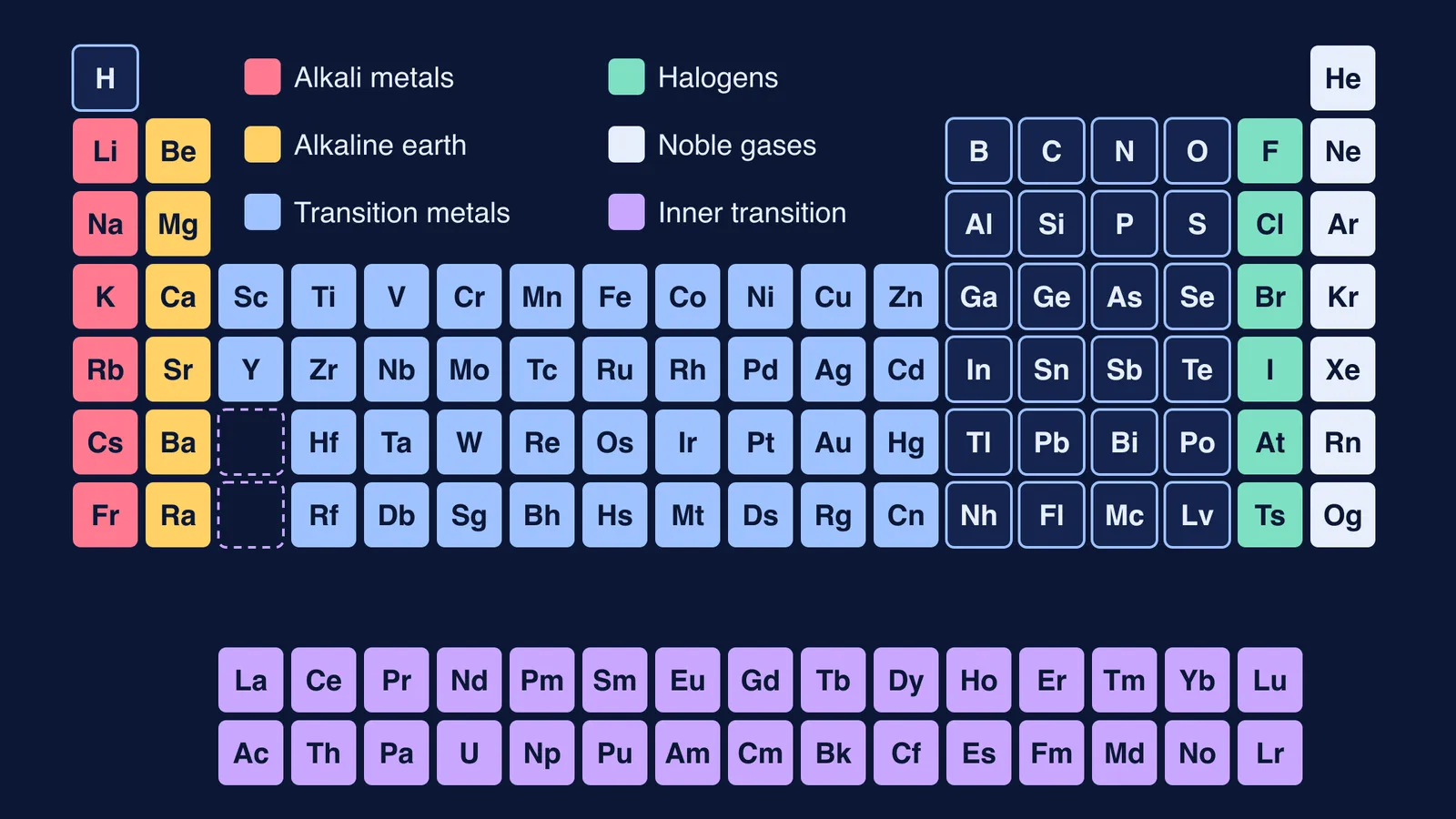
Families give the chunks meaning. Elements in the same group behave alike, so your child learns one story per family instead of one per element. Start with the four families that have the clearest personalities:
Group 1, alkali metals: Li, Na, K, Rb, Cs, Fr.
Group 2, alkaline earth metals: Be, Mg, Ca, Sr, Ba, Ra.
Group 17, halogens: F, Cl, Br, I, At, Ts. They form salts with metals, like the chlorine in table salt.
Group 18, noble gases: He, Ne, Ar, Kr, Xe, Rn, Og. They rarely react.
Then add the transition metals (groups 3 to 12), and leave the two bottom rows, the lanthanoids and actinoids, for last.
Why a family behaves alike comes down to how its electrons are arranged, which is worth understanding, not memorising. The Fermi Concept Library has a lesson for every concept in chemistry, each with its place in the map, so your child can look up periodic trends when the question comes up.
Do mnemonics and songs work for the periodic table?
They make good hooks, but the evidence says they shouldn't be the whole plan. In a 2013 review of 10 study techniques, John Dunlosky and colleagues rated the keyword mnemonic as low utility, and practice testing and distributed practice as high utility (Dunlosky et al., 2013). The keyword mnemonic is one specific technique, not every memory trick. Use a mnemonic to learn the order, and quizzing to make it stick.
Keep each mnemonic to one family. Two to try, or have your child write their own:
Alkali metals: "Little Nina Kept Ruby's Cute Frog" (Li, Na, K, Rb, Cs, Fr)
Halogens: "Funny Clowns Bring Ice-cream At Tea-time" (F, Cl, Br, I, At, Ts)
Songs work the same way. Tom Lehrer's 1959 song "The Elements" is set to the tune of Gilbert and Sullivan's "Major-General's Song" and runs through all 102 elements known at the time, up to nobelium (Wikipedia)). It isn't in table order, so use it for names, not positions.
How should flashcards be used at home?
Flashcards only work if your child tries to answer before flipping the card. In two experiments by Henry Roediger and Jeffrey Karpicke, students who took recall tests remembered more 2 days and 1 week later than students who restudied, even though restudying made students more confident (Roediger and Karpicke, 2006).
Timing matters too. A meta-analysis of 839 assessments from 317 experiments found that the best gap between study sessions grows with how long you need to remember (Cepeda et al., 2006). For a test a month away, spread revision over weeks, not one evening.
A simple setup:
Deck one: symbol on the front; name, group number and family on the back.
Deck two: "group 17, period 3" on the front; "Cl, chlorine" on the back.
Three piles: got it, slow, missed. Missed cards come back tomorrow. Got-it cards come back in a few days.
What does a four-week plan look like?
Aim for 15 minutes a day, five days a week:
Week 1: groups 1 and 2, plus H and He.
Week 2: groups 17 and 18. Begin each session with two minutes of week 1 cards.
Week 3: groups 13 to 16 for periods 2 and 3 (B to O, Al to S). This finishes the first 20 elements.
Week 4: the first row of transition metals (Sc to Zn), then a blank-table challenge. Your child fills an empty 18-column grid from memory, and you check it together.
What to say during the quiz:
"Don't look yet. What's your best guess?"
"Which family is it in? What else is in that family?"
"You missed bromine yesterday and got it today. That's how this works."
If your child gets stuck on why the families behave as they do, Fermi's AI tutor can work out what your child already knows and build a plan for the session, so they start with a clear next step.


