

On this page
Children who sell in markets often do quick mental sums that would stump them on a worksheet, and many schoolchildren have the opposite problem. A shopping trip lets you work on both. Below is a plan by age, a worked ₹500 budget and a short script for unit prices.
Why is shopping good maths practice for children?
In a 2025 study in Nature, economists Abhijit Banerjee, Esther Duflo and colleagues surveyed 1,436 children who work in markets in Kolkata and Delhi. In one Delhi round, 85% worked out the correct amount due and change in market transactions, yet the working children "were unable to solve arithmetic problems of equal or lesser complexity when presented in the abstract format typically used in school" (full text). Schoolchildren showed the opposite gap: only 1% of non-working children solved a market-style word problem in one try, and 5% by a second try, when some were given a hint.
The authors call for curricula that connect abstract maths symbols to "intuitively meaningful contexts and problems". The same split appeared four decades earlier among young street vendors in Recife, Brazil, who did better on maths inside real transactions than on school-type problems with the same numbers (Carraher, Carraher and Schliemann, 1985).
The lesson for parents is not "shopping instead of school". It is to let your child do a sum in their head at the shop, then write the same sum down at home, so the two kinds of maths meet.
Estimation is worth practising on its own. Booth and Siegler (2006) tested children from kindergarten to Grade 4 and found that every type of estimation skill they measured was positively related to maths achievement test scores.
How do you teach kids maths while shopping, by age?
Ages 5 to 7: count items into the basket, point to the bigger number on two price tags, and pay with one note, then count the change together.
Ages 7 to 9: add two prices, round each price to the nearest ten, and ask "how much change from ₹100?"
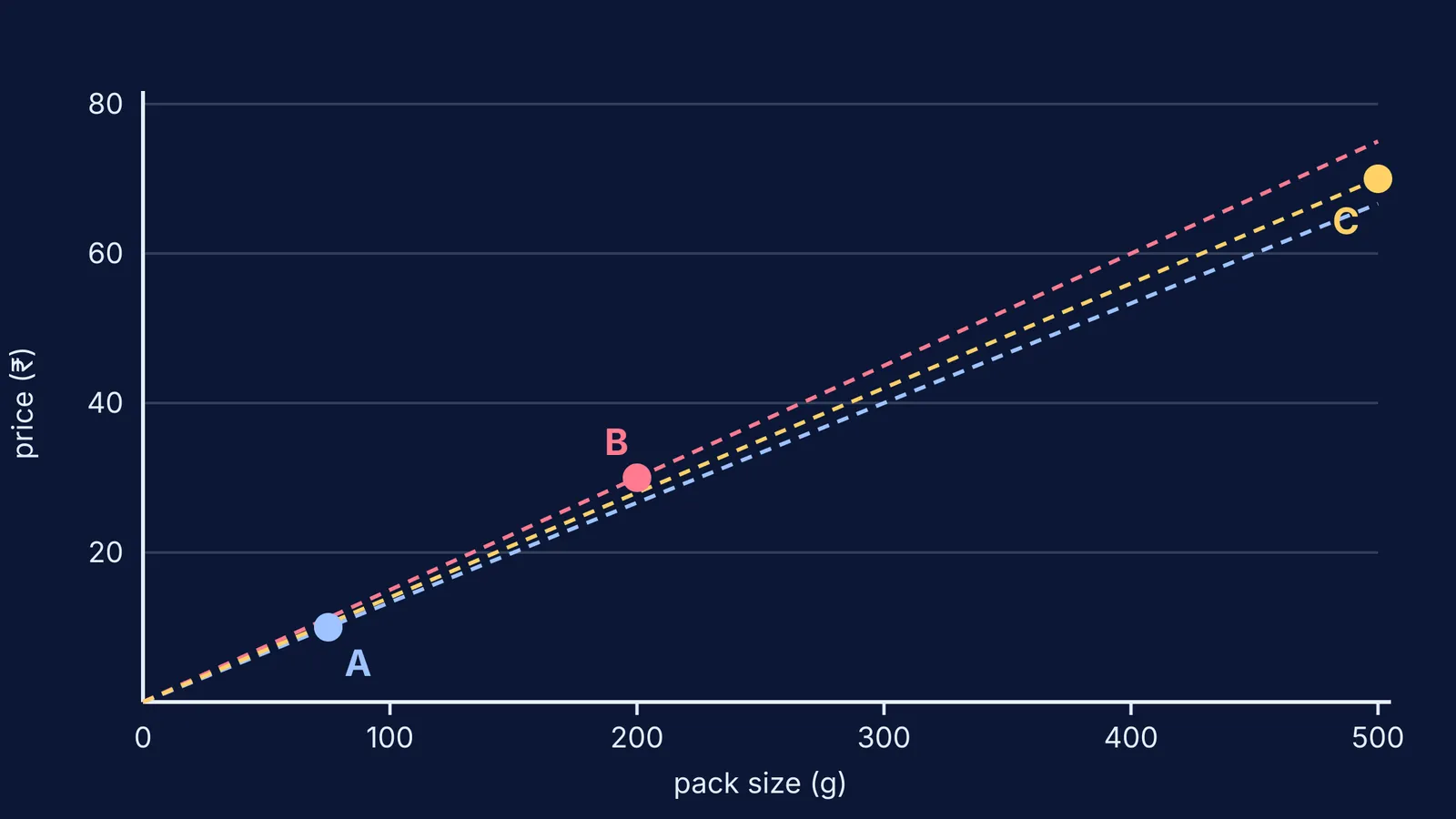
Ages 9 to 11: hold a budget for the whole list, keep a running estimate, and compare the price per 100 g of two pack sizes.
If numbers make you uneasy yourself, read what research found about parents' maths anxiety before you start. With younger children, the ideas in everyday maths talk with young children fit into the same trip.
What does a ₹500 budget look like as a maths lesson?
Give your child the list and a ₹500 limit (try it with play money at home first). The prices below are made up for practice.
Read the prices: ₹48, ₹62, ₹119, ₹27 and ₹85.
Round each to the nearest ten: 50, 60, 120, 30 and 90.
Add the rounded numbers to get 350. Ask: "Is that under ₹500? By roughly how much?"
At the counter, compare the bill with the estimate. The exact total is ₹341, so the estimate was ₹9 high, close enough to trust.
Work out the change by counting up from the bill: ₹341 to ₹350 is 9, to ₹400 is 50 more, to ₹500 is 100 more. The change is ₹159.
Back home, write 500 − 341 as a column subtraction and check that it also gives 159. That is the shop sum and the school sum side by side.
How do you explain unit price to a child?
A unit price is the cost of one standard amount, such as one gram or 100 g, so that packs of different sizes can be compared fairly. In India, the Department of Consumer Affairs introduced a unit sale price on pre-packed goods, saying it "will allow easier comparison of the prices of the commodities at the time of purchase" (PIB, 8 November 2021). Ask your child to find it on the pack.
A worked example with made-up biscuit prices:
Pack A: 75 g for ₹10, so about ₹13.33 per 100 g.
Pack B: 200 g for ₹30, so ₹15.00 per 100 g.
Pack C: 500 g for ₹70, so ₹14.00 per 100 g.
Here the smallest pack is the cheapest per gram and the middle pack is the dearest. That surprise is the lesson: bigger is not always cheaper, so check.
A script you can use at the shelf:
"Which pack do you think is better value? Why?"
"What would 100 g of each one cost?"
"Now find the unit price on the label. Were you right?"
"Will we finish 500 g before it goes stale?" Value is not only price.
If your child stalls when turning a shopping story into a sum, the questions in helping your child with maths word problems work at the shelf too. When unit rates grow into ratio and proportion in middle school, the Fermi Concept Library covers every concept in mathematics, each with its own lesson, so you can look up the idea together.
On your next trip, hand over the list and ask for one estimate before you reach the counter.


