

On this page
Finding the right financial support for senior secondary education can ease the burden on families and keep students focused on their goals. The Central Government and various state governments run dedicated scholarship schemes for girls in Classes 11 and 12.
Most of these schemes are designed either to reward academic merit or to support families under a specific income threshold. Here is a breakdown of the major scholarships available and how to apply for them.
What are the central scholarships for girls in Class 11 and 12?
The Central Government manages several schemes that apply across the country, mostly processed through a single portal.
CBSE Merit Scholarship for Single Girl Child: This scheme rewards girls who are the only child in their family. The applicant must have secured 60% or more marks in her CBSE Class 10 examination and continue her Class 11 and 12 studies in a CBSE-affiliated school (CBSE). It provides ₹500 per month for a period of two years (CBSE). The tuition fee of the school should not exceed ₹1,500 per month during Class 10 (CBSE).
Begum Hazrat Mahal National Scholarship: Managed by the Ministry of Minority Affairs, this scholarship supports girls from notified minority communities (Muslim, Christian, Sikh, Buddhist, Jain and Parsi). To be eligible, the student must have scored at least 50% marks in the previous class, and the family's annual income must not exceed ₹2 lakh (NSP). It offers ₹6,000 per annum for girls in Classes 11 and 12 (NSP).
AICTE Pragati Scholarship for Girls: If a student chooses to pursue a technical diploma immediately after Class 10 (which is an equivalent stage to Classes 11 and 12), this scheme offers substantial support. The AICTE Pragati Scholarship provides ₹50,000 per annum to girls admitted to the first year of a technical diploma or degree (NSP). The family income must be below ₹8 lakh per year, and a maximum of two girls per family can receive it (NSP).
How do state-specific scholarships work?
Many state governments run their own direct-benefit transfers to keep girls in school. These often do not require the student to be in a CBSE-affiliated school. Parents should check their specific state's Department of Women and Child Development website.
A prominent example is West Bengal's Kanyashree Prakalpa. It offers an annual ₹1,000 grant (K1) for unmarried girls aged 13 to 18 (Kanyashree). More significantly, it provides a ₹25,000 one-time grant (K2) when the girl turns 18, provided she remains unmarried and is still enrolled in an educational or vocational institution (Kanyashree).
What is a four-step preparation plan for parents?
To make sure you do not miss out on a scholarship cycle, follow this simple preparation plan:
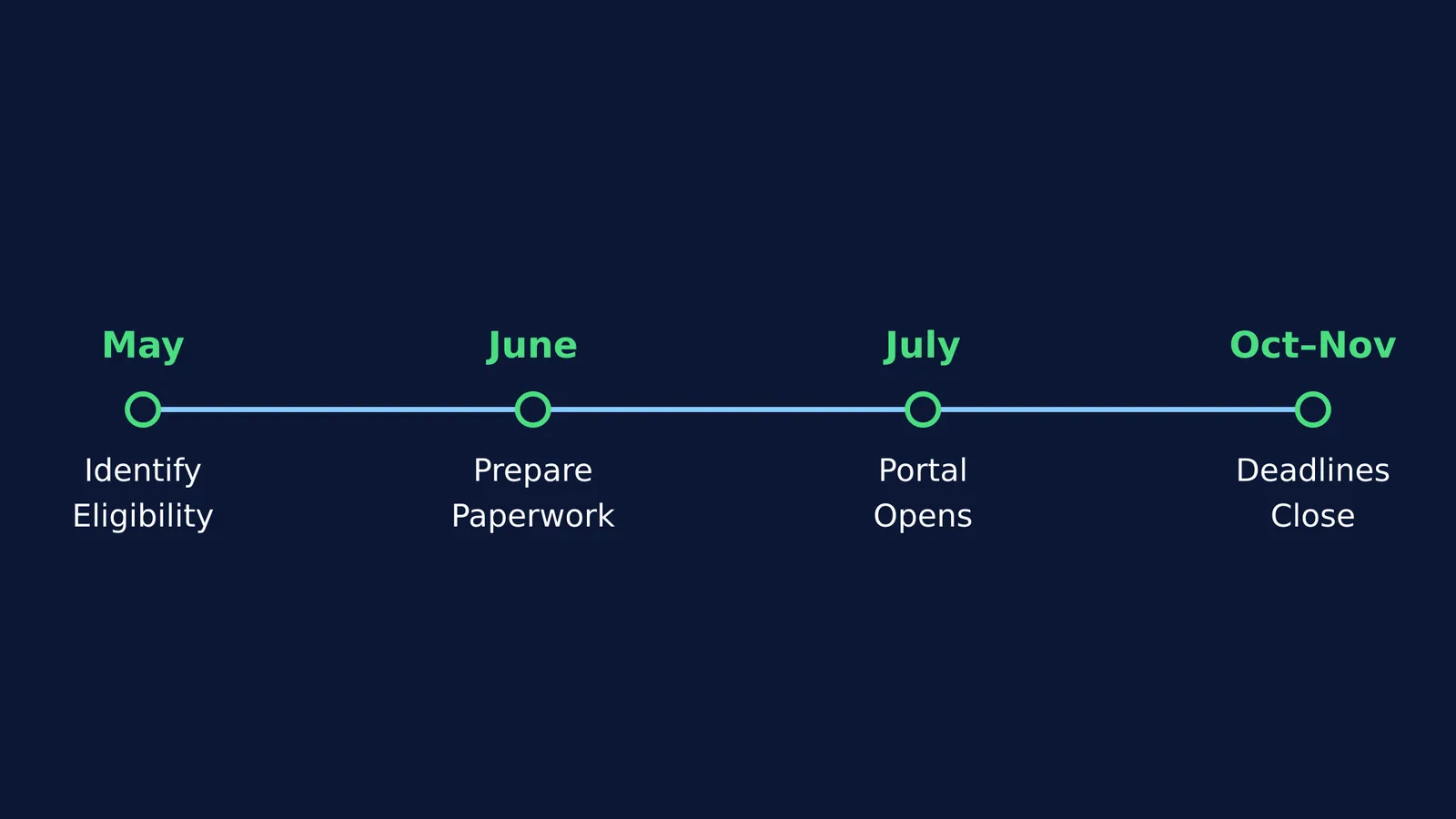
Identify eligibility early: By May, list the schemes your child qualifies for based on her Class 10 percentage, your family income and your state of residence.
Prepare the paperwork: Income certificates and caste or community certificates often take weeks to process. Apply for these from your local administration office in June. Ensure your child's bank account is in her name and seeded with her Aadhaar number.
Track the National Scholarship Portal: Bookmark the NSP website. Create the mandatory One-Time Registration (OTR) profile as soon as the portal opens in July.
Follow up with the school: Many scholarships require the school principal to verify the application online. Inform the school clerk or administration once you submit the form.
When and how should you apply?
The application cycle for most central schemes follows the academic year. The central hub for applications is the National Scholarship Portal. The portal usually opens for fresh applications in July and closes between October and November. Keep the student's Aadhaar card, previous year's mark sheet, an income certificate and an Aadhaar-seeded bank account passbook ready before you begin the online application.
While families manage the paperwork and application deadlines, students can maintain their focus on coursework. The transition to senior secondary science can be steep. If you are helping your child balance Class 12 boards and entrance exams or starting JEE prep in Class 12, an organised routine helps.
When learning complex physics or maths topics at home, Fermi's AI tutor works out what a student already knows, builds a plan for the session, and teaches through it — writing on a board, drawing the figure, running the simulation, and checking understanding as it goes. For students who need more practice, the Fermi Problem Library has worked problems with a step-by-step solver that explains the reasoning rather than printing an answer.
Finding the right scholarship requires a bit of research early in the academic year. By gathering the necessary documents in advance and checking both central and state portals, you can secure financial support that makes the final years of schooling much smoother.


