

On this page
When a video game invites a child to open a mystery crate, treasure chest, or card pack, it looks like harmless play. Bright animations flash, dramatic music swells, and an ultra-rare item seems to roll past before the prize is revealed. Behind this spectacle lies a monetization feature known as a loot box: a digital container whose contents are randomised after payment. For parents, understanding whether these chance mechanics mirror gambling is now an urgent practical question.
What makes a loot box structurally similar to gambling?
In traditional games, players earn rewards through practice, problem-solving, or time spent mastering challenges. Loot boxes change this contract by exchanging real money for an uncertain outcome chosen by an algorithm.
Researchers find this structure identical to traditional gambling. A study in Nature Human Behaviour analyzed 22 games with loot boxes and found that 45% met all five psychological criteria for gambling: exchanging money, an unknown future event, chance-determined outcomes, avoidable loss, and winning at another's expense.
The underlying mechanism is a variable-ratio reinforcement schedule. Because rewards arrive unpredictably, players cannot foresee which attempt will succeed, generating persistent engagement. In a survey of 7,422 gamers published in PLOS ONE, loot box spending correlated significantly with problem gambling severity (η² = 0.054). That link was over ten times stronger than the link between problem gambling and buying fixed-price cosmetic items (η² = 0.004). For more on reinforcement schedules, see how extrinsic reward loops influence behaviour.
Why are teenagers and children especially vulnerable?
Children and teenagers evaluate risk differently than adults. Neurodevelopmental evidence shows that the brain's reward centre—the ventral striatum—matures rapidly during adolescence, while the prefrontal cortex, which governs impulse control and long-term planning, develops well into the mid-twenties.
This developmental mismatch leaves young players receptive to reward anticipation. A study of 1,155 older adolescents aged 16 to 18 in Royal Society Open Science found that 40.5% had bought a loot box in the past month. Spending was linked to problem gambling severity with an effect size of η² = 0.120, nearly four times higher than for direct in-game purchases (η² = 0.032).
Yet chance mechanics remain widespread in titles aimed at youth. Research in Addiction found loot boxes in 58.0% of top Google Play games and 59.0% of top Apple App Store games, with over 93% rated suitable for children aged 12 and above. Setting healthy gaming boundaries for teenagers helps families balance play and daily habits.
How do games disguise the real cost and odds?
Games rarely charge real currency directly per box. Instead, they introduce psychological buffers that obscure true costs:
Currency decoupling: Converting rupees into gems or coins separates cash spent from credits consumed.
Near-miss animations: Showing an ultra-rare prize stop one slot away activates the ventral striatum. Research in Neuron shows near-misses trigger dopamine responses resembling actual wins, driving repeat play.
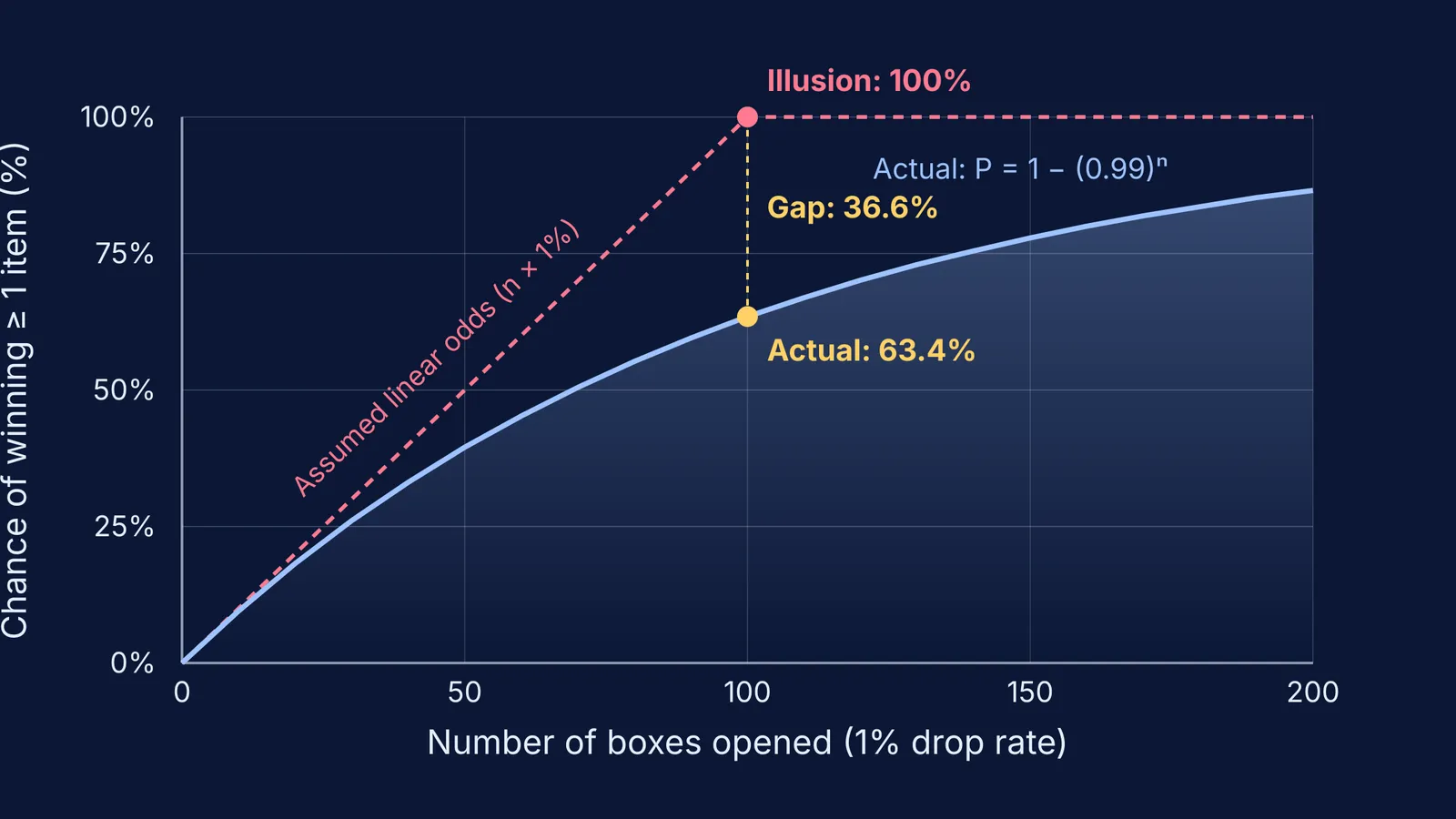
Independent odds: A 1% drop rate does not guarantee success across 100 crates because each roll is an independent trial.
We unpack this compounding effect in our guide to probability in repeated trials.
How can parents talk about gaming microtransactions at home?
Lectures and abrupt bans often provoke secrecy. A constructive conversation demystifies the game's business design:
Convert to rupees: Translate virtual tokens into actual currency. Ask: "If this outfit cost ₹1,200 in a regular shop, would you buy it?"
Calculate the odds together: Walk through how repeated independent trials work. Opening one hundred crates with a one-in-a-hundred drop rate still leaves more than a one-in-three chance of walking away empty-handed. This reframes the crate from an inevitable reward into an unfavorable gamble.
Value skill over cosmetics: Remind your child that avatars do not improve gameplay mastery.
Teaching young players how independent trials work dismantles the illusion that a rare prize is "due". While schools rarely connect textbook maths to video game interfaces, the Fermi Concept Library explains probability and expected value from first principles, and the Fermi Problem Library uses a step-by-step solver that explains the reasoning behind compounded odds across repeated attempts.
What practical settings and rules keep spending under control?
Parental conversations work best alongside device-level boundaries:
Disable one-click payments: Remove saved cards and UPI auto-pay mandates from app stores, requiring biometric verification for every transaction.
Enforce purchase caps: Use Google Family Link or Apple Screen Time to set a zero-rupee limit on in-app spending.
Choose transparent games: Favor titles with upfront pricing or direct cosmetic stores over randomized reward containers.


