

On this page
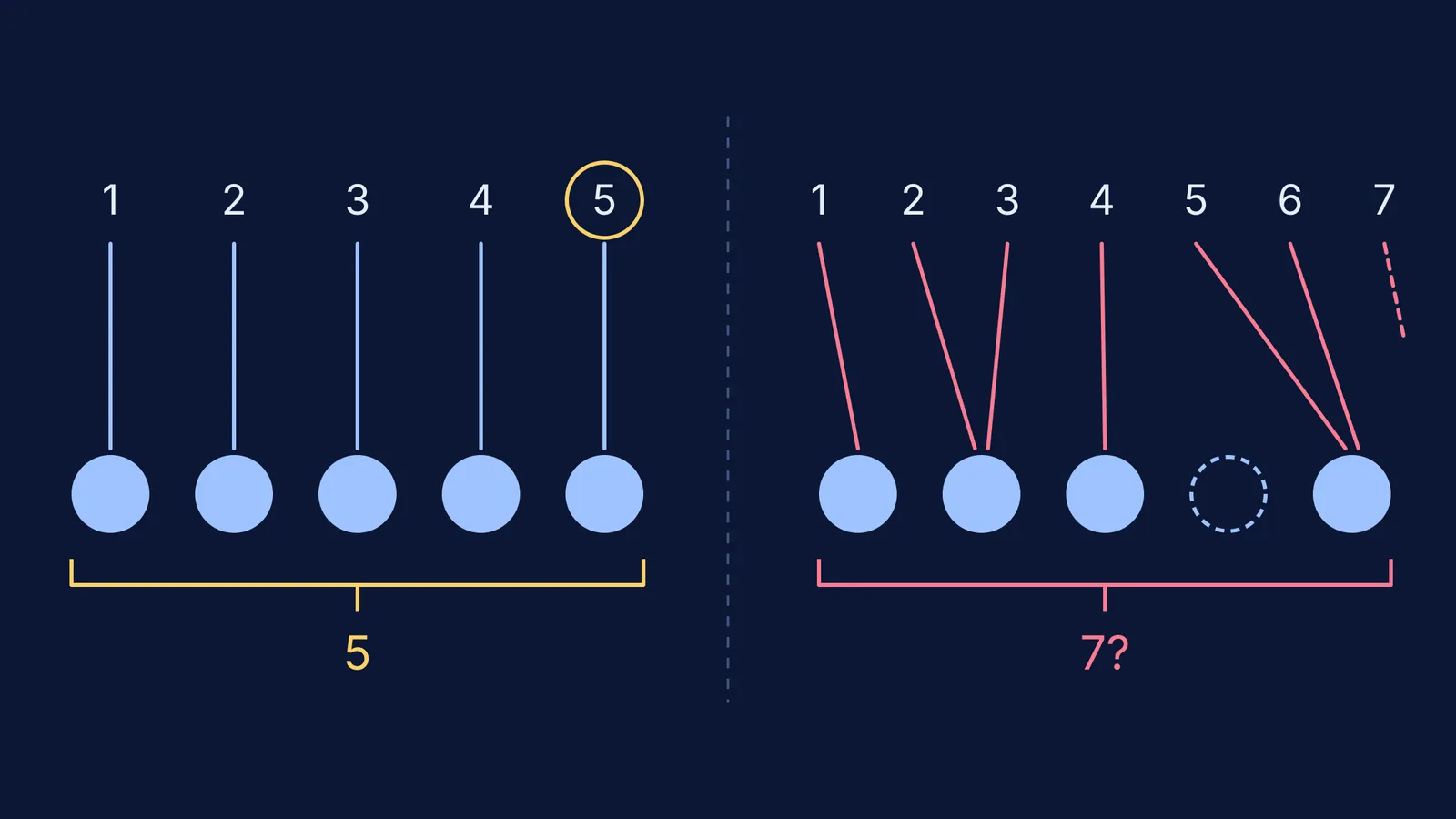
Your four-year-old rattles off 'one, two, three... twenty' in the car. Then you put four bananas on the table, ask 'how many?', and hear 'seven'. This is common, and it tells you something useful: saying the number words in order and understanding what they mean are two different skills, learned at different times.
Why can my child count to 20 but not say how many?
For a young child, the count list starts out like a rhyme: first attempts at counting are often a numerically meaningless recitation of number words (Pixner, Dresen and Moeller, Frontiers in Psychology, 2018).
Psychologist Karen Wynn found that 2- and 3-year-olds could count objects, but only the older children (mean age 3.6 years) usually answered 'how many?' with the last number they had said (Wynn, Cognition, 1990). Her children learned 'one', then 'two', then 'three', before grasping how counting works at roughly three and a half. That is an average from a small group, not a deadline.
What is the difference between reciting and counting?
Real counting combines three ideas, described in the same Frontiers in Psychology review:
Stable order: the number words always come in the same sequence.
One-to-one matching: each object gets exactly one number word, with none skipped and none counted twice.
Cardinality: the last number word you say tells you how many there are in the whole set.
Reciting covers only the first idea. And repeating the last word is not proof: Barbara Sarnecka and Susan Carey found that many 2- to 4-year-olds answer 'how many?' with the last word used in counting despite not understanding how counting works (Cognition, 2008).
How can I check whether my 4-year-old understands numbers?
Try a home version of the 'give-a-number' task researchers use (Wynn, 1990):
Put about ten buttons, bottle caps or rajma beans in a bowl.
Sit a toy beside your child and say, 'Can you give Teddy two?'
Ask for three, then five, then four.
After each, ask, 'Is that five? Can you check?'
Watch how your child answers. Counting the items aloud and stopping on the asked-for word shows they understand how counting works. Getting one and two right but grabbing a handful for five means they are still learning small numbers one by one; in Wynn's study, younger children managed only one and sometimes two, and never used counting.
Which one-to-one matching games help at home?
India's National Curriculum Framework for the Foundational Stage, which covers ages 3 to 8, lists matching, sorting, pairing and one-to-one correspondence among the mathematical vocabulary children learn in the early years (Section 4.5.2). Try these:
Setting the table: 'Everyone needs one plate. Do we have enough for Dadi, Papa, you and me?'
Touch and move: move each laddoo from the box to a plate as you say its number, so nothing is counted twice.
Stop at five: your child drops buttons into a cup while you count slowly, and must stop at five; then swap roles.
Number track race: play a board game on a straight line of numbered squares, saying each number as you move: 'I'm on four, now five, six.'
That last game has evidence behind it. Geetha Ramani and Robert Siegler found that roughly one hour in total of a linear number board game improved low-income preschoolers' (mean age 5.4 years) number comparison, number line estimation, counting and numeral identification, with gains still present 9 weeks later; the same game with coloured instead of numbered squares did not help (Child Development, 2008).
For more ideas, see our guide to maths talk with young children.
Should my child write numbers before understanding them?
Not yet. The NCF for the Foundational Stage describes a sequence called ELPS: a concrete Experience such as counting three balls, then spoken Language about it, then Pictures such as drawing three balls, and only then the written Symbol 3. A neat page of 1 to 10 practises handwriting; it does not show that your child knows seven is more than five.
The foundation matters: an analysis of six long-term studies covering close to 36,000 preschoolers in the US, Canada and England found early maths skills at school entry were the strongest predictor of later achievement (ScienceDaily report on Duncan and colleagues, 2007; paper).
If numbers make you anxious yourself, read our piece on parents' maths anxiety. An older sibling can run the Teddy game, and when their own school maths stalls on an idea, the Fermi Concept Library has a lesson for every concept in mathematics.
If your child still finds quantities very hard after starting school, despite lots of play, talk to their teacher; our guide to dyslexia and dyscalculia signs and assessment explains next steps. Tonight, start with plates at dinner.


