

On this page
On launch days, living rooms across India fall quiet as the countdown clock reaches zero. The sudden flare of rocket boosters and the deep rumble from Sriharikota capture children’s imaginations immediately. Yet without context, that spectacle quickly fades once the rocket vanishes into the clouds. In a study published in the *International Journal of Science Education*, researchers Adam Maltese and Robert Tai surveyed 1,165 scientists and graduate students and found that 65% experienced their initial interest in science before middle school, sparked largely by informal family experiences rather than classroom textbooks (Maltese & Tai, 2010). Tracking space missions—from lunar landings like Chandrayaan-3's lunar landing to solar observations with Aditya-L1—offers families an authentic bridge between real engineering and kitchen-table curiosity.
Why do space missions spark lifelong curiosity in children?
Rockets give children a direct visual demonstration of natural laws operating on a massive scale. When a launch vehicle lifts hundreds of tonnes of propellant against gravity, abstract ideas like thrust and acceleration become visceral events.
How parents discuss these events matters. In *Psychological Science*, Kevin Crowley and colleagues observed families in informal science spaces and found that parents were three times more likely to explain causal science concepts to boys than to girls, despite engaging both equally in basic observations (Crowley et al., 2001). Consciously offering causal explanations—discussing why and how things work rather than just admiring the flame—helps all children build scientific reasoning and see themselves as capable thinkers.
How can families decode an ISRO launch broadcast together?
During an ISRO launch broadcast, the mission control screen displays flight telemetry that tells a clear physics story:
Altitude (km): Vertical height above sea level. The climb starts slowly because the vehicle is heaviest at liftoff when propellant tanks are full.
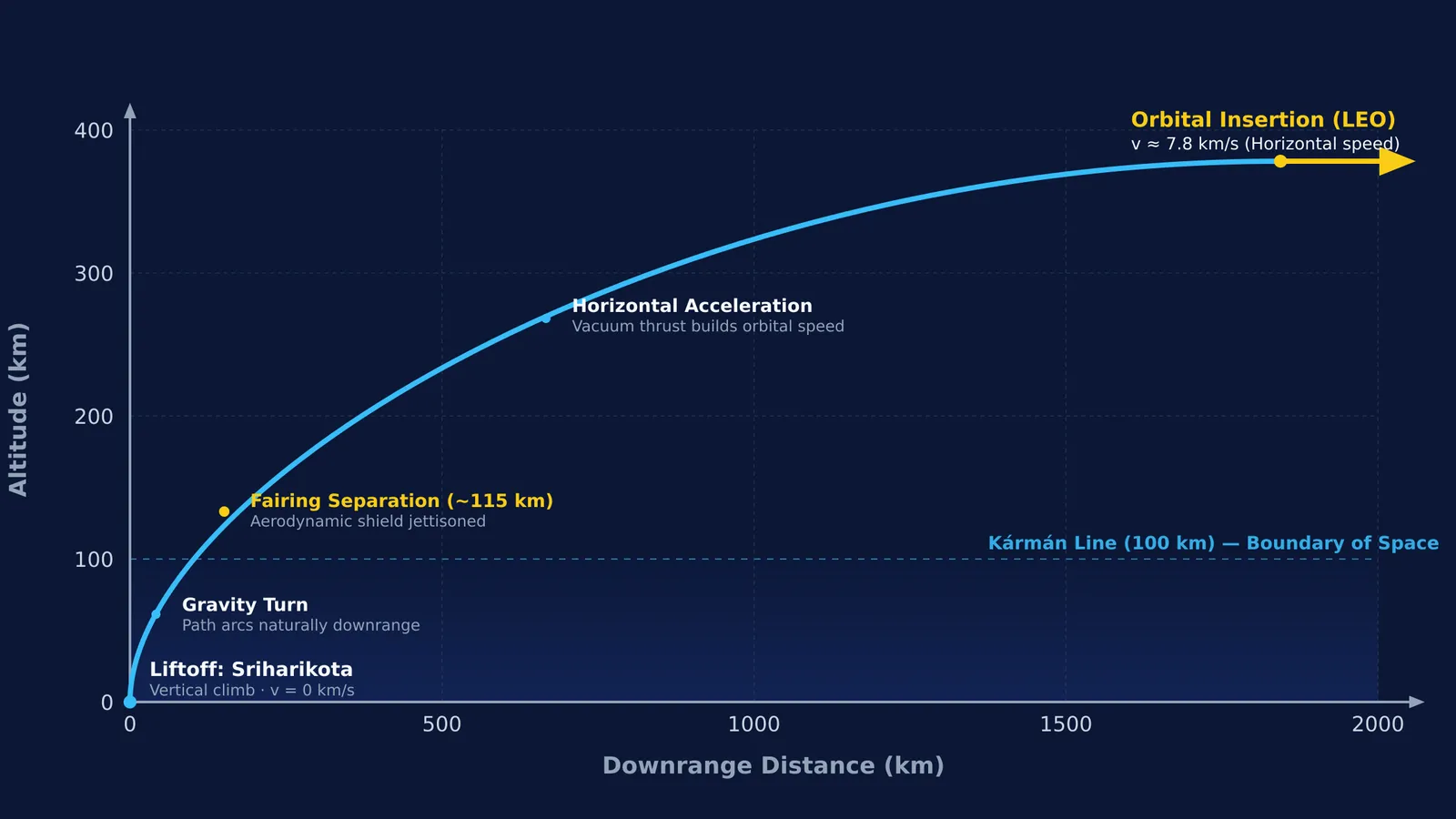
Velocity (km/s): Current speed. In orbital launches, the vehicle starts at zero and must reach roughly 7.8 km/s to enter Low Earth Orbit.
Downrange distance (km): Horizontal distance travelled eastward over the Bay of Bengal from Sriharikota.
The trajectory graph: The altitude-versus-range plot shows the flight path bending sideways rather than pointing straight up.
To turn these numbers into an active chat, try a four-step routine:
Observe: Ask your child which number changes fastest after the first two minutes.
Predict: When strap-on boosters burn out, ask what happens to the empty casings.
Explain: Point out that dropping spent stages sheds dead weight so subsequent engines do not waste fuel pushing empty metal.
Connect: Relate the horizontal curve to how satellites stay in orbit—traveling sideways fast enough that the planet's surface curves away beneath them.
For ideas that are difficult to visualize on screen, such as why an orbiting spacecraft is in continuous free fall, the Fermi Simulation Lab offers interactive simulations for ideas that are easier to see than to read. Connecting broadcast graphics to orbital speed and gravitation calculations helps teenagers link real flight parameters to high school mechanics.
What everyday questions turn rocket news into active thinking?
You do not need to wait for a launch day to talk about space. Mission news about Gaganyaan crew module development or weather satellites can prompt quick conversations at dinner:
Why do ISRO rockets launch towards the east from Sriharikota? Earth's eastward rotation provides a natural velocity boost near the equator, while spent stages drop safely into the ocean.
Why does the payload fairing split open at 115 km altitude? Above the dense atmosphere, friction and heat drop away, so shedding the shield lightens the vehicle.
How do weather satellites track cyclones? Orbital radar and infrared sensors monitor storm spirals in real time to protect coastal communities.
When students want to explore the mathematical relationships behind these questions, the Fermi Concept Library offers lessons across physics and mathematics, each with its place in the map.
Where can students take their space interest next in India?
When a child's interest in space begins to grow, families can explore structured national opportunities:
ISRO Launch Viewing Gallery: Families can register for free to watch launches in person at Satish Dhawan Space Centre SHAR in Sriharikota through ISRO's official visitor registration portal. The gallery accommodates 5,000 visitors, with registration opening 4 to 5 days before scheduled launches.
YUVIKA (Young Scientist Programme): ISRO runs a two-week fully funded residential summer camp for Class 9 students covering rocketry and satellite design through the ISRO Antriksh Jigyasa portal.
Planetariums and Science Centres: Pairing missions with local science museum and planetarium visits gives younger children tactile exhibits with gyroscopes, vacuum chambers, and scale models.


