

On this page
The board exam year runs straight through Diwali, Bhai Dooj and the winter wedding season, with the papers a few months later. What works is deciding ahead, event by event, and planning study around those choices.
As of late October 2026, CBSE had not yet posted the 2027 date sheet on its official website. When it appears, add it and your school's pre-boards to the family calendar.
Which family events should you attend during board exam prep?
Put every invitation into one of three tiers:
Go fully: the core of your family's year, such as Diwali puja at home or a sibling's or close cousin's wedding.
Go for the main part: attend the pheras or the reception, bless the couple and leave, and skip the haldi, mehendi and sangeet.
Send your love, not yourself: functions for distant relatives, and anything that clashes with a pre-board or the final run-up to a paper.
To pick the tier, ask:
How close is it to a pre-board or a paper? The closer it is, the lower the tier.
Would you still regret missing it after results day?
Can you go for the part that matters and come home?
Will you still get a full night's sleep?
Teenagers aged 13 to 18 should sleep 8 to 10 hours per 24 hours on a regular basis, according to a consensus statement from the American Academy of Sleep Medicine. A reception that ends at 1 am, followed by a 6 am alarm, costs you the next day too.
How do you plan study around Diwali and weddings?
Spacing is on your side. A meta-analysis of verbal recall studies by Nicholas Cepeda and colleagues, covering 839 assessments in 317 experiments, found that spreading study across separate sessions helps later recall more than massing it together (Psychological Bulletin, 2006). So one light day inside an otherwise spaced plan is unlikely to cost much; a blank week followed by cramming is the pattern to avoid.
Work ahead: add an extra hour on the days before a busy stretch.
Keep a minimum day: on event days, do one short session in the morning before the house fills. Recall formulas from memory, do one past-paper section, or write out a derivation without the book.
Save new chapters for normal days: keep event days for revision and flashcards.
Start later after a late night: sleep in, then begin from late morning.
Put a buffer day after each busy stretch to catch up.
If you sit down for a short session and don't know where to start, Fermi's AI tutor can work out what you already know and build a plan for that session. For the bigger picture, see our Class 12 board revision plan and how to build a spaced revision schedule.
A worked example: one fortnight
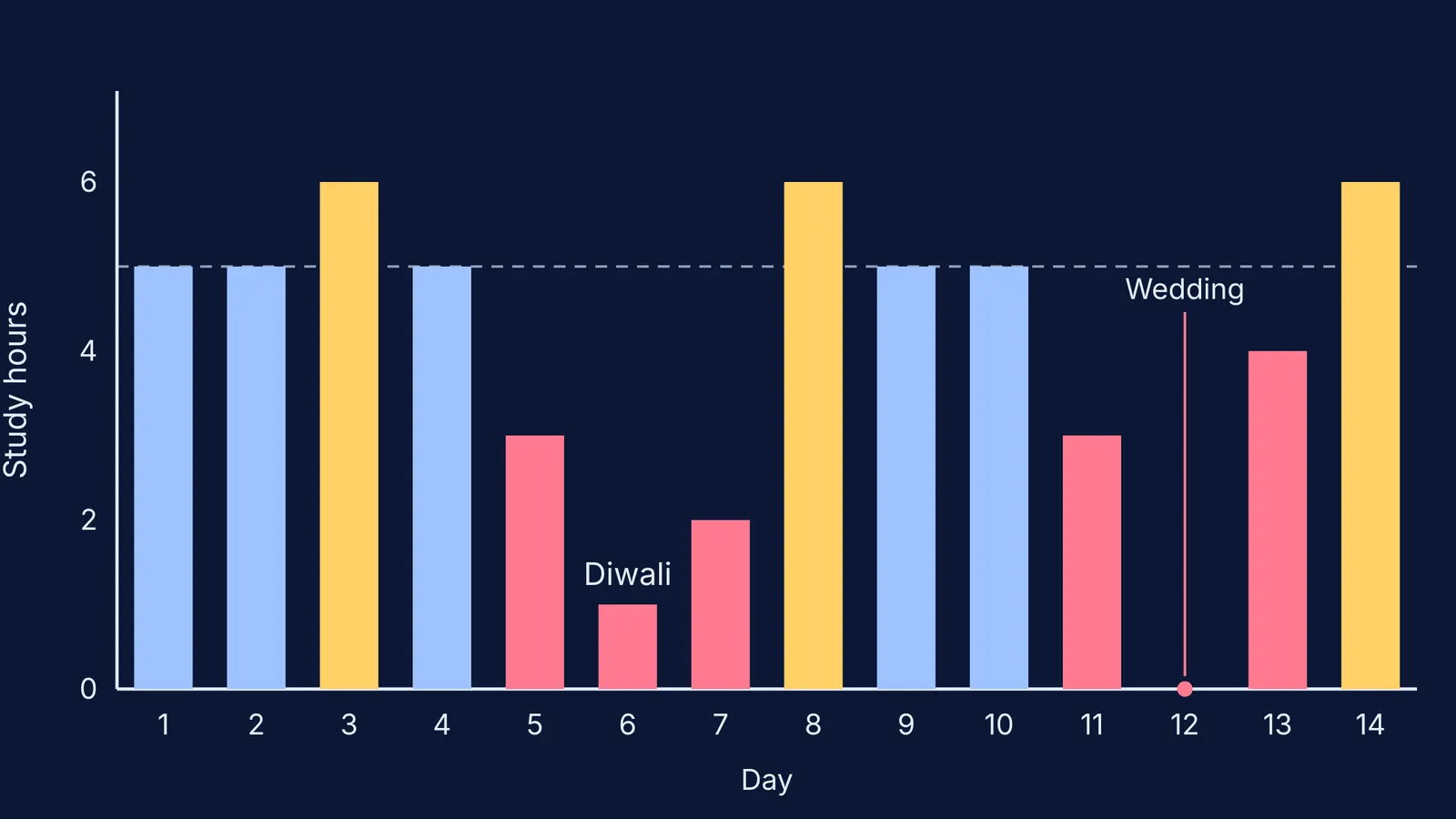
Ananya (an example student) is in Class 12 with PCM and usually studies 5 hours a day outside school. Her fortnight includes Diwali and a cousin's wedding:
Days 1, 2 and 4: normal days, 5 hours each.
Day 3: buffer, 6 hours.
Day 5, guests arriving: 3 hours, mostly in the morning.
Day 6, Diwali: 1 hour of formula recall after breakfast.
Day 7, family visits: 2 hours.
Day 8: buffer, 6 hours, including a timed chemistry section.
Days 9 and 10: normal days, 5 hours each.
Day 11, the sangeet: 3 hours, home by 10 pm.
Day 12, the wedding: no study.
Day 13: sleeps in, then 4 hours.
Day 14: buffer, 6 hours, with a full mock test.
That keeps 56 of her usual 70 hours, and every busy stretch is followed by a buffer day.
What do you say to relatives who ask why you're not coming?
It helps when a parent declines for the family, so the student isn't the one refusing elders. Lines to borrow:
Parent, declining the mehendi: "Ananya can't make the mehendi because her pre-boards start that week, but we'll all be at the wedding. She's looking forward to it."
Student, at a function: "I'm so happy to see everyone. I have a mock test tomorrow, so I'll stay for dinner and then head home."
When asked how preparation is going: "It's going steadily. Ask me again in March!"
Agree the leaving time at home, so nobody negotiates in front of guests. For the rest of the household side, read about keeping exam season calm at home.
What if the festival season leaves you behind or anxious?
Don't try to make up every lost hour in one weekend. Add one buffer day and carry on. If worry or low mood lasts for weeks, or affects sleep or eating, talk to a school counsellor or a doctor. The Tele MANAS helpline is toll-free on 14416 or 1-800-891-4416, with support in 20 languages, according to the Ministry of Health and Family Welfare via PIB.
Tonight, sort this season's invitations into the three tiers and pencil in your buffer days.