

On this page
To a young child, electricity seems like invisible magic that turns on fans, powers tablets, and lights up rooms at the flick of a plastic switch. But telling a child that electricity is "electrons jumping across atoms" usually causes glassy eyes rather than genuine understanding.
A clearer approach is to describe electricity as energy carried by a stream of tiny particles moving together through an unbroken loop. In their research on mental models of electricity, cognitive scientists Dedre Gentner and Donald Gentner found that analogies help beginners construct accurate mental pictures of unseen forces. The most effective comparison for young children is a closed bicycle chain or a circulating water slide:
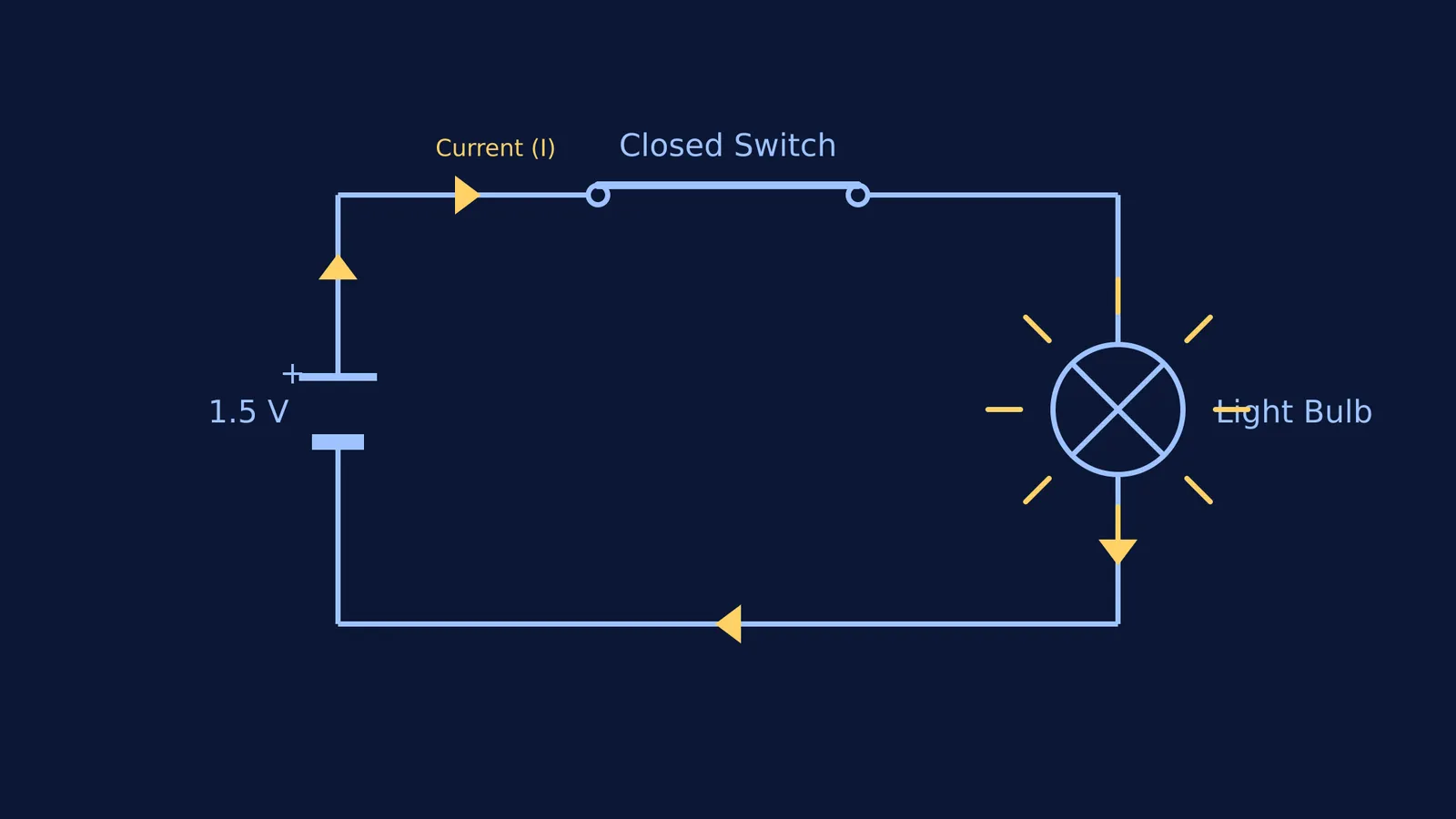
The battery is the pump or pedal: It provides the energy push that sets the entire line in motion.
The wires are the pipes or track: They give the moving charges a smooth road to travel through.
The light bulb is the waterwheel: It catches moving energy and transforms it into bright light and warmth.
The switch is a drawbridge: When closed, the bridge connects the path; when open, the gap stops the movement immediately.
You can explain to your child: "Electricity is not like water pouring out of a garden hose onto the lawn. It is like a train on a circular railway track. Every single section of track must stay connected in a full loop, or the train cannot move at all."
Why do children think electricity needs only one wire?
When children look at household lamps, they see a single cord running into the wall. It is natural for them to assume that electricity travels from the socket into the lamp like juice through a drinking straw.
In a landmark study published in the *European Journal of Science Education*, researcher David Shipstone surveyed children across secondary school grades and discovered that over 50% of 11-year-olds hold a unipolar model. They believe electricity leaves the battery through a single wire to light the bulb, regarding the second wire as unnecessary or merely an emergency spare. Even among older students, Shipstone found that nearly 60% believe electric current is consumed or "used up" by the bulb, leaving less current returning to the battery.
Helping your child overcome this misconception requires hands-on demonstration rather than spoken explanation. When you show them an open battery with two distinct terminals, or explain that every appliance cord secretly hides two or three separate insulated wires inside its outer sheath, they begin to see that electricity always requires an outgoing road and a return path.
How can you build a safe battery circuit together?
In his instructional framework for teaching circuits in Physics Education, David Shipstone recommended hands-on cognitive-conflict activities that let children discover why a single wire cannot light a bulb before introducing formal circuit diagrams. Similar to hands-on kitchen science experiments, simple tabletop physics demystifies how the physical world operates.
Gather four basic items: one standard 1.5 V AA dry cell, a small 1.5 V flashlight bulb, two insulated copper wires with stripped ends, and a metal paperclip.
Test the single wire: Hand your child the battery, the bulb, and just one wire. Invite them to light the bulb using only one wire. Let them try pressing the wire to different parts. They will quickly observe that touching a single terminal leaves the bulb completely dark.
Complete the loop: Connect the first wire from the flat negative terminal of the battery to the threaded metal casing of the bulb. Connect the second wire from the raised positive terminal to the metal foot at the bulb's base. The filament lights up instantly.
Add a paperclip switch: Disconnect one wire and insert a metal paperclip in the middle. Touching both wire ends closes the circuit, while swivelling the paperclip away breaks the flow.
Test everyday conductors and insulators: Place different objects in the paperclip gap: an iron nail, an eraser, a coin, and a plastic ruler. Your child will discover that metals let charges pass easily (conductors), while rubber and plastic block them (insulators).
If your child wants to test different component arrangements before wiring them by hand, the Fermi Simulation Lab provides interactive simulations for the ideas that are easier to see than to read. Children can swap cells, test switches, and observe virtual charge movement at their own pace.
Which household electricity safety rules should children know?
While a 1.5 V dry cell is safe to handle with bare fingers, household mains electricity is dangerous. In India, domestic wall sockets supply 230 V alternating current, where Regulation 44 of the Central Electricity Authority safety regulations requires residual current devices rated at no more than 30 mA to protect families against fatal electric shock.
Children must understand why battery experiments are safe while wall outlets must never be touched:
Never touch wall sockets or insert objects: Wall outlets carry 230 V, a much higher voltage than a small household battery. Teach children that wall sockets are strictly for grown-ups to connect appliances.
Keep water away from all electronics: While pure water is a poor conductor, tap water and wet skin contain dissolved minerals that carry electric current easily. Never touch switches, water heaters, or charging cables with wet hands.
Never yank cords from the wall: Pulling on a flexible cord can loosen the internal wires or crack the plug pins, creating a spark or shock hazard. Always teach children to grip the solid plastic plug head firmly.
Watch out for outdoor power lines: Kites, metal poles, and tree branches must never come near overhead power lines or neighborhood transformers.
Taking your child on interactive science museum visits gives them a chance to observe large-scale demonstrations in supervised settings. As students move from basic hands-on circuits to school projects or science exhibitions like the National Children's Science Congress, the Fermi Concept Library offers lessons covering every concept in physics, chemistry, biology, mathematics and computing, each with its own lesson and its place in the map.


