On this page
Most children meet x in Class 6 or 7. The hard part is not the arithmetic but the idea that a letter can stand for a number. You can teach it at the dining table with a box, a drawing of a balance and some matchsticks.
What is a variable, in words a child understands?
NCERT's Class 7 textbook calls a letter that stands for a number a “letter-number”, and calls an expression containing one, such as a + 3, an “algebraic expression” (NCERT Ganita Prakash, Grade 7, Chapter 4). It starts with ages: Shabnam is 3 years older than Aftab, so if a is Aftab's age, Shabnam's is a + 3.
That gives you a one-line definition to use at home: a letter is a number we have not been told yet, or a number that can change. It is never short for a thing. In the textbook, a is Aftab's age, not Aftab.
A study of 11- to 15-year-olds traced misreadings of algebra to intuitive assumptions, analogies with familiar symbol systems and misleading teaching materials (MacGregor and Stacey, 1997). That is one reason to skip shortcuts like “a for apples”, which suggest a letter stands for a thing.
How do I explain x to my child with a mystery box?
You need a small box and some coins.
Hide some coins in the box. Say: “I put 3 more next to the box, and now there are 10 altogether. How many are inside?”
Let them work it out (7), then open the box to check.
Write box + 3 = 10. Say: “Mathematicians write a letter instead of drawing a box.” Now write x + 3 = 10.
Swap roles, so your child hides the coins and sets the puzzle.
Next round, use two boxes holding the same number of coins, plus 1 loose coin, 9 in all: 2x + 1 = 9, so x = 4. The rule to say out loud is: the same letter means the same number every time it appears.
How does a balance picture help with equations?
The equals sign causes more trouble than x does. A study of middle-school students found that many lack a sophisticated understanding of the equal sign, and that their understanding of it is linked to how well they solve equations, even after allowing for their standardised maths test scores (Knuth, Stephens, McNeil and Alibali, 2006). A child who reads “=” as “the answer comes next” gets stuck when letters appear on both sides.
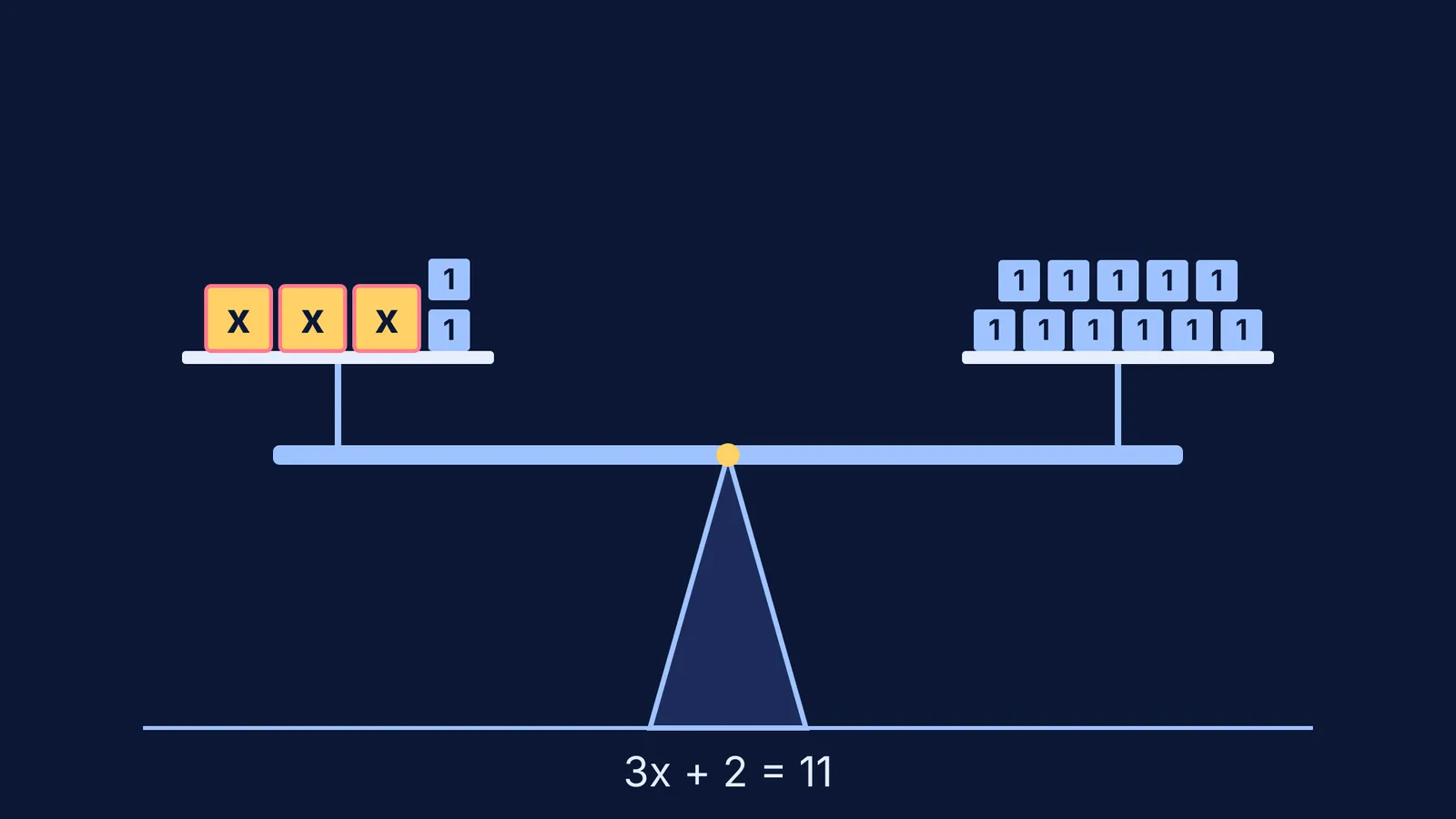
A balance shows “=” as “both sides weigh the same”. A worked example for 3x + 2 = 11:
Draw three mystery boxes and 2 unit weights on the left pan, and 11 unit weights on the right. The beam is level.
Take 2 units off each side. It stays level: three boxes balance 9 units, so 3x = 9.
Split each side into three equal groups. One box balances 3 units, so x = 3.
Check by putting it back in: 3 × 3 + 2 = 11.
In a classroom experiment with 61 seventh-graders, a diagram next to an equation made students more accurate, whatever their ability (Chu, Rittle-Johnson and Fyfe, 2017). The balance has limits, though. A review of 34 peer-reviewed articles found no clear pattern for when it works best (Otten, Van den Heuvel-Panhuizen and Veldhuis, 2019), and a study of 40 eighth-graders found that the presence of negative numbers gave rise to many errors (Vlassis, 2002).
How do pattern rules make letters feel sensible?
In the box and the balance, x is hidden. In a pattern, the letter stands for a number that changes, the second idea your child needs.
Make a row of matchstick squares. One square takes 4 sticks, two take 7, three take 10. Ask how many 10 squares need, then 100. Your child may notice you start with 1 stick and add 3 per square: the rule 3n + 1. Check with n = 1: 3 + 1 = 4.
A calendar works too. The NCERT chapter calls one date in a 2 × 3 block w, so the date to its left is w − 1. Ask for the date directly above w (w − 7) and test it on this month's calendar. For more practice, read our guide to expressions using letters in Class 7.
What should I say when my child gets stuck?
“What number could go there? Try one and see.”
“Does the same letter mean the same number both times?”
“Put your answer back in. Does it work?”
If your own algebra is rusty, see helping with maths you have forgotten. If x has turned into “I'm bad at maths”, read what to do when your child says they are bad at maths. If a gap keeps coming back, the Fermi Concept Library gives every mathematics concept its own lesson and its place in the map, so you can see which earlier idea needs another look.
Tonight, try one round of the mystery box game, and let your child set the next puzzle.