

On this page
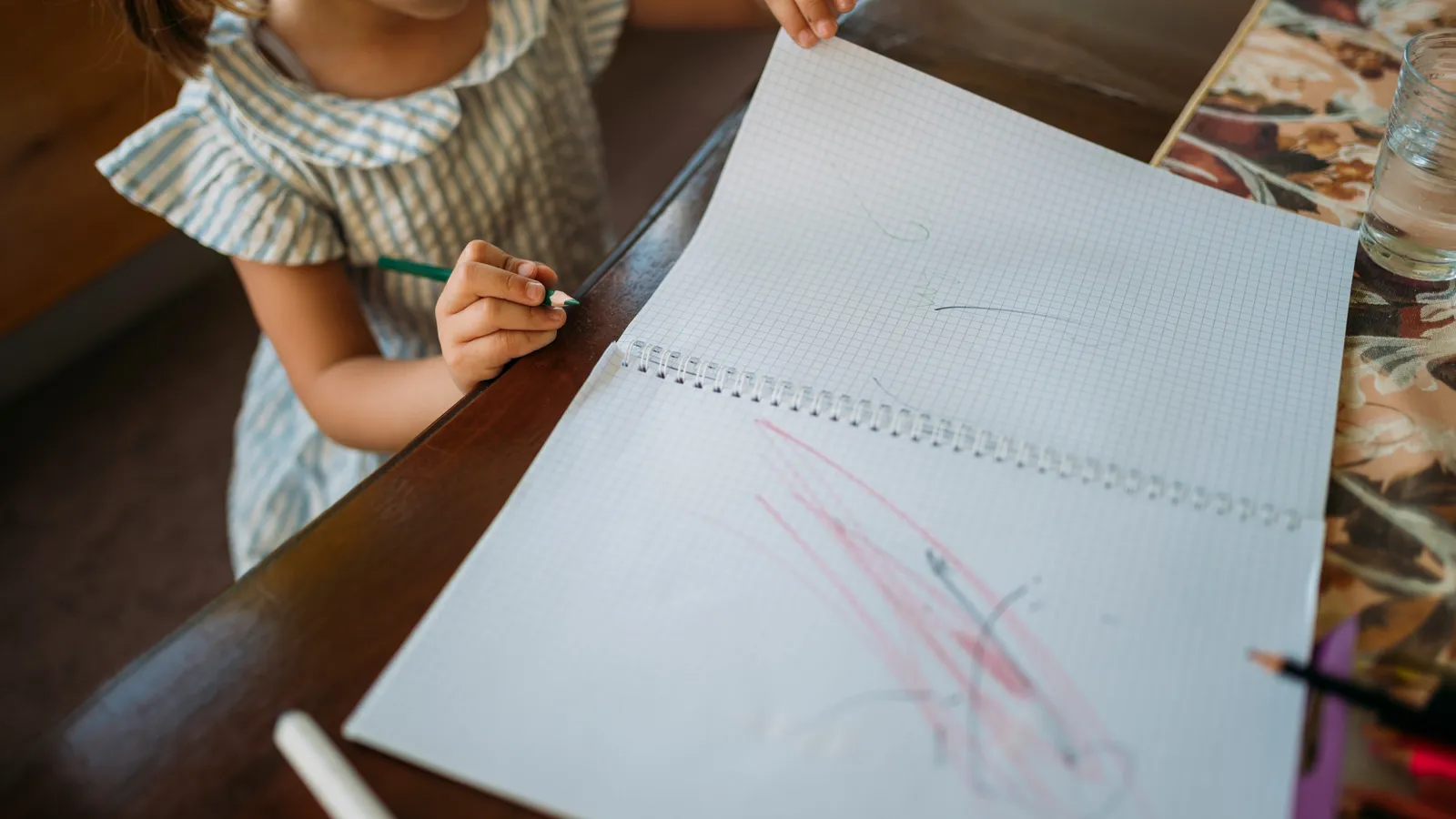
Children draw anyway. The question for a parent is whether asking them to draw what they just saw, such as a melting ice cube or a sprouting seed, helps them learn. The research says it can, with conditions. Those conditions shape the prompts you use.
Does drawing help young children learn science?
In a 2011 essay in *Science*, Shaaron Ainsworth, Vaughan Prain and Russell Tytler argued that drawing should be explicitly recognised as a key element of science education.
The clearest evidence for young children comes from memory studies. In Butler, Gross and Hayne (1995), 32 children aged 5 to 6 took part in an event and were interviewed a day later. Half were asked to draw what happened and half were asked to tell what happened; only what the children said was scored. The drawing group was just as accurate and reported more information. In a second experiment the 5- to 6-year-olds who drew still reported more after a one-month delay, but drawing did not help 3- to 4-year-olds.
Drawing is not automatically helpful, though. In four experiments by Davison and Thomas (2001), 5- to 6-year-olds who drew a board of objects just before or during recall remembered fewer objects, while putting the objects back on the board helped them. Taken together, these studies suggest drawing is better used as a way to talk about what the child noticed than as a memory test.
What does research on older students show?
The evidence is stronger for older students reading science texts. In Schmeck and colleagues (2014), 48 eighth-grade students read a text on how influenza works. Those asked to draw pictures while reading scored higher on a comprehension test than those who only read, with an effect size of d = 0.85, and a second experiment with 164 students found the same pattern. Students whose drawings were more accurate also tended to score higher on comprehension.
A 2018 review by Logan Fiorella and Qian Zhang found that creating drawings was consistently more effective than only reading a science text. Compared with looking at an instructor's ready-made illustration, the results were mixed. The review also warns that drawing can be demanding and time-consuming, and students may not make good drawings without enough guidance.
Why does the prompt matter more than the picture?
When Areljung, Skoog and Sundberg (2021) studied 11 science lessons with children aged 3 to 8, they analysed 129 drawings. The materials and examples teachers offered had a large effect on how children showed the science in their drawings. A 2021 review by Ainsworth and Scheiter makes a related point: what learners draw matters, and they need support matched to the purpose of the drawing.
For you, that means asking a specific question. "Draw something" gets a nice picture. "Draw what happened to the ice after five minutes" gets a record of an observation.
What drawing prompts work after an activity?
Use one prompt, give about five minutes, then talk. Here are prompts sorted by what you want the child to do:
Observe: "Draw the leaf exactly as it looks. How many points does the edge have?"
Show change: "Draw the glass before we added salt, and after. What is different?"
Explain: "Draw why you think the shadow got longer. Where is the torch?"
Predict: "Draw what you think will happen when we put the seed near the window."
Remember: "Draw the one thing from the planetarium you want to tell Nani about."
These fit well after safe kitchen science experiments or a science museum or planetarium visit.
A worked example: sugar in water
Your six-year-old stirs a spoon of sugar into warm water. Afterwards:
Ask: "Draw the glass before and after stirring."
While they draw, ask: "Tell me about this part. Where did the sugar go?"
If they draw the sugar gone, ask: "How could we check whether it is still there?" Let them taste a drop.
Ask them to add one thing to the drawing to show what they now think.
Write the date and their words beside it, and keep it.
You are not correcting the art. You are using the drawing to hear their idea and test it.
How does this carry on as children grow?
The habit of sketching before explaining can carry on into the teenage years, when the studies above with older students apply more directly. For older children who find an idea hard to picture, the Fermi Simulation Lab has interactive simulations for ideas that are easier to see than to read. Ask them to sketch what they expect first, then run it and compare.
If you want more ways to build the questioning side, try asking questions instead of just answering them.


