

On this page
When parents speak different languages, it is common to worry that a child will be confused by their homework. If the school teaches in English but one parent speaks Hindi and another speaks Marathi at home, you might fear that discussing fractions or physics in multiple languages will only cause problems.
However, research shows that drawing on all the languages you know at home is actually a powerful tool for learning. Instead of being a hurdle, a multilingual home environment provides unique advantages for academic success.
Does growing up bilingual confuse a child?
A common myth is that hearing multiple languages causes cognitive overload or language delays. The evidence points the exact opposite way.
A 2013 review published in *LEARNing Landscapes* by researchers Byers-Heinlein and Lew-Williams confirmed that bilingualism does not confuse children. The researchers found that bilingual children reach language milestones at the same time as monolingual children. Furthermore, mixing words from two languages in the same sentence—known as code-switching—is entirely normal and expected.
The study identifies code-switching as a sign of linguistic resourcefulness and cognitive flexibility, rather than a deficit. Your child's brain is built to handle the translation; they are simply using whichever word they can retrieve fastest to communicate the concept effectively. If they know the word for "gravity" in English but the word for "pull" in Hindi, they will naturally combine them to build a complete thought.
Additionally, navigating two languages daily exercises the brain's executive function. The constant process of monitoring which language is appropriate for which speaker, and suppressing the other language, acts like a mental workout. This means bilingual children often develop strong task-switching and problem-solving skills, which are incredibly useful when tackling multi-step mathematics or science problems. They are better equipped to hold multiple pieces of information in their working memory and evaluate them from different angles before arriving at a conclusion.
How can you handle homework across different languages?
When schoolwork involves complex subjects, you do not have to force a strict "English only" rule at the study desk. In fact, education researchers advocate for a practice called translanguaging—using your entire linguistic repertoire to make sense of a new topic.
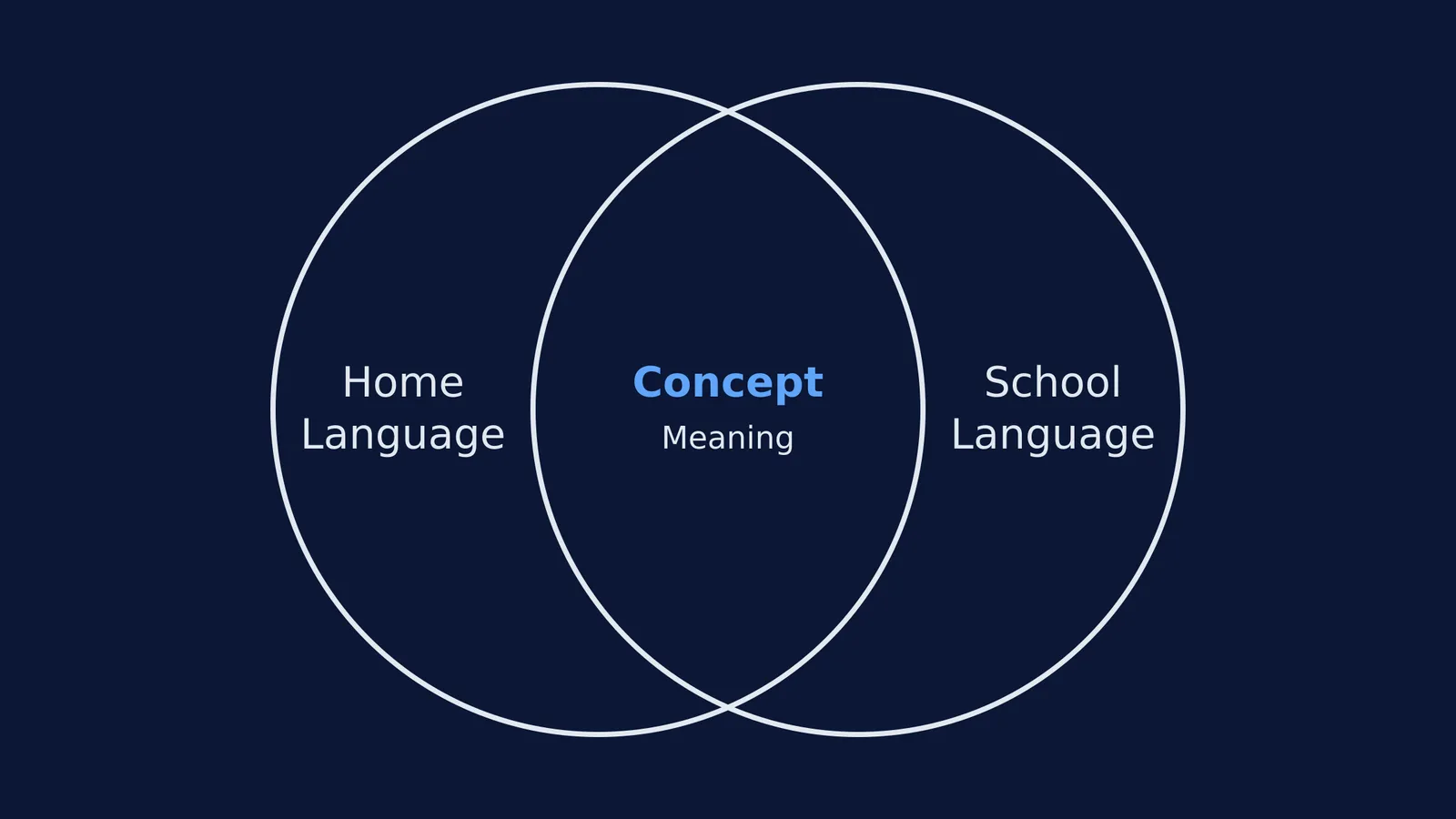
Translanguaging means that the boundaries between languages are kept fluid during the learning process. Instead of artificially separating languages into distinct boxes, students are encouraged to use all their linguistic tools to construct meaning. If your child is stuck on a difficult science concept, you can explain the core idea in your strongest home language. This approach allows them to grasp the deep *meaning* of the concept without simultaneously fighting the *vocabulary* of the school's language. Once the underlying principle is clear, they have a solid foundation to build upon.
Once the concept clicks, you can then help them map those ideas back to the terminology used in their textbook. They learn that the scientific vocabulary is just a set of new labels for ideas they already understand in their own language. If they need to build their own definitions from a dense textbook, our guide on The self-explanation effect: how to study worked examples offers practical ways to break down the material step by step.
What is a translanguaging routine for homework?
To prevent homework from becoming a frustrating translation exercise, you need a predictable routine. Setting expectations reduces cognitive load and helps your child focus entirely on the subject matter. Try this simple three-step structure when you sit down at their desk (see our guide on Setting up a good study space at home: a parent's checklist for tips on minimising distractions):
Read and explain: Have your child read the school assignment in English, then ask them to explain what the task is asking for in the home language. This confirms they understand the goal before they even begin to solve it. It ensures they are not just reading words without comprehending the underlying question.
Discuss and solve: Work through the problem or discuss the concepts using whichever language flows most naturally. The goal here is pure understanding, so code-switching is highly encouraged. Allow them to mix vocabulary freely as they reason through the steps.
Translate the output: Finally, help them draft the final written answer back into the school language. This ensures they are ready to hand the work in tomorrow and gives them practice in formal academic writing.
If the textbook explanation is still too dense, an AI tutor can act as a bridge. Fermi's AI tutor can work out what you already know and build a plan for the session. It decides whether to explain, ask, or show, which makes it much easier for a parent to then discuss the core idea in their mother tongue, without needing to be an expert in the English scientific terminology themselves.
For older students facing this challenge on their own, our guide on Studying science in English when you think in another language offers further independent study strategies. By embracing all the languages spoken in your home, you can turn potential confusion into a deeper, more flexible understanding of the world.


