

On this page
The rise of supplementary coaching has fundamentally changed how students prepare for exams in India. According to the Annual Status of Education Report (ASER) 2022, 30.5% of children in Classes I-VIII in rural India now take paid private tuition. As students move into high school to prepare for rigorous competitive exams like JEE and NEET, that reliance only deepens, with some families spending as much on coaching as they do on formal schooling. For families, choosing the right coaching centre or private tutor is a high-stakes decision.
A free demo class is your trial run. It is the best opportunity to see past the marketing brochures and observe how a teacher actually operates in the classroom. When you sit in on a trial session, you are not just checking if the seats are comfortable or if the teacher is friendly; you are looking for evidence of effective teaching methods. But what exactly should you be watching for? (If you are weighing different formats entirely, read Coaching, online classes or self-study for JEE: how to decide.)
What to look for in a coaching demo class?
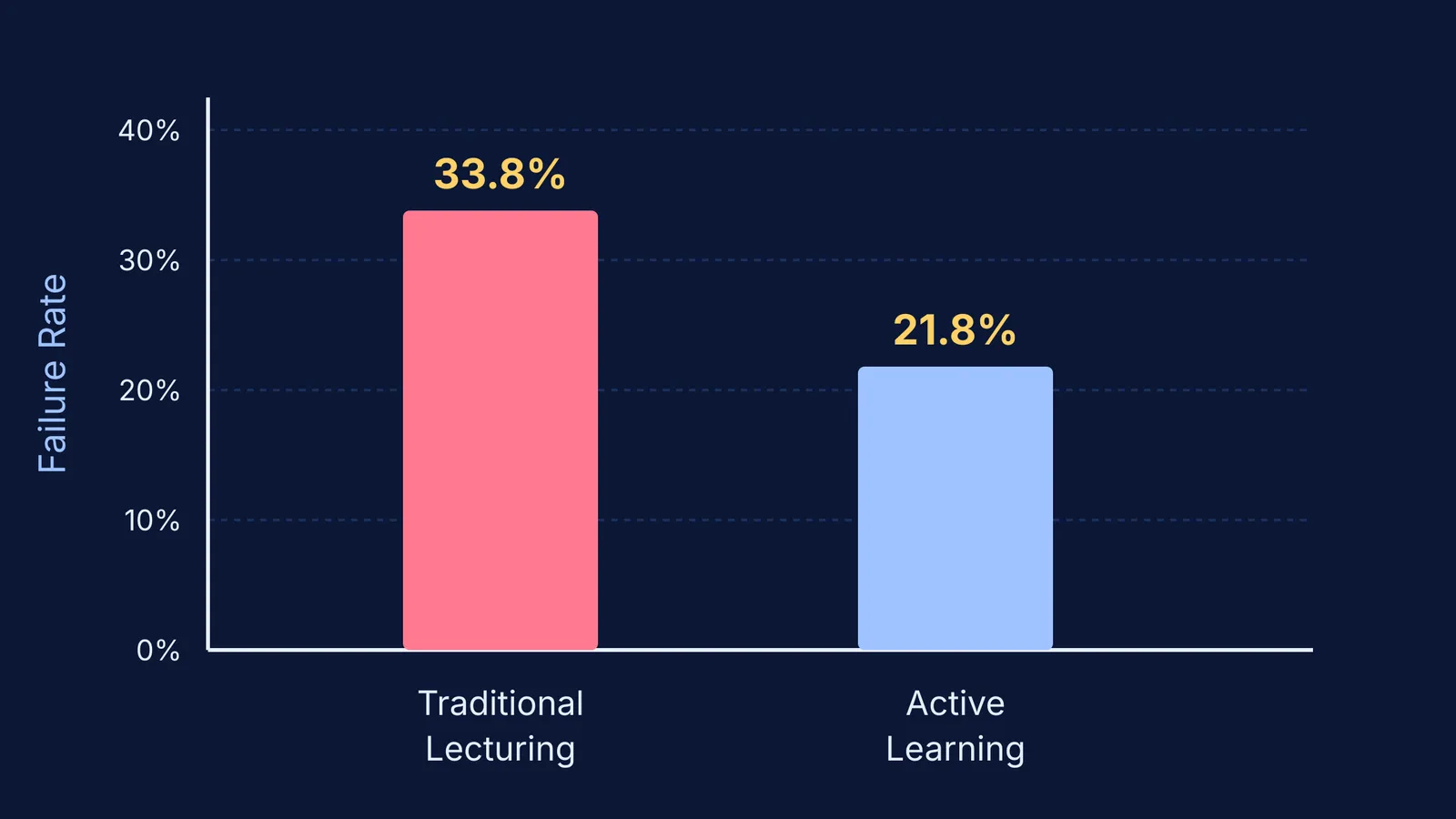
It is easy to be impressed by a confident tutor who talks smoothly for an hour, rapidly filling a whiteboard with complex equations. However, real learning happens when the student does the cognitive work. A landmark 2014 meta-analysis published in the *Proceedings of the National Academy of Sciences* (PNAS) analysed 225 studies on undergraduate STEM education. The researchers found that students in traditional lecture courses were 1.5 times more likely to fail than those in classes that used active learning. The average failure rate was 21.8% for active learning compared to 33.8% for traditional lecturing. Those numbers show why listening is not enough.
In the demo class, make sure to watch the students as much as you watch the teacher. Look for these signs of active learning:
Who is doing the talking? If the teacher speaks uninterrupted for 55 minutes out of a 60-minute class, it is a traditional lecture. Look for a tutor who regularly pauses, poses problems, and waits for students to think before filling the silence.
How are mistakes handled? When a student gives a wrong answer, does the teacher simply say "no" and state the correct formula? A strong tutor uses mistakes as a diagnostic tool, asking follow-up questions to trace exactly where the reasoning went off track.
Are students called on by name? A productive classroom requires everyone to participate. If only the two most confident students in the front row answer every question, the rest of the room is just passively watching a performance.
What questions should parents ask after a demo class?
Once the demo class is over, take five minutes to speak with the teacher or the centre's academic coordinator. This is your chance to understand how they operate behind the scenes. Avoid vague questions like "Will my child score well?" which will only invite a sales pitch. Instead, ask targeted questions about their process:
"How do you check if the class has understood a concept before moving on to the next chapter?"
"What is the specific system for helping a student who falls behind the main batch?"
"Can you show me a sample of the weekly tests and explain how you share the feedback with students?"
The answers to these questions will tell you whether the institute has a reliable, proactive structure for tracking individual progress, or if they rely entirely on students to raise their hands when they are lost. For a broader look at vetting an institute, see How to evaluate a coaching institute before you pay the fee.
An AI tutor that checks understanding
A good tutor notices where a student is stuck and makes a deliberate choice to explain, ask, or show something new. That is what we built Fermi's AI tutor to do.
Most learning tools just print an answer, but Fermi teaches. If a student brings a problem set or a difficult concept, the tutor works out what they already know and builds a tailored plan for the session. It holds a consistent line of reasoning, teaching through the problem by writing on a digital board, drawing the figure, or opening the Simulation Lab for ideas that are hard to picture, and checking understanding as it goes.


